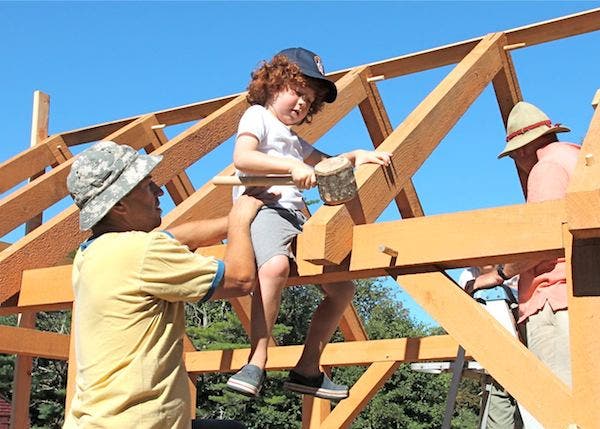
Build Locally with Roundwood Timber Framing
Dimensional lumber — 2x4s, 2x6s, etc., are about as ubiquitous as suburban sprawl is in America. (Maybe there’s some kind of relationship there..?) 2x4s are an industrial product, only becoming a dominant building material in the last century. As priorities have shifted to speed, uniformity, and ease of production, more traditional building styles have fallen out of favor.

However, it is almost certainly time to rethink how we build our homes, addressing not only downsizing possibilities, and the size and efficiency of spaces, but how we build houses themselves, and what materials we use. I believe timber framing, and specifically roundwood timber framing, fills a great need, enabling more holistic and sustainable home construction.
Building Locally?
Here’s a great passage from the USDA Forest Service’s “History of Yard Lumber Size Standards” (warning: PDF link) that hints at industrialization beginning to seep into the world of construction:
Until the middle of the 19th Century, building lumber was usually produced in a locality close to the place where it was to be used. Sizes were not a problem. The needs of builders in the locality were well understood and carpenters were accustomed to much more hand fitting on the job than they are today. As the forests were cut back from the centers of population, lumber had to be shipped greater distances. By the last few decades before 1900, lumber was no longer a locally made commodity. It then became apparent that the sizes used in different trading areas were not uniform and as a result sawmills had to cut lumber for the markets they wished to serve. Continue Reading »
Small Timber Frame House Plans and Workshop
Brian Liloia also known as Ziggy to his friends and well known for his cob house, which I have covered in the past here on the Tiny House Blog, is building a new home using a timber frame structure.
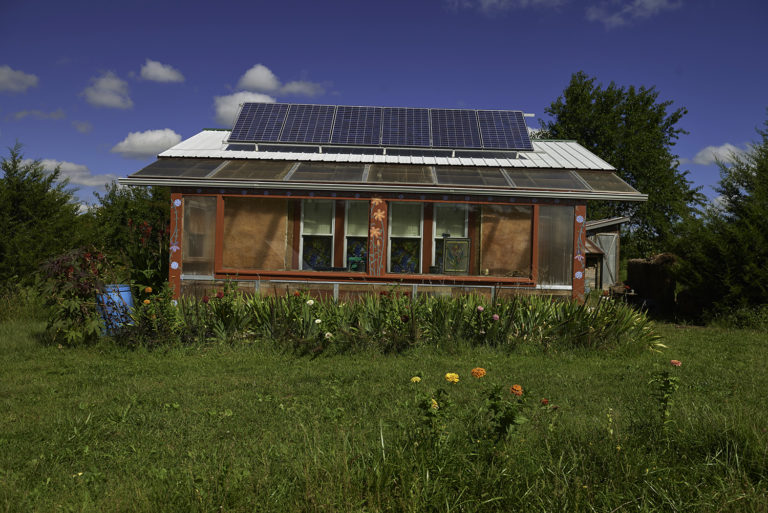
The house, code named Strawtron, is designed to be a passive solar, straw bale-insulated house using timber frame as the main structure.
The interior living area is 13 ft x 24ft which is about 300 square feet, it also has a loft and a green house area that is used to bring in passive solar heating.

Brian is making the small timber frame house plans available for free.
As a side note if you would like to help build this house Dancing Rabbit is offering a Natural Building Workshop in the summer of 2012. This includes two workshops one a Timber Frame Workshop and the second a Straw Bale Workshop. Only 12 spaces are available so click here to learn more and to apply.
P.S. Ziggy just sent me the full details so I am including them below.
10′ x 12′ Timber Frame
by Jon Anderson
Over the years, I’ve built a few log structures and along the way, timber framing got into my blood. I love the beams, the posts, and the tight fitting joints made by a builder using mortise and tenon.
I remember the first time I viewed the clean lines of a timber frame structure. The frame was draw pinned together with Red Oak pegs that were cut by hand on a shaving horse—I was hooked. And, for framing, you don’t need fancy or high-tech tools—framing square, hand saw, chisel, and auger bit have performed quite well for hundreds of years.
![WP_000303[2]](http://tinyhouseblog.com/wp-content/uploads/2012/01/WP_0003032.jpg)
When I decided to build a timber frame, I was clueless in regards to technique. Of course, like always, this didn’t stop me. Normally, I just plod blindly ahead (or in the case of the TV remote—I just mash every button randomly on the four separate remotes that are clearly critical to the operation of my cable system—something is bound to happen). However, in this case I decided to at least gain a basic understanding of the process, as there is a certain liability associated with handing big heavy things, like timbers. So, I read a few books that described traditional timber framing techniques and I took a framing class at the North House Folk School in Grand Marais, Minnesota. Continue Reading »
Charleston Tiny House
Andrea Tremols and Cedric Baele of Charleston, S.C. spent a year researching tiny homes at their local library and on the web before they decided to actually build one. Then they tore it down and started over. The couple is attempting to build the house out of 90 percent reclaimed lumber and materials while still utilizing every bit of space they can in order to obtain their ultimate goal of more conscientious living on the Earth.
After graduating from college, the couple lived communally as organic farm volunteers in Europe. As a child in his native Belgium, Cedric lived on a 38 foot steel sailboat, and after school he lived in a re-built 27 foot sailboat in Charleston Harbor. So the 200 square foot home they are building will not be a far stretch. The couple (Cedric is a seasonal bicycle tour guide and Andrea is a Spanish teacher) also knew that they did not want to go into 30 years of debt for a home during an uncertain economy. Continue Reading »
Pan Abode Mighty Cabana
Pan Abode of Washington state has been selling their custom cedar homes and cabin kits for nearly 60 years. They offer a wide scope of sizes and styles including cabins that range from 120 square feet to just over 700 square feet. However, Pan Abode also sells an even tinier home they call the Mighty Cabana. These buildings do not require a permit and come in at under 200 square feet.
The Mighty Cabana is pre-cut from solid wood and is connected by a patented building system for strength and ease of construction. They can be used as a small house, a small business, a vacation home, an artist studio, pool house or storage shed. Continue Reading »
Seeing Is Believing
My Visit to Innermost House
by Kent Griswold
The other day I found a real intense peace sitting in front of this fire conversing with my new friends, Diana and Michael Lorence. Diana wrote a popular article for Tiny House Blog earlier this year entitled Diana’s Innermost House.
There is something almost unbelievable about Innermost House. When I received Diana’s invitation to visit, I was so curious to see it for myself.

144 square feet. No hot water or electricity. All their heat and cooking from the fireplace. I had seen the pictures on Diana’s website, and it’s hard to believe the house belongs to modern times. But Innermost House is real I can now say, and I can see how a couple really could live there. Seeing is believing.

It turns out the Lorences have lived there full time most of the last seven years. It’s their only home, though they do travel some. They didn’t even own a car until recently. Continue Reading »