Free Tiny House/Straw Bale Framing Report
by Gabriella Morrison
Straw bale construction is a wonderful building technique. It yields walls that are 3 times more fire resistant than standard construction, 3 times the energy efficiency of conventional construction, uses a waste material that otherwise gets burned in the field and creates huge levels of pollution, is very easy to learn even for people with no prior building experience (think stacking large Legos), and creates a beautiful home environment.
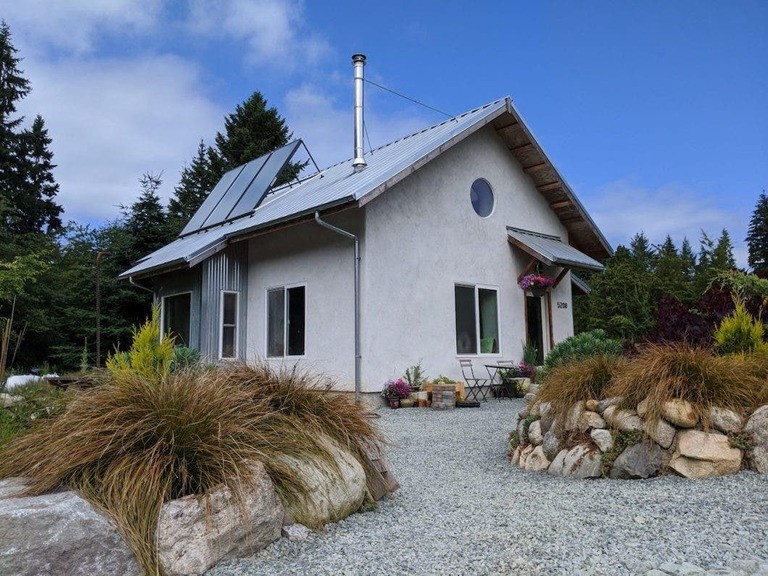
We have designed a brand new straw bale structure named the Mountain View Cabin. It is a 198sqft, no permit required structure that has been specifically designed for ease of construction, maximum use of space and for the lowest cost possible to build. The Mountain View Cabin is also the very structure that we show how to frame in our brand new “How To Frame For Straw Bale Construction”, nearly 3 hour long, DVD set. This DVD will launch for sale this Friday, July 6. With the inclusion of this DVD to our existing line of How-To instruction videos, one can learn the entire building process of how to create their own straw bale home. We now cover everything from Foundation, to Framing, To Baling (which includes electrical and plumbing installations), and finally to Plastering.
To celebrate the upcoming launch of our new Framing DVD, we are giving away our 12,442 word, 34 page FRAMING REPORT for free. Further, everyone that downloads our Report also has the opportunity to receive the FULL ARCHITECTURAL PLANS FOR THE MOUNTAIN VIEW CABIN for Free with every purchase of our new Framing DVD when it launches. The plans are a complete set and have all of the information you need in them in order to build your own Mountain View Cabin.
To gain access to the Free Report, please click here:
http://strawbale.com/store/
By the way, you are under no obligation to purchase our Framing DVD when it launches this Friday if you download the Report. It is absolutely free to you.
Straw Bale and Tiny Homes
Guest Post by Andrew Morrison
As you may know, my wife, 12 year old daughter, and I recently sold more than half of our worldly belongings to fund our adventure, let go of our large rental house, and spent the next 6 months in a quest to reconnect with each other and with what really matters in life. Most of that time was spent in a 150 sq ft pop up tent trailer in Baja, Mexico where we were able to live off grid and to essentially unplug ourselves from our “normal” day-to-day lives. What we learned was that in living with the least, we gained the most and that in finding the stillness that comes in not busying ourselves, we reclaimed our joy and inner calm (to read more about this journey, please visit www.SmallHouseRevolution.com).
One of our favorite topics of conversation since embarking on this adventure has become housing. What defines a home, what are the things that are essential in making a home a wonderful space, what do we want in our own dream house, etc… Being that the professional focus for most of our adult lives has been straw bale construction and green housing, we naturally have been exploring the merits of this mode of building as a solution for those of us that are wanting to build affordably, to tread lightly on the planet, and to be involved with our own home’s creation. We now see, more than ever, that straw bale construction is an amazing building technology fully able to fill those needs.

The idea of stacking straw bales to create a super insulated and natural shelter first appeared on the Nebraska plains over 100 years ago and some of these original homes are still in use. The technology has advanced significantly since those early builds and today, two major styles of straw bale construction have been developed: Load Bearing and Post and Beam. Load bearing construction uses no structural frame (such as framed 2×6 walls) to support the roof. Instead, the bales carry the load. Post and beam construction, on the other hand, uses a structural frame to support the roof while the bales act as insulation within that frame. Whichever system is implemented, the benefits of building with bales include: 3 times the insulation value of a conventional wall; 3 times more fire proof than a conventional home (yes, you read that right!); lessens pollution by using a waste material that normally contributes significantly to the pollution cycle; ideal building system for the owner builder; incredibly sound proof; able to withstand natural disasters (earthquakes, high wind/tornado) significantly better than a conventional home; aesthetically beautiful. Continue Reading »
Living in the Future
According to the Lammas ecovillage in Wales, living in the future means looking to the past. This series of videos shows the baby ecovillage’s plans and struggles to develop a low impact village in the open countryside. The series also profiles several other successful ecovillages around Europe. The village is named after the pagan holiday that celebrates the abundance of the fall months.
Lammas is the United Kingdom’s first planned ecovillage and is sited on 76 acres of mixed pasture and woodland in Pembrokeshire. The houses use low-impact architecture which uses a combination of recycled and natural materials. The village will contain five detached buildings and one terrace of four dwellings. The homes will be built of straw bale, earth, timber frame and cob; they will have turf roofs and wool insulation and will blend into the landscape.
The videos (also available as podcasts) cover everything from searching for land, working with local codes, inspectors and design councils, examples of different types of natural building including straw bale and cob, surviving cold weather, self-sufficiency, growing your own food, and keeping community intact. The ecovillages profiled are Cae Mabon, The Village, Ireland and Findhorn. That Roundhouse by Tony Wrench is also featured. Continue Reading »
Tiny Straw Bale Village Getaway
Recently I had the opportunity to work closely with Strawbale.com to introduce to you the new Applegate Residence, a small straw bale home that can be built for around $20,000. I am very intrigued by this type of construction but I have never actually stayed in a straw bale home. As I was learning more about Strawbale.com I stumbled across a page that showed some tiny straw bale homes for rent. I contacted Gabrielle Morrison to learn more about them and she wrote back with the following information and photographs. I’ll let Gabriella tell you more.
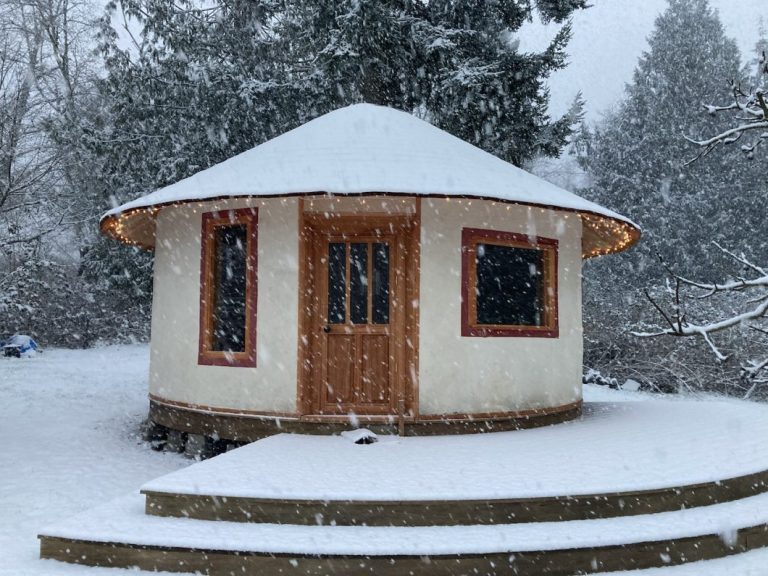
Over the course of about 3 years we built a series of 4 charming and beautiful straw bale cabins, all at 200sqft to create a mini “Straw Bale Village.” Three of them serve as sleeping cabins and have plenty of space for queen size beds as well as desks.
Continue Reading »
StrawBale’s Applegate Residence
I am excited to introduce a brand new small house straw bale plan. I have been involved with Gabriella Morrison wife of Andrew Morrison of Strawbale.com to design a straw bale home for the Tiny House Blog readership. The new home has been named The Applegate Residence. These plans are fresh and hot off the drawing board and I have had the privilege of looking at them first hand and they are excellent. The home has not been built yet but the Morrison’s are hoping to have one built sometime in the next six months. The plan is to build one through their workshops. If you buy the plans and would like to have it built please let me know and I will get the word to them.
The Applegate Residence was meticulously designed by Chris Keefe of OrganicFormsDesign.com and every nook and cranny has a function and purpose. There is 770 sqft of living area which includes a great loft space and a downstairs bedroom and can comfortably house a couple and perhaps even a small family. All of the comforts we are accustomed to in the western world are included so it’s really not about lowering the quality of living but rather, adjusting the size to be more in line with what is really necessary and sustainable not only for the planet but also for the pocketbook.
The Applegate Residence has been designed to be affordable to build so that you can live debt free in as short amount of time as possible. The $20,000 estimate to build the Applegate includes the cost of the foundation, walls, bales, mesh, plaster, roof, interior walls, so everything that makes up the structure. It also includes $2,000 as an initial budget for finish flooring, cabinetry, appliances, wiring, plumbing, fixtures, and finish materials. In our experience, it is possible to find these items at very low cost or salvaged, depending on how motivated you are to find the best deals on those items.
This beautiful bungalow style home is perfect for those looking to get out of the rat race by downsizing into something that is super efficient and cost effective. This is a perfect example of space-smart design in which every space has a use and is essential to the overall flow of the home.
The plans are available in two different designs. The 770 square foot with the downstairs bedroom or the 570 square foot without the downstairs bedroom. You decide what is best for you.
Included with the plans are three free DVD’s which include the following:
- Post and Beam Straw Bale Instructional Double DVD set (nearly 3 hrs of step-by-step instruction)
- How To Plaster With Natural Hydraulic Lime
- How To Pour A Monolithic Concrete Slab Foundation
Strawbale.com is offering the Tiny House Blog readers an introductory discount for four days starting at 7:00 A.M. PST Friday and ending on Tuesday July 12th at 7:00 A.M. PST. So I would like to invite you to jump in and purchase these plans right away by clicking this link Here!
(Note all strawbale.com plans and DVD’s bought through the Tiny House Blogs links and ads help keep this site running.)
Straw Bale 101
Guest Post by Andrew Morrison
Straw Bale construction is an old technology that has grown to become a respected and viable building option in most locations and climates. Not only is it beautiful and energy efficient, but it is also three times as fire resistant as a conventionally framed home and does extremely well in natural disasters such as earthquakes and extreme wind conditions. Straw bale and tiny house enthusiasts have a lot in common in that both are invested in being responsible earth stewards, want to reduce their living expenses, aren’t afraid to try something new and do things on their own, and are committed to creating a new model of sustainability by living within their means financially and from a resource stand point. Here are 9 reasons why we think you should consider building with bales:

Reason #1 Energy Efficiency.
A well built straw bale home can save you up to 75% on heating and cooling costs. In fact, in most climates, an air conditioning unit is not needed in the home as the natural cooling cycles of the planet are enough to keep the house cool all summer long. In addition, a simple heating system, very often radiant floor heating, can inexpensively supplement a passive solar design to keep a house warm all winter long.
Reason #2 Sound Proofing.
Straw bale walls provide excellent sound insulation and are superior wall systems for home owners looking to block out the sounds of traffic, airplanes, or other urban sounds. The assembly itself, a rigid skin of plaster sandwiched around a softer core of bales provides excellent sound absorption.
Reason # 3 Fire resistance.
Straw bale homes have roughly three times the fire resistance of conventional homes. Dense bales mean limited oxygen which in turn means no flames. Now wrap the dense bales in over an inch of plaster and you have a superior fire wall assembly.
Reason # 4 Environmental responsibility.
Building with straw helps the planet in many ways. For example, straw is considered a waste product that is either burned or composted in standing water. By using the straw instead of eliminating it, we reduce either air pollution or water consumption, both of which impact the environment in major ways.
Reason #5 Natural Materials
The use of straw as insulation means that the conventional insulation materials are removed from the home. Standard fiberglass insulation has formaldehyde in it, a known carcinogen. Bales also eliminate the use of plywood in the walls. Plywood contains unhealthy glues that can off-gas into the house over time. By building with natural materials, a healthy home is created from the start.
Reason #6 Aesthetics
There is nothing as calming and beautiful as a straw bale home. Time and time again I walk people through homes and they are immediately struck by the beauty and the “feeling” of the walls. I really can’t explain this one, you’ll just have to walk through your own to see what I mean. There really is nothing like it.
Reason #7 Minimize wood consumption.
If built as a load bearing assembly, the wood in the walls can be completely eliminated, except for around the windows as necessary to attach them to the structure. The harvesting of forests is a global concern and any reduction in the use of wood is a good thing for the long term health of the planet. Even framed walls with infill bales (bales as insulation) can reduce the use of wood by using engineered lumber for the posts and beams. The engineered material uses smaller, faster growing trees in place of larger, slower growing species. In addition, even a standard post and beam frame can use smaller timbers on larger spacing, thus reducing the amount of wood in the home and also working with the faster growing, more renewable wood resources.
Reason # 8 Built in window-seats/niches/storage
For space conscious builders, the options for creating wall niches and storage into the bale walls are pretty much endless. Because the bale walls are so thick, there is plenty of depth for people to essentially carve out niches for storage. Further, one can create window seats with some simple modifications during the construction process which creates space saving seating. The end results are beautiful and timeless.
Reason # 9 Perfect for the Do-It-Yourself builder
Building with bales is frankly, quite simple. If you’ve spent time building with legos, you already understand the basic principles of baling! The baling process goes very quickly and is extremely fun and rewarding to be a part of. Working with a natural material is also a wonderful way to connect with responsible building practices. It doesn’t take long to learn. In fact, we can teach people how to bale their own homes including the electrical and plumbing and plastering systems within our 7 day workshops (www.strawbaleworkshops.com).
This is just a short list of reasons to build with straw bales. This construction technology is widely accepted in nearly all building municipalities in the US and other countries around the world and many locales even have their own straw bale code for straw bale. You can run electrical wiring through the bales without any problems and have plumbing in the house as well. It is possible to get insurance and bank funding. This technology has really come a long way from when it began in the mid-west in the late 1800s!
If you are interested in learning more about straw bale construction, please visit www.StrawBale.com for tons of free information. We also offer instructional DVDs showing the whole process step by step at www.LearnStrawBale.com.
Andrew Morrison
Consultant, Teacher, Inspiring Change
===================================================
Learn the Secrets to Successful Home Construction:
www.BeYourOwnContractorTraining.com
===================================================
Get Your Straw Bale Construction Questions Answered at:
www.StrawBale.com
====================================================
Sign Up For a Seven Day Straw Bale Construction Workshop Near You at:
www.StrawBaleWorkshops.com
====================================================
Work Directly With Me at:
www.StrawBaleConsulting.com
Follow Me on Twitter: @StrawBaleTeach
*Note if you purchase the DVD’s or workshops through the links above a portion goes to support the Tiny House Blog.