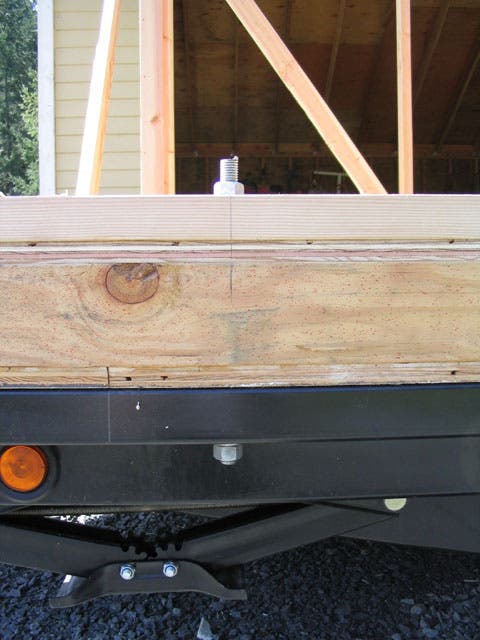
Phase I: Subfloor Sandwich System

by Kent Griswold on March 25th, 2010. 33 Comments

Todd Miller from the Oregon Cottage Company is building another cottage and is going to be sharing with us a series of the steps involved in building a tiny cottage on wheels. This is the first in the series and I hope I can assemble his information in an easy to understand way. This first phase is about assembling the subfloor sandwich system. I will turn it over to Todd now:

Once you have a design set, received your lumber, windows, doors, fasteners and updated and provided your proper tool maintenance you will be ready to get your hands dirty.

Custom 10,000 lb GVWR Frame

I call this first phase of construction a “sandwich system” because of the way the materials are stacked to get you to the wall framing phase of the project.

Simply put, the “Sandwich” is 3 ½” rigid board insulation layered between two sheets of ¾” T&G plywood. Continue Reading »

Posted March 25th, 2010 by Kent Griswold and filed in Construction Articles
Tags: , ,
33 Comments

Insuring Your Tiny House on Wheels

by Kent Griswold on February 2nd, 2010. 19 Comments

Tarsha Downing who is building a tiny house and keeps us updated on facebook and also her personal blog is coming right along with her build.

As Tarsha invests more and more into her home she was wondering what other owners with tiny houses on wheels have done for insurance? If it is possible to acquire it and how to approach an insurance company to insure the tiny house?

If you have had experience insuring a tiny house on wheels, please use the comment section to respond to Tarsha’s question. I will than post an update to share the knowledge with everyone.

Posted February 2nd, 2010 by Kent Griswold and filed in Construction Articles
Tags: , ,
19 Comments

Arogel Insulation in a Tiny House?

by Kent Griswold on January 13th, 2010. 14 Comments

Erik sent me an email asking if anyone had considered Arogel insulation for a tiny house? I personally had not heard of it before so with Eriks help did a little investigation. If you are not familiar with it I’ll give you a small overview and than you can decide if this might be an option when you build your own tiny house.

Here is a brief description: Nicknamed “frozen smoke,” aerogel is extremely lightweight material, with a density only 3 times that of air. Only a small fraction of a volume of aerogel is the material itself. Most of the volume is filled with air. This makes aerogel an excellent insulator. (Aerogel provides nearly 40 times the insulation of fiberglass insulation.)

It is very expensive so has not made a big move into the building industry. NASA and other high tech companies have used it extensively up to this point.

A company called Themoblock is one company trying to bring it to main stream construction. Thermablok material is available both in sealed strips for stud insulation, and in bulk roll form.

Thermablok’s thin 1/4″ (6.35mm) profile allows it to fit between framing and sheathing without altering standard construction. It is applied in strips with a peel-and-stick adhesive backing or staples. It can be customized to fit on headers, rim joists, corners, rafters, window flashing and other hard to insulate areas. This makes ThermaBlok aerogel insulation an effectively universal solution for enhanced insulation value in any building partition. Continue Reading »

Posted January 13th, 2010 by Kent Griswold and filed in Construction Articles
Tags: , , , ,
14 Comments

Building a Shed – Fine Homebuilding

by Kent Griswold on December 31st, 2009. 8 Comments

I am in the process of creating a small photo ebook to go along with the Sonoma Shanty plans and one of the resources I found to help in your construction education is located on the Fine Homebulding site called “How to Build a Shed.

This is an excellent video series that walks you through the process of building a high quality shed and I think anyone building a tiny house would benefit from these videos.

Veteran contractor Rick Arnold is a contributing editor at Fine Homebuilding magazine. The shed you’ll see Rick build is not a prop in a studio. It’s an actual project, and the construction methods that Rick and his helper demonstrate reflect the best practices of professional builders. You’ll see firsthand what’s involved in locating and leveling the foundation, framing the structure, installing doors and windows, installing siding efficiently, and even landscaping effectively.

Of course remember to always consult local regulations before starting work. And good luck on your project! Go to the Fine Homebuilding website to view these videos.

Gypsy Wagon Design and Build Seminars

by Kent Griswold on December 11th, 2009. 8 Comments

Last year I let you know about a coveted workshop offered up in Port Townsend, Washington on Gypsy Wagon design and builds. Jim Tolpin contacted me the other day to give me the schedule for the 2010 year.

Jim says, “We’ve shortened the seminars to three days to focus on design development and to make the class more affordable.” The price is $295 for the three day seminar and limited to 25 students at each of the seminars offered. Register Here.

DSC00584-sm

Students helping to steam bend a wagon hoop around a form.

In this three day weekend we will begin by exploring in depth how the late 19th century, English-made “Living Wagons” (called “Vardos” by the Gypsies)—were designed, built and used. Continue Reading »

It Has to go Somewhere!

by Kent Griswold on December 4th, 2009. 12 Comments

Water and Waste Management Systems Part II

By Kerri Fivecoat-Campbell

Last week, I posted about water sources. This week, we’ll discuss what to do with the wastewater.
We put in a standard septic system with lateral lines that seep into the ground. We really didn’t have a choice, but for us, I think it was the best one anyway.

kerri

Although our land had been in my family, ownership was technically transferring, so we had to adhere to modern codes. Others in our area who have held their land prior to code laws are grandfathered and can even still build outhouses if they wish.

I believe we only had to have an acre to place a septic on our property when we build our Little House, but today our county requires at least three acres.

This happened with property my parents owned on another lake in Kansas as well. Landowners weren’t grandfathered when codes were made more restrictive and their 1- acre lot became virtually worthless on the real estate market.

Septic systems are also the most expensive, I believe ours cost about $4,000 nearly 7 years ago. We did have one installed bigger than recommended, which is a plus since we added another bathroom when we built the office. The load supported a second bath and if we hadn’t done that, we would have either had to replace the tank with a bigger model or tossed the idea of a second bath altogether.

We don’t have a gray water system, but I hope to install one at some point. We treat the septic once a month with RidX, as recommended and haven’t had any problems. We also haven’t had it pumped and we will most likely look into that this year.

We did have issues when they were digging for places where the septic would “perk,” (meaning the soil would drain the water) we ended up with more trees cleared than we wanted, as our project manager had them clear the trees before testing our first choice for a septic site, so it is advisable to have several sites tested if you want to keep trees in tact.

The placement of the septic system has caused us a few issues as you cannot put the tank or lateral lines anywhere you might have to drive over, or build over. As well, the placement of the septic was a huge issue when deciding where to dig the well, which had to be dug at least 1,000 yards from the septic and lines on a grade where the waste was not contaminating the well water. A little tricky on the side of a mountain.

Here are a couple of other ideas for waste disposal:

  • Wastewater Lagoons: These are basically wastewater ponds and could use a standard septic system, but instead of having lateral lines that seep into the ground as ours does, the wastewater goes into a pond. When we were looking at property in Kansas, we looked at many rural properties with these. The plus side to this is that if it is used without the septic tank, it is more economical. The downside is you have to treat the water and well, you have a visible pond of wastewater on your property. Codes in your area may also not allow them for individual property owners.
  • Composting Toilets: The one thing I couldn’t stand when we were campers was taking that portable toilet and then having to deal with the waste. Composting toilets are now more affordable, odorless and deals with waste in an environmentally friendly way.

We would like to hear about your wastewater systems.

Kerri’s Little House in the Big Woods is featured in the December/January issue of Mother Earth News starting on page 68. She blogs about life in 480-square feet at www.livinglargeinourlittlehouse.com