Free Spirit Spheres
What do Ewoks and Julie “Butterfly” Hill have in common? They have discovered the ethereal magic of living up in a tree.
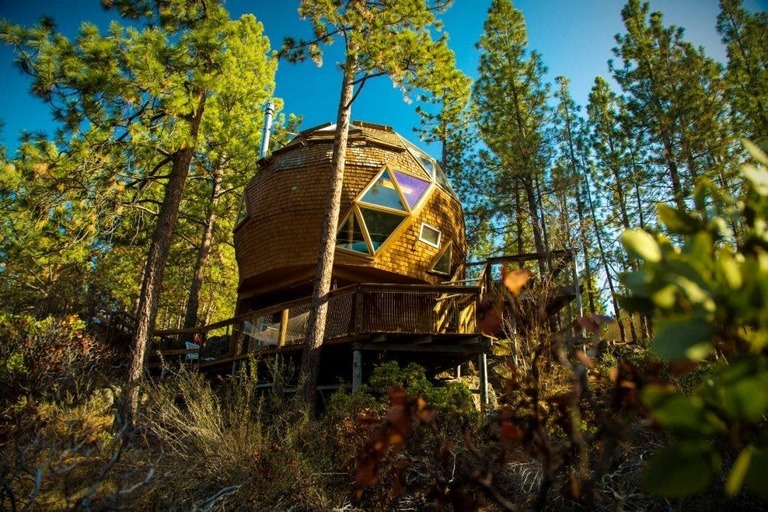
Tom Chudleigh of Vancouver Island, Canada has discovered the same magic with his Free Spirit Spheres, handcrafted tree houses that bob among the trees like giant apples.
Chudleigh calls his design a bio-mimicry. Each sphere attaches to a web of rope. The web connects to whichever strong points are available. This replaces the foundation of a conventional building. A tree house sphere uses the forest for its foundation, so the occupants of a sphere then have a vested interest in the health of the trees. Each sphere has four attachments on top and another four anchor points on the boom. Each attachment is strong enough to carry the entire sphere and contents.
A suspended sphere is tethered by 3 nearly vertical ropes to each of 3 separate trees. This distributes the load evenly over the 3 trees and results in a stable hang. Like an inverted three-legged stool, there will be almost equal tension in each of the three suspension ropes. The sphere resides in the center of the triangle formed by the 3 trees. It can be slung from 5 to 100′ off the ground, depending on the size of the trees.
If something really big, like a tree, falls through the web then some strands will break and let it pass through. The sphere remains suspended by the remaining strands. A major disaster like that is not likely, but possible. Everything, including spiral stairways and suspension bridges, are hung from ropes. Trees are protected where the spiral stairways hug the trees and ropes pass around the trees. The spheres are well adapted to life in a large mature forest.
The sphere concept borrows heavily from sailboat construction and rigging practice. It’s a marriage of tree house and sailboat technology. The wooden spheres are built much like a cedar strip canoe or kayak and suspension points are similar to the chain plate attachments on a sailboat. Stairways hang from a tree much like a sailboat shroud hangs from the mast. The joinery is yacht style with much brass trim, varnished wood and cane doors. They have closets on either side of the door.
A sphere is accessed by a spiral stairway and short suspension bridge. The two lower back suspension points of the sphere are tied horizontally to the two back trees, to keep the suspension bridge from sagging when it is walked on. The door faces the “door tree” and the suspension bridge connects the two. A helical stairway spirals up or down from the suspension bridge to the ground or next level.
Two Spheres, named Eve and Eryn, are available for overnight rental year round. Eve rents for $125 a night or $199 for two nights while Eryn rents for $175 a night or $299 for two nights Eryn’s rate is based on 2 people. The motion in a sphere is a slow gentle rocking when the wind blows. The rope tethers are almost vertical which lets the treetops move considerably while hardly moving the sphere at all. When another body inside a sphere shifts his/her weight the motion is abrupt. This is because the mass of the sphere is low.
In the Eryn style, there is a double bed on the right centered under the 40″ window. A settee with table is placed in front of the 42″ window on the left. The back wall opposite the door provides a galley area with counter cupboards and a sink. A microwave and refrigerator are also installed. Above the galley area there is a loft bed with full sitting headroom at the center. Circular shelf segments connect the loft bed to the cupboards on either side of the door. An outhouse and washroom are located nearby on the ground.
Free Spirit Spheres can also be purchased as completed projects or as shells and component kits. Wood spheres are made of two laminations of wood strips over laminated wood frames. The outside is then finished and covered with clear fiberglass. The result is a beautiful and very tough skin. The cost of these are sold for about $125,000-$150,000.
Fiberglass shells are also sold at $39,000-$45,000. The skins are waterproof and strong enough to take the impacts that come with life in a dynamic environment such as the forest.
Both wooden and fiberglass spheres are insulated. Vinyl upholstery fabric is stapled to the frames (lines of longitude). Each fabric joint is then covered with a decorative wood strip. The wood strips come together at the top and give a nice cathedral ceiling effect.
Copyright © 2009 Tiny House Blog
If you enjoyed this post, subscribe to our feed
Eco-Pod Home
Energy efficient Eco-pod Home
Rene just sent this to me and I really think it is cool, what do you think?
An ‘eco-pod’ home, which promises to be more energy efficient than standard houses, has been shown at this year’s Grand Designs show at London’s ExCel Centre.
Eco Hab is committed to dramatically reduce our carbon footprint, by building a range of the highest performing energy efficient Eco friendly Homes.
Every step has been taken during the design and construction of our Eco Pods, to minimise the Homes demand and dependency of fossil fuels.
This has been achieved by incorporating the following features into the Eco Pod:
• High level of thermal insulation giving an overall U value
of up to .18 for the 4m pod and .16 for the 6m pod
• Sealed Envelope (no air leakage)
• Hot air recovery ventilation
• Wood/ solid fuel burning stove
• Under floor heating
• Full recycling facility (5 separate waste shoots)
• Factory built (controlled work environment)
Optional extras:
• Solar Panels – PV Panels /Wind Turbine /Thermal storage tank
• Backup Generator – dry toilet – rain water harvesting
To learn more visit the Eco Hab website.
If you enjoyed this post, subscribe to our feed
Monolithic Cabin
Sarah wrote me about the new Monolithic Cabin and wanted me to share it with everyone. I had seen it in it’s early design stage but wanted to wait tell they had photographs to show you this unique cabin. It is not going to win a beauty contest but portability and durability will rank high for this tiny home. Here are some details about this cabin.
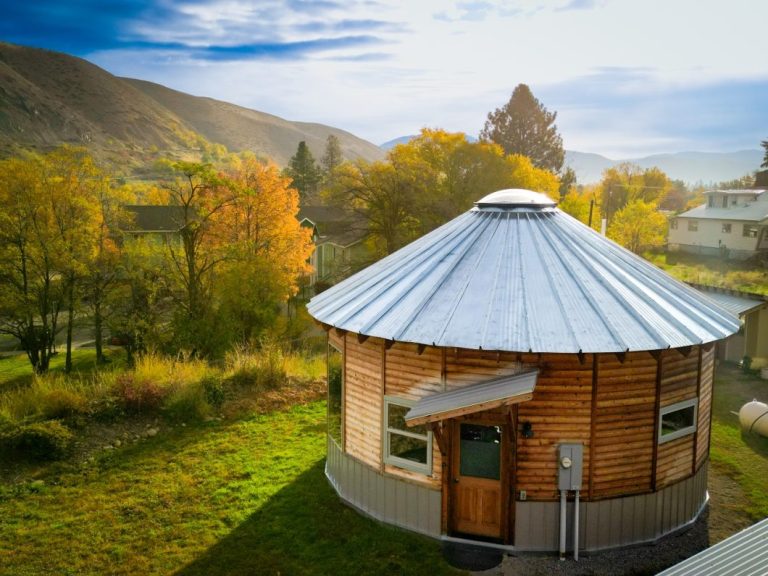
The Monolithic Cabin is a modified Monolithic Dome – like a tunnel with rounded ends. These domes all have a diameter (width) of 12 feet, but their total length and interior space depends on the model.
Model 15 has a length of 15 feet and a living area of 150 square feet. Model 18 is 18 feet long and 201 square feet. Model 24 is 24 feet long and 266 square feet. All models are a nominal 10 feet high, from bottom of crossbeams to top of roof.
David South, President of Monolithic, sees the Monolithic Cabin as “one of the most versatile, small domes we have ever designed. It’s really an all-purpose unit!
“We manufacture these cabins here, at our headquarters in Italy, Texas and load one or two of them on a truck for transport to the client’s site,” David says. “They weigh about 9 to 14 tons, are definitely shippable and require only a small amount of land.”
The Monolithic Cabin can be used as a rental unit, eco-housing or granny flat, disaster shelter, workshop, office or studio, game room, vacation dome, exercise room, temporary housing for work crews or home builders, guest house or storage. They can be designed as single living units or combined with others. The list goes on and on!
To learn more go to the Monolithic Cabin site. They are quite reasonable price wise, you can get a completely furnished unit for less than $40,000. A unique home worth looking into.
Monolithic Dome rentals are now available! Built on private country real estate giving you the small-town environment. Most units include a bathroom with shower, basin and toilet; a kitchen with stove, refrigerator, table and chairs; a furnished sleeping area; heating and air conditioning. You can find out more at the Monolithic Dome rentals site.
If you enjoyed this post, subscribe to our feed
The Pod Camping Hut
I was planning on writing a couple of book reviews today but discovered this on materialicious and really liked it and wanted to share it with you. The design is so simple but it looks so cool, it reminds me of a wine barrel or a boat flipped upside down for a tiny living space.
The Pod, what is it? Well it’s a rather well built, insulated wooden hut that provides basic accommodation much in the way of a tent.

The POD is designed to be comfortable – the roofing material is designed to cut down the noise of heavy rain. The window and lockable French doors are double glazed to reduce condensation and provide sound insulation. The wood used in the construction is a naturally ‘warm’ material but to provide extra winter warmth we have installed sheep’s wool insulation inside the walls while a special foil layer under the roof helps keep summer temperatures in check. There is a small, high level window in the back wall this not only provide light but will help keep the living space well ventilated and aid ‘through draft’ on hot summer days.
The Pod is wonderfully enigmatic – it is many things to many people. It has real presence but does not impose. It is a complex shape, but is beautiful in its simplicity. It is a blank canvas which can be a basic shelter or soft-furnished to be as sumptuous and elegant as you like. It seems to occupy a curious niche in our psyche that takes us back to the very roots of civilization on earth.
It is the cave dwelling, the Romany caravan, the meditation cell, the primitive hut that our instincts inform us is the comfort zone that our ancestors knew well!
Built in the UK and available all over the country to rent, at this time you will have to go to the UK to test them out. I’d sure like to see them brought to the states. Visit The POD website to see more pictures and learn more about this great little shelter.
If you enjoyed this post, subscribe to our feed
Igloo Satellite Cabin
One of my favorite cabins that I discovered recently is the Igloo Satellite Cabin. I first saw this at materialicious and have sense been in contact with Anthea Wallhead of Icewall One in Australia where the igloo satellite cabin is made. At the current exchange rate, a basic igloo will costs approx $8,500 USD plus shipping. Here is a little history of this neat dome cabin:

Igloo Satellite Cabin
Designed to provide safe, reliable accommodation in remote areas, the Igloo Satellite Cabin has been used for over 25 years in conditions ranging from the tropics to polar icecaps. Units can be flown by helicopter fully assembled, and often fully equipped, to locations inaccessible by road transport. Igloos are ideal short-term accommodation for exploration and research, as well as an attractive alternative for eco-tourism.
Each wall and floor panel is a composite of fiberglass and polyurethane insulation with an R rating of .904m2K/W. Windows are double-glazed polycarbonate panes, which are shockproof. Floor panels have a non-skid surface, and are bolted to wall panels and to each other. Each cabin has two ventilators, one in each door and top cover.
Igloos can be lengthened to six or more metres by adding sets of extension panels, or interlinked by tunnels to provide a complete weatherproof base. All Igloos are customized to suit specific requirements and are available in a range of colours and configurations. Basic assembly tools, bolts, sealant tie-down lines, assembly instructions and brochures are supplied with each order.
There is a great article over at the Australian Antarctic Division’s web site if you would like additional information.
To learn more contact Anthea Wallhead at Icewall One.
If you enjoyed this post, subscribe to our feed
U-Dome
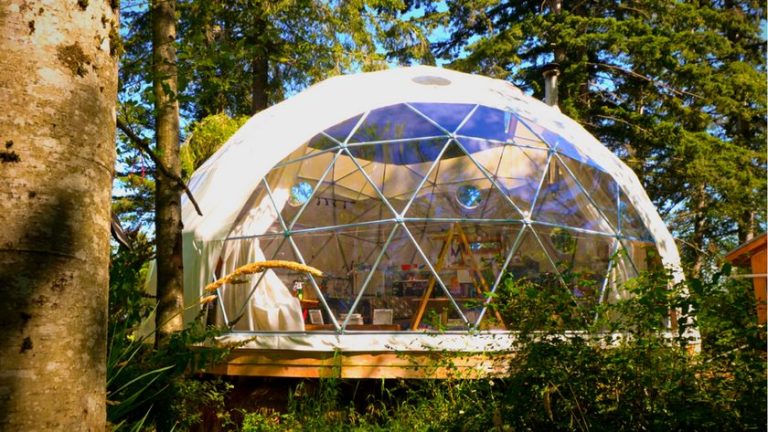
If your looking for basic shelter with a very limited budget. Check out World Shelters U-Dome. a 200 sq ft 12 feet tall dome structure. This may be just what you are looking for to get started in a tiny house living structure.
The U-Dome is a versatile, all-weather shelter that can withstand extreme heat and cold, significant wind, and light snow loads with proper installation. They are made with materials that resist rot and mildew, patterns that can easily incorporate local materials, and they are re-usable. Joist floor plans, included with purchase.
Options include pre-hung screen and aluminum double door. Windows and vents. Use a highly efficient electric or propane heater. Off-grid options such as solar and wind, water collection and cistern and composting toilets, allow you to place this just about anywhere.
At $1545 plus options and your floor how can you beat this price?
To learn more visit the World Shelter site.
If you enjoyed this post, subscribe to our feed
Eco-Dome
CalEarth’s Eco-Dome can be built out of nothing more than dirt, barbed wire, and the same kind of polyethylene bags used to make sandbags to contain floods. The house will probably last longer if you mix some cement with the dirt, but it’s not absolutely necessary.
The bags come in the form of a continuous tube, and the house is constructed of layers of dirt-filled “snakes,” with barbed wire laid between them to keep them from moving.

This 400 sq. ft. home is one of CalEarth’s plans that can be built from the dirt on your land.
It’s 21st-century adobe: faster and easier than traditional adobe construction, because you don’t have to make and dry individual bricks. This construction technique can be learned quickly by anyone, and is about the cheapest possible way to build lasting shelter. But these are by no means temporary buildings; they are so robust that they meet California building codes.
Plans and a DVD and bags are available at the CalEarth’s Eco-Dome web site.
Eco-Dome video of the construction:
httpv://www.youtube.com/watch?v=WMNzoWkXTtc
Eco-Dome pictures of the structure.


DomeSpace
I like the unusual which you may have noticed by some of the tiny houses represented in the tiny house blog.
I also would like to spread our wings and include tiny houses from around the world. The DomeSpace originates in France but also has an office in the U.S.
This is there smallest dome and they also make much larger sizes.

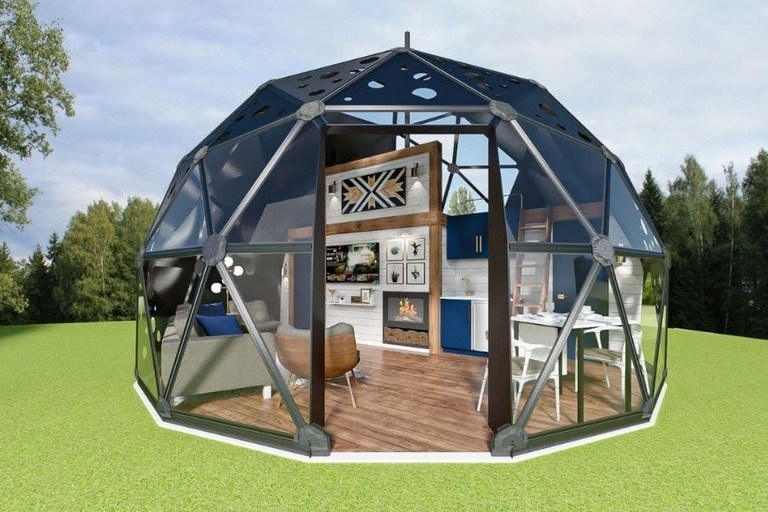
Domespace produce spruce, pine and oak wooden domes for tiny house living (above is their Transit 4,35 model) with the added bonus that it is largely hurricane resistant. According to the brochure, the whole thing is rotatable (using a remote control from inside, the movement is not noticeable), light, warm, has good humidity, and is spacious with cork insulation. Options include solar panels.
If your French is a bit rusty try the Solaleya site, the US distributor but the best photos are at the French site.

The above article was written by Alex of the ShedWorking site in the UK.
If you enjoyed this post, subscribe to our feed