Kootenay Lake Gypsy Wagon

by Kent Griswold on September 24th, 2012. 10 Comments

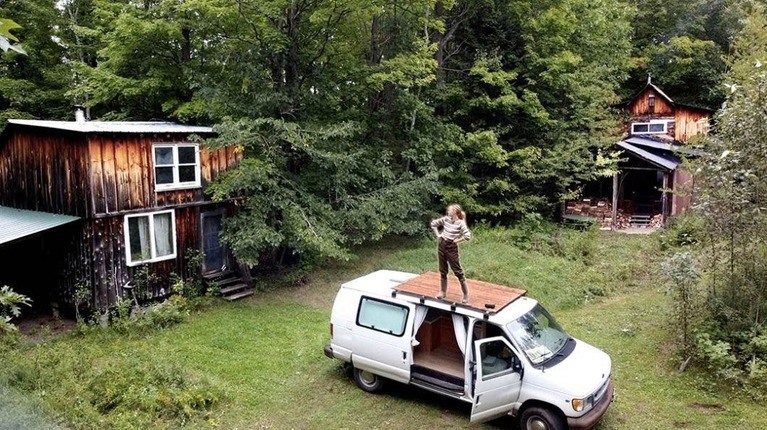
Inhabitat (one of my favorite sites) recently featured this rustic, but beautiful gypsy wagon (one of my favorite tiny houses) which sits in the forest near Kootenay Lake in British Columbia. The 8 foot by 20 foot wagon was built on a $100 salvaged 5 ton chassis, with 2×4 construction and curved rafters. It cost about $8,000 to build and took several years.

Most of the building materials for the wagon were recycled. The floor is locally milled hemlock tongue and groove and the windows were second hand finds from the local classifieds. The exterior shingles were cedar “seconds” split with a hatchet. The round window was ingeniously made from a 1970′s picnic table and is framed with rope for a natty, nautical style. The curved roof is covered with flexible metal sheeting and has two, curved Lexan skylights. The interior of the wagon is covered with stretched canvas, stapled into place and painted with white wash. Under the wagon is space for the storage of supplies and firewood. Continue Reading »

Paul’s Tiny House in the Woods

by Kent Griswold on March 16th, 2012. 53 Comments

Guest post by Paul Mittig

I built my 10 x 20 house in 2005 for about $10,000 in materials, including all furnishings. It is built on six poles set two feet into the ground, that support the floor and roof. There is no framing in the walls except at the door and the large window. The walls are rigid foam insulation, R21, covered with ½ inch sheetrock and all glued together. The ceiling has R38 fiberglass insulation, and the floor has R19 fiberglass insulation. I spend about $100 a year on propane for heating, cooking, and water heating.

The house is located in the hills of Northern California. I live in it full time. The house is set up for one person, but you could easily put a double bed by the door where the tall bookcase stands. If you did this you might want to move the window. Continue Reading »

Mad Woman in the Forest

by Christina Nellemann on December 26th, 2011. 29 Comments

Take a look at that window. That glorious window was the catalyst for the design of Laurie Halse Anderson’s cottage in the forest. Laurie is the author of several young adult books and historical thrillers and she writes in a small cottage in the forest. She expressed her need for a “room of her own in which to write fiction”, and her video from 2009 recounts the conception and building of her writing cottage. It was built over the course of a year by her carpenter husband and several of his friends. Laurie and her family wanted it to be off-grid, made with reclaimed materials and easy on the environment.

That amazing window (which Laurie called “a magic window”) was found lying up against a barn and turned out to be a church window from the 1800s. Custom glass was made for each round section of the window. She and her husband also perused the salvage yard and found old growth pine boards to use for the floor and chimney pots for the roof. Soybean based foam insulation was sprayed into the walls and the roof is Vermont slate. The house is powered by wind and solar. Continue Reading »

The Signal Shed

by Christina Nellemann on August 8th, 2011. 20 Comments

This off-the-grid cabin in Northeast Oregon, named the Signal Shed, was recently featured in Sunset Magazine, and the couple who spent two years planning and two weeks building the cabin are now offering the plans and prefab models for sale.

Mariah and Ryan Lingard fell in love with the woods and lakes of Joseph, Oregon and purchased some partially burned, partially logged land after seeing an ad in the local paper. The 100×150 foot parcel of land cost them $47,000 and is located smack dab in the middle of hiking, skiing and snowshoe territory. The couple has a full-time home in Portland, but they make the 6-hour trip to the Signal Shed about four times a year.

After two years of planning and extended weekend camping trips to their land, the couple built the 130 square foot cabin over a two week period with friends and family. The materials cost about $10,000 and the cabin features several recycled windows, IKEA cabinets and laminate flooring. They found the barn door hardware and the woodstove on Craigslist. The cabin rests on a floating pier to minimize impact on the land and cedar screens used to lock it up when Mariah and Ryan are not around. The Signal Shed has no running water, no electricity and the couple uses the woodstove for heat and some cooking. Continue Reading »

Rustic Retreat: Log Cabin in the Woods

by Kent Griswold on February 10th, 2011. 18 Comments

Though not a tiny house this is small by today’s standards and I think will give you some great ideas. Enjoy!

By: Estemerwalt Log Homes of Honesdale, PA

Photos:  http://www.estemerwalt.com/log-home-photos/exteriors/m-logcabin1.html
Photo Credit: Estemerwalt Log Homes/ www.estemerwalt.com

This Pennsylvania log cabin is a year-round rustic hunting and fishing retreat – the perfect outdoors getaway, and the very definition of aesthetic simplicity.  While not teeny-tiny, this little cabin is a marvel of simple efficiency.  The 1,200 square feet of living space relies on nooks to delineate space functionally; two small sleeping lofts meet at a spiral staircase, and there are three more beds on the main level.

Furnishings are sparse, as are amenities: this home is completely off the grid.  There is no running water – only an outside well and an outhouse. There is no power – the owner brings a generator with him when he’s there, and the log cabin is heated only by the woodstove and fireplace.  (The photographer brought a generator with him for this photo shoot, to light the cabin.) Continue Reading »

Tiny House in a Landscape

by Kent Griswold on December 4th, 2010. 20 Comments

With winter moving in across the country, this old trapper’s cabin in the woods seemed appropriate to me for this weeks Tiny House in a Landscape. Thought the landscape is mainly trees it still presents a peaceful setting for this simple log cabin.

This cabin is living simply and covers the basics of protection from the harsh cold outside. It surprises me how many things we think we need to live, but when it really comes down to it all we need is shelter, warmth and food. What do you think?