Shantyboat Interview
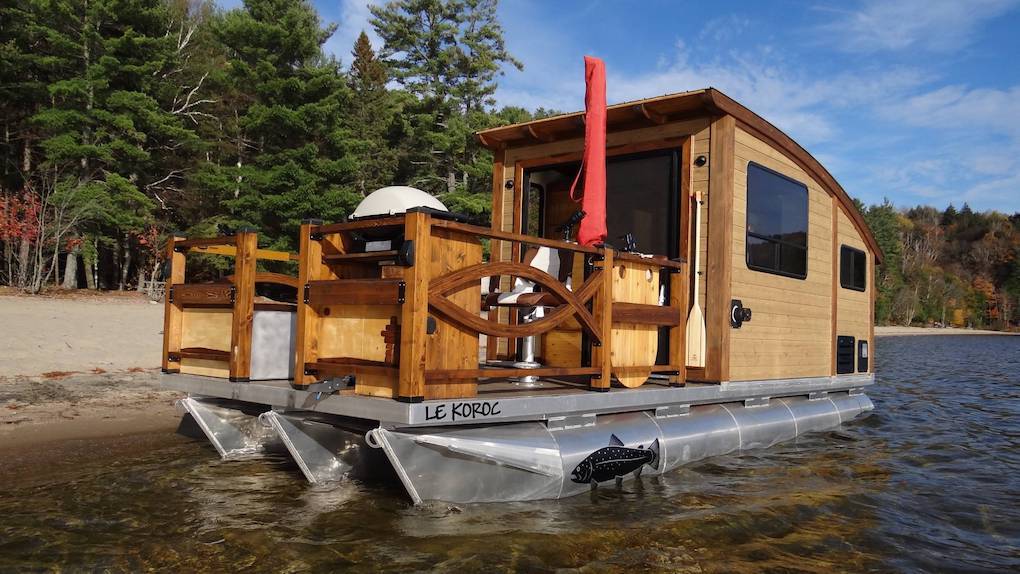
A Shantyboat/Tiny Floating House Interview with Seattle’s Bryan Lowe (by Derek “Deek” Diedricksen of Relaxshacks.com)
Bryan Lowe ordered a copy of my book “Humble Homes, Simple Shacks…” a ways back, and as in many fortunate cases with those who have done the same, it became a common ground on which we began emailing back and forth on our love of tiny shelters/houses, and more specifically, shantyboats. Bryan too, is Harlan Hubbard obsessed (I’m telling you READ “Shantyboat”- its pretty amazing/gutsy).

Well, back on track, it only seemed fitting to grab an interview, for all to read, from a guy who actually runs the blog http://www.shantyboatliving.com, so here you go….And thanks to Kent Griswold, for helping to spread the word as well, and to the many other friends that are part of this whole community (can I get a “Whoa Bundy!?”). Ahem….cough….bad eighties references aside, here’s our “yap session”….. Continue Reading »
Floating Guest House
As many of you know I am a huge fan of floating homes and have often thought of starting another blog focusing just on them. Recently through a google alert I discovered this little floating guest house in Portland, Oregon. Designed and constructed by a company called Studio Hamlet Architects, PLLC based in Bainbridge Island, WA. Julia Zander was kind enough to send me some wonderful photographs and gave me permission to share this project with you.

Floating Retreat
This floating guest house is nestled among a community of eclectic houseboats on the Willamette River in Portland, Oregon. The project was designed to work as a part-time residence for a couple’s use while their main floating home is being built. After moving into the main house, the guest house will become a vacation retreat for visiting family and friends. Continue Reading »
Sausalito Floating Homes
If you love houseboats or floating homes, you may want to make a walking tour of the famous Sausalito Floating Homes part of your next trip to the San Francisco Bay area. I thought I would profile these particular floating homes because the community is maintained by homeowners and individuals rather than city officials. This makes this waterside neighborhood unique in that the designs of these homes, that are docked in Richardson Bay, are up to the owners.
The famous Sausalito floating homes community has a history that stretches over a century. During the 1950s, ’60s and ’70s improvised floating homes made from scrap wood, old tugboats, elegant ships and even old Pullman cars were built by professional artists, and since the dock areas were so small, most of the floating homes stayed small. Some of these homes are now offered as vacation rentals and there are usually a few for sale. Some of the homes have names including the Taj Mahal, the Train Wreck and the Pirate. Continue Reading »
The Nutmeg of Consolation – Studio on a Lifeboat
Benjamin Wheeler brought to my attention Tom Dolby’s blog and his restoration of on ships lifeboat that he has converted into a music studio over in England. Though not used as a tiny house there is absolutely no reason that it couldn’t be converted into one.
I’ll let Tom Dolby tell you a little bit about the boat and you can use your imagination to see where you could take a boat like this.

She was built in the 1930′s as one of a pair of ship’s lifeboats aboard the SS Queen Ann, a British merchant vessel serving in the South Seas. If you look at the red stripe down the side, this was her original gunwale: the deck was added in the 1960′s and we built the wheelhouse this year. In the 30?s she would have had a sail, oars and small paraffin engine. It’s carved on her bowpost that she could hold up to 99 souls. Continue Reading »
Indianapolis Island
What looks like an iceberg in the middle of a lake or a half-melted marshmallow is actually is an experimental living structure inhabited by art students. Indianapolis Island is an art piece created by Andrea Zittel and inhabited this summer by art students Jessica Dunn and Michael Runge. It is one of the eight works of art in the Indianapolis Museum of Art’s 100 Acres art and nature park.
About 20 feet in diameter, Indianapolis Island is a tiny house made of fiberglass and foam that examines the daily needs of contemporary human beings. For the next four summers, the island will be occupied by one or two commissioned residents who are local art students. They will collaborate with Zittel by adapting and modifying the island’s structure according to their individual needs. Continue Reading »
Bridge Tender Houses
I recently got back from a trip to Europe to visit family and kept my eye out for tiny houses across the pond. What caught my attention in downtown Copenhagen, Denmark was a steel and copper bridge tender house. My husband and I actually peaked into the windows and contemplated if we could buy one of these things and spend our days watching the traffic and bicyclers speed past. These particular bridge tending homes are now being used as municipal offices, but I think most of these types of buildings would make great tiny houses along the lines of a lighthouse…utilitarian and beautiful.
In the past, bridge tenders were needed to run the electronics and machinery that raised and lowered bridges on major rivers, waterways and railroad bridges. The machinery was kept in a small house near or on the bridge and the bridge tender would spend most of their time in the house, or even lived there. Their jobs consisted of controlling and monitoring traffic around the bridges, keeping the bridge and the raising/lowering mechanism in good condition and running telegraph machines and other communications. Most bridge tender houses were usually built by government departments of transportation. Continue Reading »
Trawlers
With summer on the way, the tiny house dream of some people might take the form of a boat. Instead of a sailboat or other sleek sailing craft, a trawler has all the amenities in a tough little package – with a loyal following.
A trawler or pilot house is a usually a boat used for fishing or for the military and the police, but pleasure versions of the them are built as well that have comfortable areas for living and cooking. These boats are called cruising trawlers or trawler yachts and they come in many styles and sizes. Since they don’t have a sail, they rely on fuel and have cruising speeds of around 14-20 knots.
Typical designs of trawlers include a raised pilothouse or offset deckhouse and a “portuguese bridge” which consists of a walkway behind the foredeck, in front and to the sides of, the pilothouse windows, separated from the foredeck by a (generally) waist-high bulwark. The purpose of the bridge is to deflect water from the foredeck up over the superstructure top rather than slamming against the forward windows of the pilothouse. It gives a semi-sheltered area outside the pilothouse while underway. A secondary benefit is that it provides a “safe area” or handhold when it is necessary to be on the foredeck in inclement weather. Continue Reading »