Small, Cool House Contest
Thanks Diane for alerting me to this contest going on over at Apartment Therapy. The deadline is April 13 which is coming up soon. If you have a tiny or small home you would like to enter please go over to Apartment Therapy read the rules and get your home in now.
Apartment Therapy is looking for beautiful, inspiring and ingenious use of small spaces from coast to coast. If your home is 1,200 square feet or less, submit five pictures (& a floorplan) of your small space and you could win from a pool of $10,000 in gift certificates from Room&Board.
Here are the categories:
- TEENY-TINY 300 Square Feet and under
- TINY 600 Square Feet and under (but over 300 Square Feet)
- LITTLE 900 Square Feet and under (but over 600 Square Feet)
- SMALL 1,200 Square Feet and under (but over 900 Square Feet)
- INTERNATIONAL All non-US entries (under 1,200 Square Feet)
This home pictured here is of Brian and his dachshund Charlie who live in a studio of 285 square feet in Midtown West in New York City. It is one of my favorites of the teeny tiny contestants. Here is what Brian has to say about his home:
My favorite element is the Murphy Bed that allows me to entertain friends without it feeling like a bedroom. My couch was designed as a bench, so I wouldn’t have to move furniture around to let the bed down. This configuration allows me to have a living room space, dining area, work area, kitchen, and what feels like a separate bedroom in a 20’ x 11’ space that doesn’t feel over crowded. Talk about space efficiency.
Go see more contestants and cast your vote at the Apartment Therapy Site.
If you enjoyed this post, subscribe to our feed
Tiny Garage Conversion
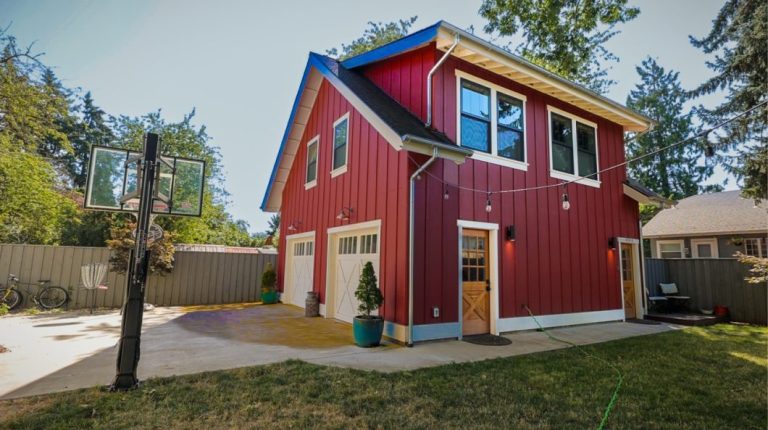
This tiny garage conversion by Martin John Brown of Portland, Oregon attracted my attention because of the wonderful styling and details in such a small space. Check out that great purple color!
With architect John Perkins, Martin converted a detached garage into a beautiful 400-square foot house for his mother-in-law to live in. In his blog, bottleworld, John documents the process, including the issues he had with the city codes while trying to create an environmentally friendly tiny dwelling.

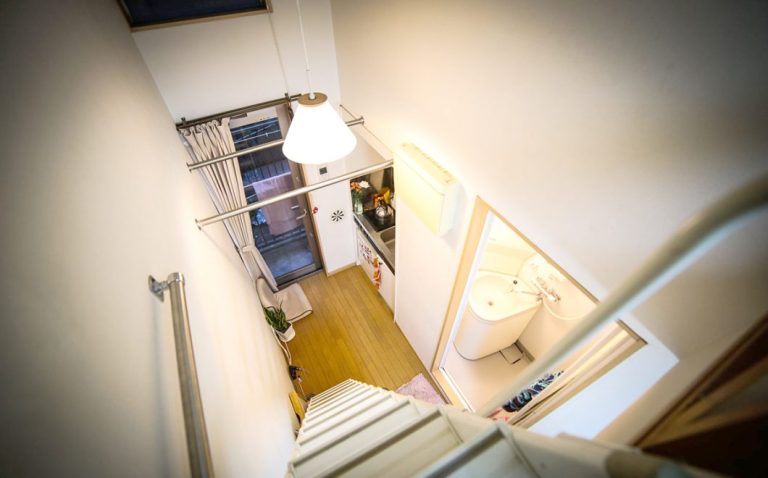
The house includes a curved kitchen counter, round windows, a loft and skylight and an alternating tread staircase. The staircase allows comfortable ascents and descents in a considerably steeper pitch than a standard stair. They are straight, making transporting long items (like mattresses) easier than on a small-diameter spiral stair.


It is interesting how Martin talks about how adding one extra foot in such a small space makes such a big difference. In most average sized homes, an extra room is usually needed for more impact on the living space.
The cost for the conversion came to $75,000 including $7000 for permit and $4000 for architect.


Photos by Martin John Brown
If you enjoyed this post, subscribe to our feed
Katie’s Kitchen Remodel
Katie in Berlin, Germany recently wrote me to let me know about their tiny kitchen remodel. I am going to let Katie tell you their story.
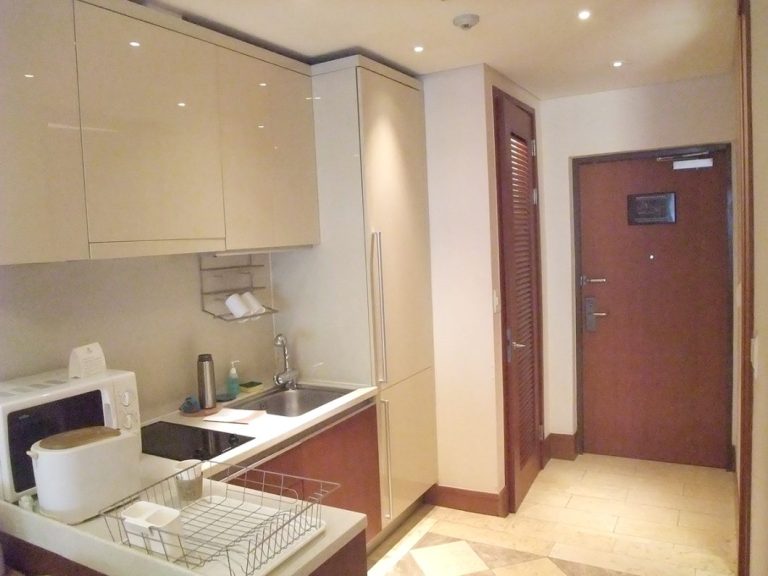
We live in a 480 square foot apartment in Berlin. Our kitchen in Berlin, Germany left a lot to be desired when we first saw it. It was easy to see why. At 36 square feet, there were no drawers, counter spaces, or places to store anything. The last tenants kept a fridge and freezer in the living room with dishes stacked on top of it. We thought that there just had to be a better solution. We had no idea where to get tools or construction supplies.
Our apartment also didn’t have any lights except this one dangling hazard. When people buy or rent in Germany, their homes don’t come with any light fixtures. People prefer to take their lights with them from home to home.
We were considered lucky, though, most homes also don’t come with kitchens.
Germans call American homes “cardboard houses”. I don’t think we truly understood why until we started to tear down our kitchen walls. They were solid drywall, and they weren’t even load-bearing! Each of those drywall bricks weighed at least 50 pounds.
And slowly, we progressed without breaking the law… What law? The notorious German law that enforces strict quiet hours every single day. It makes work for young remodelers nearly impossible; it offers their neighbors a bit of bliss.
- Our cabinets extend all the way to the ceiling, utilizing every inch of vertical space.
- Our oven is too small to cook a turkey, which is fine with us. (We’re vegetarians) It also happens to be our microwave, too.
- We picked a two-burner stove. It turns out we hardly ever use three burners, let alone four.
- Our dishwasher is half-sized. It really feels like just the right size for a family of two.
- Our fridge is a standard German fridge… which happens to be the same tiny size Americans have in college dorms. It’s covered by wooden panels, which is traditional in German kitchens.
- Our recycling system is super compact… and still manages to provide us with a way to sort our recycling in TEN ways (required by German law).
We like to think that good living can come in any size. And so far, so good!
To see more pictures of the project and read more of Katie’s experience go to her blog.


If you enjoyed this post, subscribe to our feed
The Spite House
A Tiny, Beloved Home That Was Built for Spite
Fred emailed me this story from the New York Times written by Steve Baily. Below are short quotes from the article, to read the full article go to the New Your Times website.
Photo above: Circa 1924. “Ford Coupe at ‘little house’ in Alexandria, Virginia.” National Photo.
The Spite House (in blue), built in 1830, is 7 feet wide, about 25 feet deep and a whopping 325 square feet in two stories. It is located on Queen Street in the Old Town district in Alexandria, Va., just across the Potomac from Washington.
Jack and Colleen Sammis, shown with his son, Jake, own the house now.
Although the couple who previously owned the Alexandria house for 25 years used it for most of that time as a full-time residence, Mr. Sammis has used it mainly as a pied-à-terre since buying it for $135,000 in 1990.
Structurally, it’s more of an enclosed alley than a house — the brick walls of older houses on either side form the painted brick walls in the living room. It’s called the Spite House by some because John Hollensbury, the owner of one of the adjacent houses, built it in 1830 to keep horse-drawn wagons and loiterers out of his alley.
“The area loves the house,” Mr. Sammis said. “It’s on napkins and cards that show Old Town scenes. It’s always on the Christmas tour.”
The house has drawn attention out of proportion to its size.
Beneath the stairs is a cupboard with a small microwave oven on top. On the other wall is the kitchen counter with a small sink, a small four-burner gas range and an under-counter Sub-Zero refrigerator and freezer.
Upstairs, a bathroom with a claw-footed tub/shower is at the rear. Storage space lines a narrow hall beside the stairs.
A full-size double bed is pushed sideways against a wall; it is made up as if the side against the wall is the head.
Mr. and Ms. Sammis also entertain at the house. “Unless we put some of the people upstairs,” Ms. Sammis said, the house can hold only “about 12” guests.
Again you can read the full article by going to the New Your Times website.
Photo Credit: New York Times
If you enjoyed this post, subscribe to our feed
Box of Tricks
24 Rooms Tucked Into One
Christian and Shelly both sent me an email this morning in regards to a New York Times article about a modern and cool and high tech and very expensive tiny home in Hong Kong, that has some neat ideas we can apply to tiny space living.
Mr. Chang, an architect, can impose on his 344-square-foot apartment, at least 24 different layouts. Using shifting wall units suspended from steel tracks bolted into the ceiling, the apartment becomes all manner of spaces — kitchen, library, laundry room, dressing room, a lounge with a hammock, an enclosed dining area and a wet bar.

The article called 24 Rooms Tucked Into One by Virginia Gardiner can be viewed at the New York Times website. Following are a few pictures and descriptions.
Photo Credit: Marcel Lam for The New York Times

Living Area
The walls in the apartment’s main room, awash in yellow because of tinted windows, are pushed against the wall to the left to create an open space, with CDs to the left and the desk to the right.

Bedroom
Mr. Chang uses a hydraulic Murphy bed of his own design, hidden behind a sofa during the day.

Bathroom
Behind one movable wall of shelving is an extra-large Duravit bathtub. A glass shower stall doubles as a steamroom with color therapy and massage and a Toto toilet has a heated seat and remote control bidet. Sound emanates from a six-speaker home entertainment system.

Kitchen
A panel hides the nook, and the TV wall moves to reveal the kitchen.

Closet Storage
Mr. Chang, 46, has lived in this seventh-floor apartment since he was 14, when he moved in with his parents and three younger sisters. His experiment in flexible living began in 1988, when his family moved into a bigger apartment a few blocks away with his grandparents and uncles.
If you enjoyed this post, subscribe to our feed