Mini House ONE+

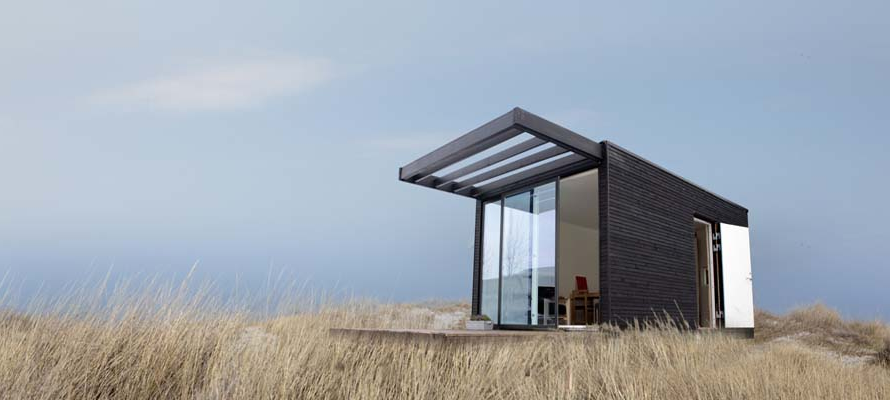
Described as a lego set for adults, the Mini House ONE+ was designed and built by the Swedish company Add a Room. The ONE+ houses are designed to start out as a basic 15 square meter (approximately 161 square feet) module which can be added on to as needed in many different configurations. Add a Room will design the ONE+ to an individual’s needs, build it within a controlled, covered environment and deliver it to your site.
This concept is based on a cooperation between Denmark and Sweden and choosing high quality materials from both countries. The system includes decks and deck covers as well as an indoor or outdoor kitchen, a mini bathroom, beds, wardrobes, full insulation, plumbing and electrical fittings.

Read more

Quarters: Prefabricated Housing

Bowen Island seems to be an attraction for tiny houses. It’s home to the Eco-Shed by James Glave and is now home to the Quarters house by industrial designer Amanda Huynh in collaboration with Anna Gukov, Lydia Cambron and Emilie Madill. Following nearly a semester of intense research in materials, compact housing and the homelessness epidemic in Vancouver, a full-scale, timber-framed unit was built to house 1-2 residents in need of a simple shelter.

The 8 foot by 8 foot structure has a built-in sleeping loft, a readily available 5-gallon bucket wash basin, a City of Vancouver rain water barrel and modular furniture, which could be easily configured to create a second sleeping space. Because the individual unit does not provide running water or electricity to reduce cost, it would function best in a community of such dwellings with central kitchen/washroom facilities.

Read more

Les Roulottes de Campagne

Ever since Kent posted the MiniCasas on the Tiny House Blog, my love of gypsy caravans has been renewed. The other day I ran across these gypsy caravans for rent and for purchase in France, and was amazed at how beautiful and spacious the designs were. The Roulottes de Campagne were designed by the same company who created the Carré d’étoile or the French Cube. Gypsy caravans like these are offered in over 50 locations within France. They cater to vacationing Europeans, but tiny house lovers can get a lot of ideas on how to live luxuriously in a small space with these beautiful photos.

The caravans are built from partially recycled timber and meet high quality environmental standards. The insulation is made from wool and the windows and doors have double glazing. A hot water heater and electrical wiring is included.

Most of these caravans are around 215-230 square feet and include a kitchen, a bathroom and sleeping facilities as well as plenty of storage, heating for winter use, outdoor living spaces and lovely details including polished brass port-hole windows. They come fully equipped and can accommodate up to four people. Some are even accessible for the disabled. The units start at €29.800 or $41,000 and take 2-4 months to be completed.

Read more

The E-den and the Hut

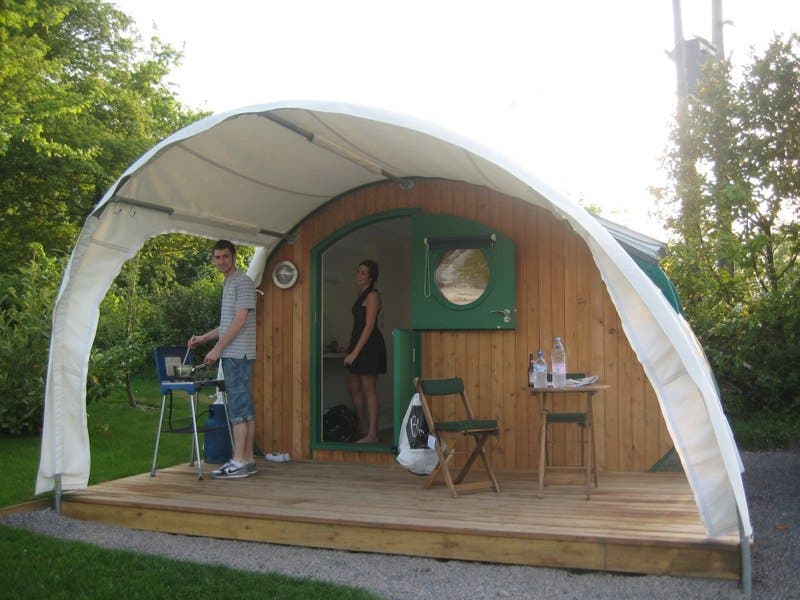
The E-den and the Hut are two new outdoor living/tiny house designs by the UK company Timber Tradesmen. Timber Tradesmen are selling these tiny buildings as alternative options to camping in a tent or trailer, or as a tiny office, but I think they would each make a great tiny house. Both of these buildings have a unique, organic design that fit comfortably in any surrounding, while providing an uncluttered, spacious interior – complete with a large bunk bed, full insulation and storage space. They also include an optional deck and and a canvas canopy for additional luxury and privacy.

The E-den is hand built by skilled craftsmen in Somerset using a combination of timber and steel framework, locally sourced materials and incorporating modern timber frame construction techniques. They each include a wide door for people with mobility problems, a large roof window for natural light, and electricity can be added into each E-den. They are each constructed in a workshop and delivered as a complete unit on a trailer. To launch the project the company has decided to sell the first 10 E-dens at cost to establish them in the marketplace, therefore the prices below are a genuine special offer and will be offered on a first come first served basis.

Read more

Things to Think About

Di has been responding with a lot of comments on the Tiny House Blog and I thought she had some great ideas of things to think about when looking into downsizing or designing a tiny house. I asked Di to do a guest post and following are her suggestions and ideas.

DIMENSION:

  • Think of the present and future. Try a one-story building.
  • Adjust the height, width and length of a building. An 8′ ceiling may be sufficient.
  • Measure and rearrange interior items. It’s easy to edit a floor plan in MS Paint.
  • A twin bed is 3′ x 6.25′. A double bed is 4′ x 6.25′.
  • Most under-counter appliances are 2′ x 2′.
  • Some stoves/fridges are more narrow.
  • Some fridges/dishwashers are small enough to fit under a kitchen sink.
  • Rather than a porch/deck, store a portable screenhouse and lawn chair in the trunk of your car.

Photo Credits: ProtoHaus

LIGHTING:

  • Rather than rely on lighting, provide adequate daylight.
  • Try windows east, west, north and south.
  • For longer-lasting daylight, try skylights.
  • Use windows/skylights where needed, such as over the bathroom, kitchen counter, bed/couch.
  • For spaciousness, try recessed lighting and deep window sills.
  • Rather than drapes, try a small curtain at the top of a window.
  • For curtains, recycle your favorite fabrics – they’re easy to make, clean and change.
  • Mini blinds are more versatile than shades.

Read more

Shelter House

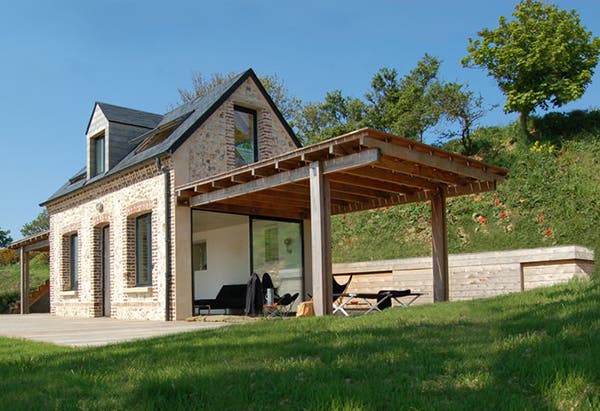
While this eco-friendly and beautiful home is not really tiny, elements of the interesting “wing” design can be taken into consideration for a tiny house design. The Shelter House by Franklin Azzi Architecture is located in Yport, near Normandy, France. The two expansions which protrude on opposite sides of the house, resemble wings with covered patios and rooftop terraces.

This modern, sustainable home is constructed mainly of wood with a rustic masonry face, and features a rainwater-recycling system, geothermal energy, and solar panels that keep this house off the grid. The building materials are recyclable and locally sourced from within 100 km of the home’s location, and then assembled on-site. Vegetable fibers are used for walls and insulation, heating comes via wood-burning stove, and cooling and ventilation are passive. In addition, all the equipment providing hot water facilities have been placed outside the home, in a gallery 30 meters long, which is dug into the hillside. A final system supplies the toilets from the recovery of rainwater, stored in a 200 liter underground tank.

Read more