Snowbirds in Florida
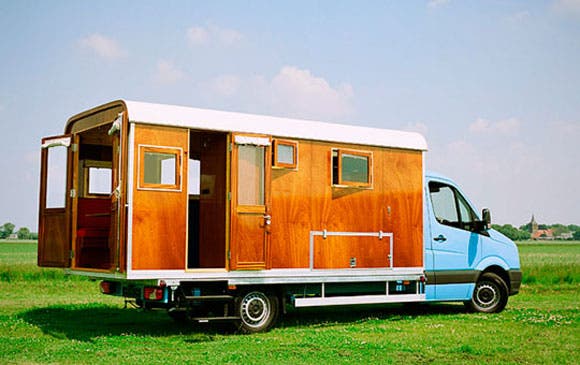
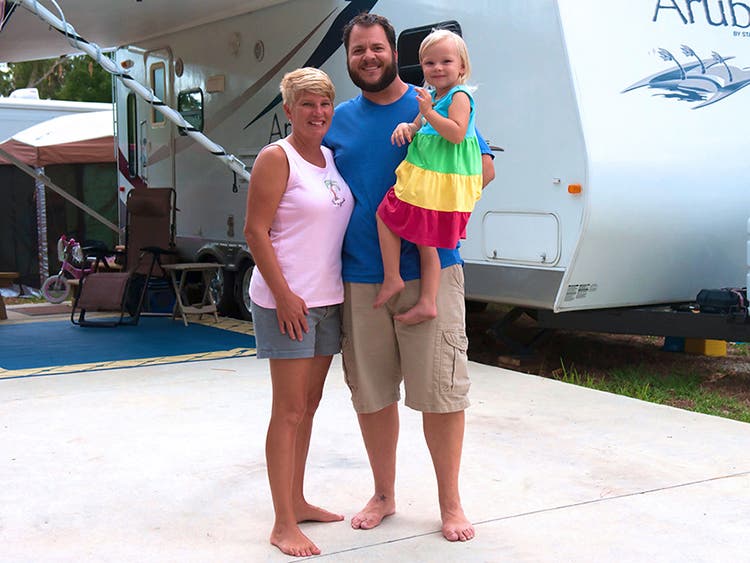
One of our readers, Royal sent this to me the other day and I wanted to share this unique home with you. On Monday 11/02/2009 Royal saw this trailer in the parking lot of WalMart in Mariana, Florida.
This little home is certainly distinctive! Due to the signs on the back of the trailer (Neenah, WI – Tampa, FL) and the owner saying they had come to Florida for the winter…I assume they are snowbirds.

The owner said the following may be hard to believe, but the left rear corner of the trailer was run into by a car driver … IN BROAD DAYLIGHT! Continue Reading »
Kevin’s Camper Kart
We have looked at a couple of homeless shelter options on a couple of posts in the past. Logan husband of Tammy from Rowdy Kittens found this cool site that had this and another tiny house concept within it.
Kevin is an artist who likes to paint vehicles, he says, “I find beauty in derelict cars and unkempt landscapes. I have always been interested in painting vehicles and scenes that have defined the evolution of the American landscape.”
He also seems to like to create projects that fit a need and has done so with this camping cart. I see one issue with this design, in that the cart wheels would most likely have difficulty supporting a person sleeping without some type of bracing or way to lock it in place.
I really like the concept though and would love to see something like this developed into a real product. Great work Kevin!
Check out Keven’s website and enjoy his paintings and drawings.
Copyright © 2009 Tiny House Blog
If you enjoyed this post, subscribe to our feed
Mule Drawn Tiny Home
13 months in a 21 square foot, Mule drawn Tiny Home
Bernie Harberts of River Earth recently bought a set of Sonoma Shanty plans and when we were communicating by email because he is wanting the shanty on wheels version, I discovered his website and learned about his interesting story.
Bernie recently downsized his wagon for a second journey across America, he went from 60 square feet down to 21 square feet in order to cut down weight and make his home more easily pulled by his trusty mule Polly.

Everything I ever built in my life has/had wheels under it: from the boat I sailed alone around the world to the boat I built and sailed from Canada to the Bahamas to the wagon I lived in while voyaging from Canada to Mexico.
Bernie’s old wagon was 2360 pounds, empty and he designed his new one to be only 800 pounds. Here is what Bernie has to say about his design.
This time I paid closer attention to what the original pioneers wagons measured. I took a tape measure to my mule skinner buddy Tash Hudson’s wagons. The beds on his traditional wagons measured 36″ to 48″ wide, fully 2 feet narrower than my original wagon. Another friend, Sue Maska, who spent 5 years traveling the country with her husband in their horse-drawn wagon, gave me tips on a practical interior layout. Their wagon was only 3 feet wide.
Then I fired up my welder and got to work. Using 1 1/2″ X 1/8″ angle iron, I welded up a steel frame that weighed 100 pounds.
To that, I attached lightweight walls fashioned from 3/4″ foam insulation sandwiched between two sheets of 1/8″ plywood.
The new wagon measures just over 2’ 6” wide by 8’ long. A 3’ covered area where I sit while driving, what I call the front porch, brings the overall length to 11’. Headroom inside, instead of 6’, was reduced to 4’ 10”.
Bernie is an author and sold books along the way to help pay for his trip. You can see two of his books pictured below. I want to encourage you to go explore his site and learn more of his story as I can’t do it justice in a short post. Visit his the General Store if you would enjoy getting one of his books and getting the full details of his travels.


If you enjoyed this post, subscribe to our feed
The VW Bus
Not just for hippies anymore, the VW bus seems to be the epitome of traveling adventure. And they make snazzy little houses, too! Their stubby shape, tell-tale buzzing engine and ability to be customized have given the VW bus a dedicated following. If you are going to live for any length of time in a VW bus, you will most likely be living in a vintage bus that has been refurbished.
The original VW bus, the Plattenwagen, was designed by businessman Ben Pon from the Netherlands in 1947. His idea was considered revolutionary at the time and the design had to be built by Volkswagen on the chassis of the beetle car.
My favorite VW conversion belongs to the Bumfuzzle couple, Pat and Ali Schulte. They have traveled through most of North and South American and part of Europe with their 1958 panel van and have created attention wherever they go. Ali affectionately calls it their little house. This van will soon be going up for sale in the UK, as the couple are going to have their first baby. Keep an eye on their website and you might be able to snap it up.
Chad and Ana Memmel are also living and traveling the world in their 1977 VW Type 2 bus with a pop-up named Mango. They have a great list on their website of what they modified to make their mobile home more liveable.
Luke Janes has been living in a 1977 VW bus named Charlie for the last 6 years. He started living in his bus because he wanted to be able to work for the work and play for the play. He came to love so many of the “fringe benefits” that he now prefers it as a lifestyle, and he choses to continue to live in the bus. He gives a few advantages and disadvantages of living in a bus:
- Low impact: No electricity, no heating, no natural gas, small land use, low construction materials next to a home.
- Freedom: No lease, no rent, no mortgage.
- Preparedness: Everywhere he goes, he has everything he needs
- Financial ease: His monthly expenses are low
- Simplicity: No room for excess stuff
- Cleanliness: Everything has its place.
- Health: He goes to the gym most days, and bike most places.
- Beauty: With a little driving he can move his home to the places where people spend millions of dollars to live
- Connection to community: It keeps him spending a lot of time in public spaces — gyms, cafes, parks, restaurants.
- Resourcefulness: He has learned a lot of skills working on the bus
He adds that living in a bus allows him to winnow down the people he associates with. “People put off by this tend to be closed-minded or boring, and people interested in this tend to be open-minded and adventurous. This means that all of my friends and lovers are open minded and interesting! Sweet!”
Luke also lists the disadvantages of living in a bus:
- It can be illegal
- It may be unsafe for women
- It can be stereotyped
- Too hot in the summer, too cold in the winter
- You can’t cook or clean dishes easily or keep things that need cold refrigeration
- You can’t throw good parties
- Getting mail and packages can be problematic
Even with their disadvantages, what is it about these colorful little buses that keep people coming back? Maybe it’s the community of bus lovers. It seems that once you meet another VW bus owner, they become a quick friend…if not family.
This couple spent their honeymoon in a a VW bus
Luxurious Living in the VW Westfalia Camper
If you enjoyed this post, subscribe to our feed
Caravans Are Cool Again
Kaisha one of our readers emailed me this recently and I thought it was cool and that you would enjoy it too.
Mobility and living on the move are very important themes of our fast-moving age. People want to be mobile but at the same time, have a strong desire for a lasting home and their own personal four walls. In the camper market there is strong demand for new design and personalized, tailor-made solutions. Individualist tourists want a caravan that is made just for them.

The solution to the problem is offered by the “Mehrzeller” – the multicellular caravan. Using the online Configurator, every user sets up a design that is unique, their own layout that they can identify with. The configuration is generated by a computer using the customer’s inputs, and then the final design is done by parameters from the architects to yield an attractive and practicable result. The caravans are produced using the principles of “mass customization”: this allows both the individual wishes of the customer to be accommodated while producing the caravan with series methods.
To learn more visit the Mehrzeller web site.
If you enjoyed this post, subscribe to our feed
Travel Cottage Made with Antique House Parts
One of a kind “new” thirty two foot long travel cottage featuring “old” house parts throughout.
A sampling of the antique building materials in the cottage include: a Dutch door, a genuine vintage ice box, reclaimed bead board ceiling, reclaimed pumpkin pine flooring, a 1930’s gas cook stove, and an antique copper kitchen sink–the cottage is also fully solar powered.
This cozy home on wheels boasts all modern amenities; including a shower with holding tank, a custom-designed kitchen, a family room, and two single beds that can be combined to form a full-sized bed. The newer components of the structure include both spruce and plywood, with an epoxy-fiberglass coating.
To learn more go to The Old House Parts Company website.
If you enjoyed this post, subscribe to our feed
The T@B Trailer
After doing a post on teardrop and vintage trailers a few weeks back I thought I would do a post on the ultra-modern T@B. Since it was introduced a few years ago, the T@B trailer by Thor Industries has exploded as a popular alternative to a larger, heavier travel trailer.
The T@B is known for its European design, styling and lightweight construction. They are about 16 ft long and can be purchased for between $9,000 and $20,000. The full trailer stands at 7 ft 9 inches and the interior height is 5 ft 9 inches. It weighs under 2,000 lbs unloaded.
The T@B, which stands for Take America Back, also has all the amenities of a larger travel trailer (heating, air conditioning, fan, sink, refrigerator, stove and storage) but can be pulled with a smaller car and has no need for electronic brake control. The only thing the T@B does not have is a bathroom and shower. A port-a-potty can be installed. The Clamshell T@B even has a kitchen that opens up in the back, like the classic teardrop trailer.
The T@B also includes:
- Several floor plans
- Alufiber® construction
- Surge coupler attached to the hitch
- Seating area that becomes a 60 x 70 inch bed
- A covered area for a 20 lb. grill-style LP propane bottle and deep cycle RV battery
- A 5 gallon fresh water tank and on demand water pump
- A 25 amp power converter
- A marine grade amp with removable 20 foot power cord
- Smoke, propane, and carbon monoxide detectors
The T@B, because of its people friendly design and comfort, could be used for a temporary home or one that is more permanent. I came across several websites of people who live in or take extended trips in their T@Bs. I was specifically interested in the modifications they did to make the their T@B more comfortable and suited to their living needs.
Tabventures: Lynne takes extended trips with her dog, Millie
Chris Dunphy lived in his T@B for two years, before he upgraded to an Oliver
Mike and Trisha Kennedy travel in their T@B
Al’s T@B Mods: A list of T@B modifications
If you enjoyed this post, subscribe to our feed
Teardrops & Tiny Trailers
“It has often been said that owners of travel trailers (and especially vintage travel trailers) are some of the friendliest people on earth…it also appears that the smaller the RV, the friendlier the owner.”
- Douglas Keister, Teardrops and Tiny Trailers
How would you like to get rid of everything and live in a tiny trailer? Once you take a look at Teardrops and Tiny Trailers by Douglas Keister, you will realize how stylish tiny trailers can be, and will want to run off with one of your own.
Keister, who has written books about and photographed everything from cottages to cemeteries has a new book about teardrops and tiny trailers. Last May, I attended the 15th Annual Dam Gathering of the Tears in Lakehead, Calif. with my Little Guy Rascal. I was able to meet Keister and view a slideshow of his teardrop and tiny trailer photographs. I also realized that teardroppers really are the friendliest people in the world. So, of course I had to buy the book.
Keister emphasizes the neighborly warmth that emanates from the owners of tiny trailers. Because of their small size, owners are really forced to spend more time outside their trailer or RV and interact with the people around them. Teardrop owners will even decorate their camping space to mesh with the design of their teardrop.
The other benefits of a teardrop or tiny trailer are:
- You don’t need a large vehicle to pull a tiny trailer. I pull my Rascal with a Dodge Neon.
- Your camping clutter is kept to a minimum in a small space. You only take what you really need.
- You save money on gas.
- Teardrops and vintage trailers are sure to gather a crowd. You will be popular in the campground, so be prepared for many admirers.
The book mostly profiles the design and history of teardrops, canned ham trailers such as the Shasta and the Serro Scotty, the Canadian boler and of course, the Airstream. The book also includes a chapter on European caravans.
There is really no mention of people who live out of their teardrops or tiny trailers, except for the temporary residents of Slab City in Niland, Calif. Most people use them for camping or more extended vacations. I use my tiny teardrop for camping and sometimes for guests who don’t mind the cramped quarters. Tiny House Blog recently had a post on using a teardrop as a guest room. I did run across the blog of Misty Tosh, who is a writer and producer and lives out of her vintage trailer while she travels and works.
If you are interested in staying in a vintage trailer, you can visit the Shady Dell in Bisbee, Arizona.
All photos by Douglas Keister
Teardrops and Tiny Trailers Forum
If you enjoyed this post, subscribe to our feed
Gypsy Rose
Because of their size and aesthetics, tiny houses lend themselves to being named: weeHouse, Tumbleweed, Box Turtle. Rarely do you see a 3,500 square foot house with a name.
Kevin Rose named his mobile house Gypsy Rose, after his last name and the fact that his lifestyle in this tiny house and aboard his boat (Raven) is somewhat footloose. Any similarity to the famous stripper, Gypsy Rose Lee, is purely coincidental, he said.
Kevin told me that the idea for Gypsy Rose was completely independent of the “small house movement” that has recently gained in popularity, and that simplicity and functionality were the primary criteria in designing the house.
“I live on a boat on Lake Champlain in Vermont for 7 months a year and had a need for winter accommodations,” he said. “My friend Marion had a need for summer accommodations on the land she owns in eastern Vermont. One day I called her up and suggested that we build a mobile cabin that we could share between the two locations. We designed it ourselves based on the maximum dimensions allowable on the highway without a permit (8.5 feet wide by 13.5 feet high) and my experience with efficient use of space on boats.”
The trailer for Gypsy Rose was custom made and Rose did the rest of the framing and details himself. Gypsy Rose is self contained and off the grid. It uses many systems that were developed for marine applications. She operates primarily on 12V electrical systems whose batteries will ultimately be charged by solar or small-scale hydro (with a generator backup). Propane powers the stove, the refrigerator, the furnace, and the on-demand hot water heater and a composting toilet handles the waste.
Rose’s passion for nature, sustainability and creating a sense of place is evident in his blog which documents the process of building Gypsy Rose, and his life around the New England area.
Ecomodder: Building Gypsy Rose
If you enjoyed this post, subscribe to our feed