Reclaimed Space

by Kent Griswold on July 5th, 2011. 31 Comments

Guest Post by Tracen Gardner

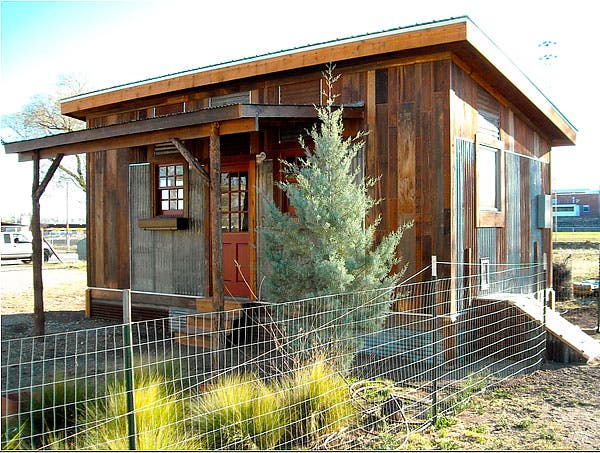
I came up with the idea for Reclaimed Space when I needed a living space on my ranch outside Shiner, Texas. There was no electricity or running water on the site, which is located 15 minutes from the nearest hardware store. I did not want to use all that energy driving back and forth and was concerned with not only with time constraints but also the confusion involved in meeting sub contractors in a remote area. I was afraid of not completing the project in time and that it would take too long to “dry-in” if I worked only on weekends.

I decided to build my Reclaimed Space to fit a “shipping envelope.” Not so tall that it would hit bridges, but wide enough to be usable. I also incorporated sustainable practices I learned at UT like cross wind ventilation, single pitch roof optimized for rain water catchment, solar compatibility (orienting the space long way east/west preventing too much sun), over insulation, and the use of piers. The piers eliminate the need for a lot of concrete and are able to relocate easily if needed.
Since I painted my way through college, I knew where most damage would occur from the sun and rain. To compensate for this, I placed galvanized tin on the bottom 1/3 of the north and south walls, and almost all of the east and west walls. The structure was built with eaves for the same reasons.

Next came style, for years I had collected 100 yrs old material with great appreciation for it’s structural strength, historic value, rich colors and textures. I was happy to do my part to save landfill space. Continue Reading »

Posted July 5th, 2011 by Kent Griswold and filed in Stick Built, Tiny House Concept
Tags: , , , ,
31 Comments

Small Living Makes Giant Strides

by Kent Griswold on July 10th, 2009. 7 Comments

A Look at America’s Growing “Small Living” Movement

Shireen Qudosi wrote this article for the Tiny House Blog and will have a couple followup ones in the next few weeks, so stay tuned. Shireen’s bio is at the bottom of the article.

In a super-sized obsessed age, we’ve now fallen into the gap where we believe our home should also reflect a shift toward the grandiose.

Yet this obsession with gigantism has completely dwarfed our sense of self.  Whereas even meals used to be an art form, the rising trend on bigger (and ultimately considerably ridiculous creations) is aimed at promoting a consumer culture that ironically strips us of culture.

The Micro Compact Home

Some would even argue that in addition to relinquishing culture, we rescinded our identity as we grow increasingly lost amidst a rising expanse of materialism. With consumer culture, it’s no longer about what we have, but about how much we can stuff into ourselves, pile on ourselves, and collect around ourselves.  An inflationary ideology that compromises quality for quantity, the idea that more is better and less is miserly can be traced back to Hollywood and celebrity, two groups that promote a culture of excess that majority of star gazers flock to emulate.

Yet an undercurrent movement referred to as “small living” is creating waves as a chic counter culture against wasteful consumption.  An increasing number of global citizens are realizing that bigger is not better, that more is not necessarily feasible, and that a continued practice of parasitism is not in our mutual interest.

This all began with a green movement, ironically enough kindled by the very same group that initially made it popular to be wasteful. It was Hollywood and celebrity that made it trendy to be environmentally aware, and while they were not the first group to practice earth-friendly habits, they are the group that got it mainstream attention.  Still, the green movement has taken off considerably since its infant days where recycling was the height of eco-culture.  The newest trend is in sustainable living, a striving effort to live a lifestyle with a minimal or reduced carbon foot print.

Thinking green has spread a new leaf.  While in the early stages of sustainable living, eco-friendly decisions centered on what could be different in the home, the trend now is to change your home itself.  Quickly gaining momentum, the small living movement is leading a greater number of people to realize the personal and communal benefits of conscientious consumption.

From small houses to yachts-turned-homes, people across the country are completely rethinking their approach to living.  And with the rise of do-it-yourself shows and home makeovers, we’re all realizing that we can have the comforts of a larger home, even the aesthetic appeal, without having to scrape out our wallets for that last little penny to fund it all. Whether it’s a boat, mobile, or studio living, the fact is a majority of Americans are downsizing their dwelling space.  This in light of the recent recession mixed with a rising awareness to cultivate positive eco-friendly living solutions, has left the market saturated with a number of alternatives to conventional living.


The emphasis here is not just on saving the environment, but also on saving a green resource of another variety.  Conscientious about carbon foot prints and wasteful spending, many global citizens are down scaling from a humble abode to perhaps an even more humble abode in an attempt to salvage hard-earned dollars.  With that, the trend these days is perhaps not even just to get a smaller apartment, but to get the most compact home possible for your lifestyle.  The idea of compact living has not only gotten many people to downgrade the number of services they use (i.e. cable, internet, dry cleaning, gourmet coffee), but it’s also raised a new crop of spatial economists that have traded in expansive lofts for more resource-friendly spaces.

source.apartment therapy 2
Small living is simply much
cheaper. It’s cheaper to furnish your place, utility costs are lower, and smaller spaces are generally much more affordable to rent or purchase.  It was Leonardo da Vinci who first said, “small rooms discipline the mind and large ones distract it,” – and perhaps he was right.  Surprisingly, there are a number of other benefits that go with smaller spaces, which anyone who’s walked the walk will quickly recognize.

Small living also undoes the idea that your home is your castle. While it remains true that your home is your sanctuary, those living in larger estates are less likely to explore their outside environment.  As such, what was once meant to be a castle becomes a cage that keep dwellers locked in, even if that condition is self-imposed.

On the other hand, a smaller home encourages you to get out, be more social, and explore your outside environment.  Smaller spaces allow for more creative design ideas, in which your home becomes an authentic reflection of you, as opposed to larger homes where the home somehow becomes a fixed museum that dwellers and visitors have difficulty engaging with.

Ultimately, the key is sustainability.  If small living isn’t your cup of tea then the next step is to look into how you create a sustainable environment in your home, no matter what its size.

Shireen Qudosi is an LA-based writer with a passion for sustainable living. Recently teaming up with Air Conditioner Home, she works to help consumers maximize their eco-awareness. To contact her, email [email protected]

If you enjoyed this post, subscribe to our feed

Posted July 10th, 2009 by Kent Griswold and filed in Tiny House Articles
Tags: , ,
7 Comments