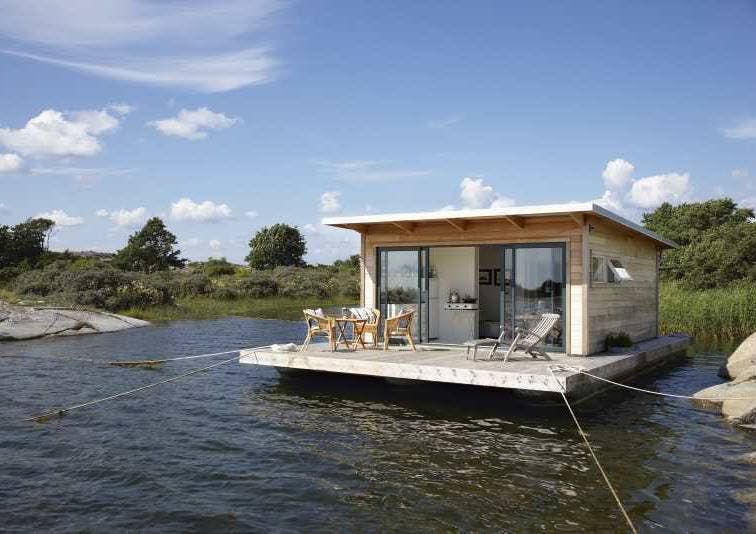
It’s been awhile since I have covered any cool floating homes. Remember Steph’s Floating Cottage. She is busy remodeling it and getting ready to really move in.
This week I discovered this cool little Swedish retreat thanks to materialicious. This floating retreat is located somewhere in the Swedish Archipelago, where it is off the grid and a long ways from anywhere. It has an outboard motor on the back to move it around and flip up steering wheel on the roof.
I like the simplicity of the design. It makes you think that just about anyone could build a basic structure like this. The interior is finished off with white painted boards and cabinets which makes the space seem larger than it is. I don’t know the exact size as the website is all in Swedish. Go to Sköna hem to get the details. If you can translate the site and pass on everything to me I would really appreciate it.
If you are interested in creating your own floating home you might want to check out the book Handmade Houseboats: Independent Living Afloat
Also check out the Paycheck Shantys located at OneUglyBoat for more ideas of building your own floating retreat.
Here is a translation of the floating retreat:
John and his wife anchor their house in the outermost skerries every summer. A houseboat is the ultimate solution if you want to live like a multimillionaire, but have more ideas than money. Maybe not child-safe, but the cats really enjoy themselves.
By: Per Wennberg Text: Gisela Fridén Photo: John Carlson
Published: 2008-07-26
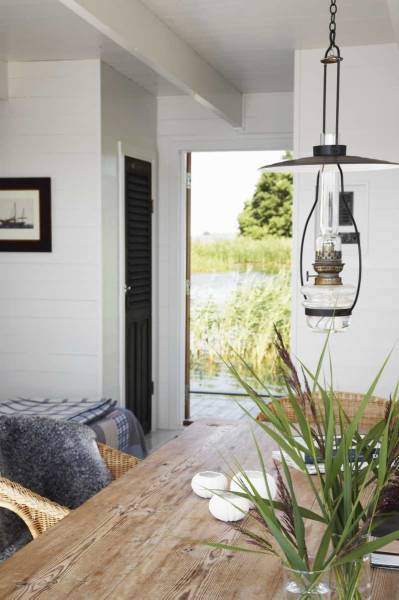
The dark brown jalousie doors has been taken from an old outdoor toilet. John found two identical doors in Nacka Architectural and put them opposite each other – one in the bathroom and the storeroom. The open door leads out to the rear deck.
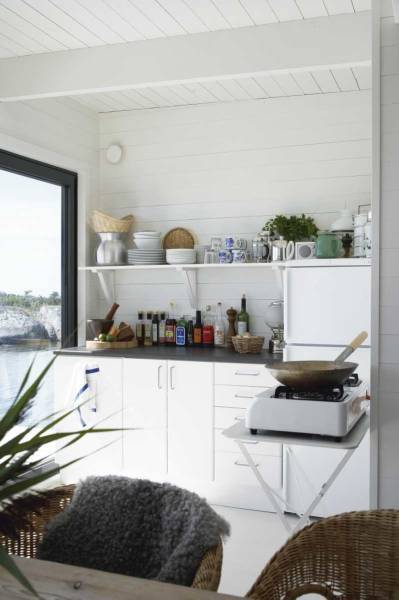
The kitchen interior consists of cabinets, shelf and plates from Ikea. Refrigerator & freezer supplied with electricity from solar cells, while the food – mostly Asian – is cooked on a small gas stove. A Thai rice cooker for sticky rice is well-used, placed by the TV on the shelf. China is Ikea, blue and white mugs from R.O.O.M. Green tea pot from Burma, and down on the bench a modernized oil lamp.
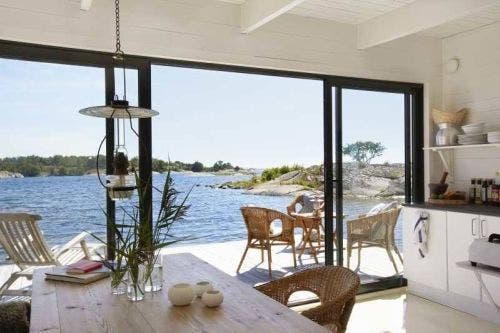
Old pine table with a view. Chairs are from Ikea and the kerosene lamp on the ceiling is newly manufactured, from Brass Master in Stockholm. Johan bought the sea urchin lamps on the table at Liberty’s in London. Out on the sun deck stands a folding table and a deck chair
in teak, easy to obtain anywhere. Kerosene lamp on deck is a storm lantern from the Nature Company.
The stern of the houseboat has an exit to the scullery and a mini spice garden. Just bend down and take the sea water in a bucket, warm it on the stove and wash the dishes in a tub of hot and cold. Washing place is bought at Heal’s in London. The outdoor storage space
has a window opening.
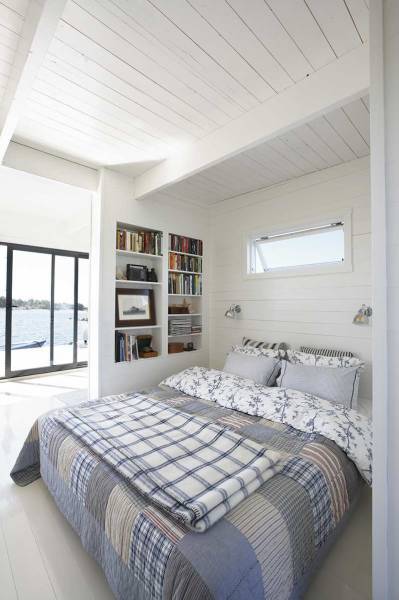
The kitchen and sleeping nook are separated by a small wall with recessed bookshelf. The bed is from Ikea, the sheets from Gant, the bedspread from Lexington and blanket from R.O.O.M. Danish cabin lights over the bed. The shelves have among other things, a Chinese rice paper painting from the 1800s. The motif is “houseboat.”
60 square meter houseboat (645 sq ft), including 20 on the sundeck. Almost all of the short side which faces the sea is glazed with sliding doors. In addition the houseboat has five smaller windows. When John and his wife “change the address” they go up the steps outside the kitchen corner, clamber up on the roof, fold up the wheelhouse and chug away.
The houseboat was built by carpenter Stefan Dillner,
tel: 08 718 48 48, Mobile: 0709-22 69 69
e-mail: specialsnickerier@telia.com
Photos: Johan Carlson

If you enjoyed this post, subscribe to our feed
This is cool. Nice and simple. I love the idea of being able to float around freely. Now imagine a PV array on the roof and that little outboard being an electric motor.
I tried using Google’s translation service on the URL with no luck but I was able to translate parts of the article with a copy and paste into their tool. Here’s what I found on size, “Barge 60 square meters, of which 20 on the sundeck.” …So 40 square meters interior space or 430 square feet.
looking at the inside, I wouldn’t think of it as being a floating house. Great design.
Beautiful. My mother knows some Swedish, so I will try to get more information from her. All I can really pick out is that most of their furniture is from IKEA, of course!
This place is definitely only for summer use. The Swedish Archipelago gets icy cold and very dark in the winter.
My mom (half Swedish) translated the article, here are the details:
Johan stays in the house every summer with his wife. Houseboat is the best solution if you want to live like a millionaire with more ideas than money. Not child safe, but the cats love it.
The kitchen is from IKEA and the appliances are run by solar cells. The furniture is from IKEA and travels to Asia.
In the back there is room for washing and an herb garden. It is 60 meters total. It can be parked on a lake or in an ocean inlet, and when they want to change their address, they start up the motor and move someplace else.
Christina thank you for having your mom do this. I think I will include some of this information above so people get the full picture.
awesome!
This is the coolest house I have seen…love it! Thanks for finding it. I have been looking to transition to a floating home from my recently sunken boat. I’m looking for “property” (basically waterfront access) off grid, any suggestions?
Just a small note – I didn’t see anything about the furniture being from Asia, just that they loved to cook Asian food. 😉
1. No mention of plumbing, bathroom, toilet, water treatment.
2. No mention of rules and regulations regarding boats, their licensing and safety requirements.
3. No mention of property rights of the people’s or public land you moor your house to.
Hi Peter,
Unfortunately, that information was not available through the article. Plus my lack of the Swedish language makes it difficult for me to contact the owner and answer these questions.
These questions would need to be answered if you are planning to live this lifestyle and you would need to know these regulations before you park your floating home. I’m glad you brought them up.
There are many sites on the internet dedicated to floating homes. The Tiny House Blog is demonstrating this as an option, but I do not claim to know all the answers in this area.
Kent
Hi Kent, you mention ‘One Ugly Boat’ at the top of the Post, and in another, that you have corresponded with the business owner, Harold. The business is now defunct and I am wondering if you could pass on his contact info?
Regards, Geoff
I am also looking for Harolds info, would love to drop him a line in regards to his expertise in boat canvas work!
Kent, Peter,
Just contact the owner in English if you have questions. Any Scandinavian will speak (and read/write) English quite well.
/Joseph
I live about 75% of the year in a float cabin on Powell Lake in Coastal BC. I have a blog where I tell a lot about float cabin living and how ours was constructed. You can go to http://PowellRiverBooks.blogspot.com and select “Float Cabin Living” or “Float Cabin Construction.”
I can answer peter’s questions at least from my experience.
1. We have an outhouse on shore but plan on getting an on-float composting toilet in the future. Gray water goes back into the lake so we are very careful about it. We wipe all dishes prior to washing with biodegradable soap. We also drink the lake water (after boiling).
2. Our cabin in on a lake in British Columbia. It is moored in a stationary location and we have a water lease from the government for 20 years at a time. We pay a lease fee each year along with property taxes on the assessed value of our cabin. Both are about $500 a year. There is currently a moratorium and no new cabins can be added for environmental safety. Because our cabin is not considered a boat there is no licensing. We carry property insurance just as if it was a land cabin.
3. We don’t have any property rights where we are located, but do have access to the land as long as we don’t cause any damage. The lease covers this land access and restrictions for its use.
We’ve had our float cabin since 2001. We stay there in winter, but the other owners are usually only summer occupants. — Margy
I love the house! My guess is his wife is from Northeasten Thailand, but just a guess based on their kitchen essentials.
That’s a really nice houseboat. I didn’t think you could have houseboats like that here in Sweden. I think there’s pretty strict regulations etc. with these kind of homes. You can always contact the carpenter who built the boat at specialsnickerier@telia.com if you have any questions.
Just amazing! Are there plans avaliable for this? This is one of best floating homes I’ve seen!
If you learn of plans availability, please let me know. Thanks
Great design!