Judith’s Pole Barn Cabin

by Kent Griswold on May 15th, 2013. 20 Comments

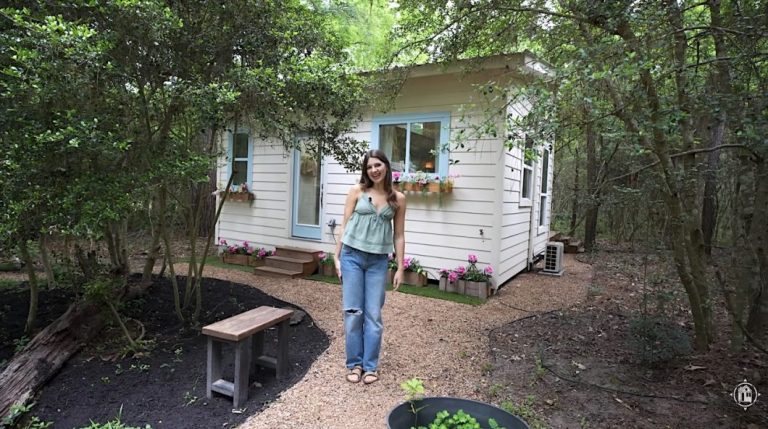
It is going to be my full time home as soon as I get the propane hooked up. Right now I live next door with my parents during the work week and at the cabin on the weekends, as my original farmhouse burnt down. This cabin is on my farm property. It is 10 x 12 with a 4 foot overhang porch. It is heated with a small woodstove and I have more than enough wood on my property.

front porch of cabin

The cabin is insulated inside and out with isoboard, and the siding is 12 inch rough lumber board and batten. The roof is metal and is insulated conventionally with battens.

The cabin was built in the pole barn fashion, not framed. I started it in September ‘11 and was putting the roof on in December. The hardest part was getting the framework square and it is not 100% square. The floor is a raised platform suspended from the poles, it is rough lumber with isoboard and vapour barrier over, and then plywood and clickflooring. The space under is gravel with a plastic barrier over it. Continue Reading »

Little House in Spokane

by Kent Griswold on April 2nd, 2013. 47 Comments

Here is our little house story in Spokane, Washington.

In the spring of 2006 I was walking through my neighborhood, as I had done so many times over the years and for some reason I really noticed this small, tired and neglected building with its Mission Revival architecture, very unusual for Spokane. As an Albuquerque, New Mexico transplant, I was automatically drawn to its style. It turned out the owner was a local contractor preparing to demo the building and construct a duplex. My partner, Val, and I made an offer and were soon the new owners of the North Hill Substation, built in 1930 as the local utility power distribution site with a mere 374 square feet and 13ft ceilings. We started ever so slowly, huddled in a corner with an electric heater, pen and paper and tried to wrap our heads around our vision for this great piece of history. It has evolved to what it is today affectionately called “The Little House.”

before renovation

One big obstacle to this adventure was learning to let go of all my stuff. As a dealer and collector of antiques I had a daunting task ahead of me! For 4 years with the help of eBay, Craig’s List, thrift store donations and the dump I was able to whittle things down. Two years ago I was ready to vacate my 1500Sqft apt and see if I could really be happy in one fifth of the space. I made due with a woodstove for heat. I also had a propane cook top and refrigerator I used previously for camping. I found not only was it do-able, but soon realized that less is truly more. After 13 years, Val and I decided to move in together into her house. But with 2600 sqft, 3 bathrooms and kids grown and moved away plans have changed once again. Together we are diligently working towards the “small move” back to the Little House. Continue Reading »

Dee Williams Lives Large in a Tiny Footprint

by Kent Griswold on March 27th, 2013. 15 Comments

By Alyse Nelson

How much house does it really take to be happy? Some people are taking a hard look at the question, and discovering that the answer is: not much.

These “tiny housers” are bucking the idea that “bigger is better.” Their homes, ranging from 800 square feet to less than 100 square feet—a far cry from the 1000 square feet per person that has become the North American norm—take many shapes and sizes. And the people who live in them are as diverse as the homes themselves. Some hope to save money on housing; others hope to “live green” by choosing a smaller space; some are trading living space for a neighborhood they love; and others want to live closer to family or friends.

Dee's house with class

Dee Williams talking to a group outside her tiny house

Photo by Flickr user irooshka

Dee Williams’s story starts with her questioning her lifestyle choices. After helping build a school in Guatemala and watching a close friend fight cancer, Williams reevaluated her priorities. “He was getting sicker and sicker, and I didn’t have the time or the money to really throw myself into helping him. I was spending a lot of time and money on my house. So the house was the easiest thing to try to get rid of,” Williams told Yes! Magazine.

“I started really wondering if the cost of owning a house, of maintaining a house, of remodeling my house, was really kind of socially what I wanted to be about. So I decided to bite the bullet and go for it!” Williams said in this video. So she sold her 1,500 square foot Portland home and built an 84-square foot tiny home for $10,000.

Her 8-foot by 15-foot home is parked in a friend’s backyard in Olympia, Washington. She helps out with household chores in exchange for the space and drinking water. She lives with just a few outfits and shoes, but also is mortgage-free. This has allowed Williams to work less and spend more time and money investing in giving back to her community.

Williams’s story has spread far; because she’s been featured in national news more than 20 million people have viewed (in person or via video) her tiny home. She received the 2008 Governor’s Award for Sustainable Practices in Washington State. Now she co-owns PAD—Portland Alternative Dwellings—a tiny house company that holds workshops to help future tiny housers get their start.

Dee showing her house

Dee Williams shows off her tiny house.

Photo by Flickr user irooshka

But the help tiny housers need most isn’t advice about building or living in a small space; it’s navigating the maze of regulations they’ll confront as they downsize.. Some cities set minimum size requirements for dwellings. Others say a recreational vehicle can’t count as an ADU, which is typically how a tiny house is categorized. This means “you can camp in your little house, but not live in it,” writes Williams. Williams helps other tiny housers navigate the regulatory barriers that come with tiny house living.

Through her activism—and her lifestyle—Williams is helping create a wave of interest in tiny homes that local governments cannot ignore for long. Williams proves that even if your house has a tiny footprint, you can still live large.

Bio: Alyse Nelson is an urban planner for a small town in Kitsap County, Washington. She is a Writing Fellow for Sightline Institute. This post is adapted from a full article published here:

The Stannexe

by Kent Griswold on March 21st, 2013. 13 Comments

by Benjamin Vine
rdp architects
Hastings, East Sussex, England

When our Octogenarian clients came to us in 2010 with the idea of converting a tired leaky small trapezoidal garage into an artist studio with accommodation we jumped at the chance. The brief was to take the existing unusable garage and create a self-contained, multi-role building that can be used for storage of general items at the front, as a bright artist’s studio and also as temporary accommodation for visiting family and guests.

garage

Located in the Ancient Seaside Town of Hastings, on the south coast of England we are used to dealing with tight sites and designing around listed buildings whilst maintaining sympathetic design, required for most of the town’s conservation areas but this was the first conversion of a garage. Being located in a conservation area we took great care to design the Stannexe [named by the Client, a combination of “Studio” and “Annexe”] to enhance the locality through the use of quality finishes whilst having an individual style.

plan

Despite strong opposition by the local Planning Department, permission was eventually gained for the Stannexe through Planning Appeal.

The Stannexe gets its unique form from the shape of the original garage, it was designed so that when viewed from the nearby street a passer-by would simply see a slate roof and gable end typical of many buildings in the vicinity. The act of maintaining this roof line along the side viewed from the street created the tall side and rear elevations that give the building such an individual character. Continue Reading »

Ben’s Tiny House

by Kent Griswold on March 19th, 2013. 47 Comments

(Fall 2011 – Summer 2012)

My name is Ben Norton. This is my tiny house story. A neighbor of mine was all excited about your blog and showed me lots of really cool tiny houses that people have built. I was hooked. I just said, “That’s what I’m going to do,” and I just started; buying materials as I had money. I don’t think anyone really thought I was serious because I was eleven years old at the time.

ben1

Growing up, my parents gave my brother and me skills that many kids don’t have. We worked on lots of different projects with real hammers, nails and wood. From an early age I was like a sponge and absorbed all I could about power tools, building, tree cutting, engine repair, and even asking the right people for advice and help. Continue Reading »

Warren’s Tiny House

by Kent Griswold on March 14th, 2013. 27 Comments

by Warren Wood

I acquired a half acre of land in Taos, NM in 1976. I bought a pickup truck full of reject 2×4′s from a lumber mill and culled out enough usable ones to frame out my 8×14 home. In those days, in that area, there were no worries about permits.

original home

I hauled water in 5 gallon jerry cans, used kerosene lanterns for light, and a tiny “tin lizzy” to keep the place warm in the winter. The kitchen sink had a 5 gallon bucket directly underneath to collect grey water, which I used to “water the sagebrush.” Being young and a product of the ’60′s, I lived contentedly like that for 4 years.

completed home

I then made some additions, transforming the cabin into a galley kitchen [with a heavy kerosene powered refrigerator]. I now slept in a low ceilinged loft, later came a bedroom and proper bath. Utilities had been installed by this time. The house is located at the far end of a dead end road and I still have a good amount of space surrounding the property. Continue Reading »