Better Built Portable Buildings

For anyone with vision, a few building skills and a great set of tools, several of these portable buildings by Dix Enterprises in Wichita, Kansas can become a personalized tiny house. Better Built Portable Storage Buildings by Dix are outdoor storage sheds, barns, garages, cabins and offices that are built onsite in Kansas and then delivered by truck. At that point they can be customized by the customer. Dix claims all of their portable barns, sheds, cabins and garages are built to hold up under heavy use and provide a lifetime of service. Most of the buildings are for storage, livestock and gardening, but three of their designs may make a great tiny house: the Lofted Porch, the Portable Casita and the Mini Cottage.

casita5

Continue Reading »

Rustic Island Log Cabin

Posted October 27th, 2009 by Kent Griswold and filed in Log Construction, Tiny House for Sale
Tags: , , , ,
8 Comments

Alice sent me this listing of a quaint little log cabin on an island in British Columbia, Canada. Built in 1986 this 241 square foot cabin with loft on a small piece of property and a very good price of $89,000 Canadian dollars is a dream cabin which I wouldn’t mind if I could make it my own.

If your dream is to live on an island do some research on Galiano Island in British Columbia. Below is the listing and a few more pictures.
cabin1

RUSTIC LOG CABIN WITH LOFT ON GALIANO ISLAND serviced with power and phone. The property is a small lot (plus or minus 0.1 acres). Located adjacent to Bluff Park. Court Ordered Sale (foreclosure). Separate small bath house with a shower, toilet, and sink serviced with water, and septic. Telus high speed internet is available at the property. To view the listing and more photos go here. Continue Reading »

Keith’s Tiny Log Cabin

Posted August 26th, 2009 by Kent Griswold and filed in Log Construction, Tiny House Concept, Your Story
Tags: , , , ,
1 Comment

Keith from Indiana sent me his story about his little log cabin that he built himself with no prior knowledge. Here is Keith’s story:

I built the cabin in 1990 with the help of a friend, both of us having zero prior knowledge or construction skills.

After reading three main books (Building a Log Cabin From Scratch by Ramsey, The Wilderness Cabin by Rutstrum and How to Build Your Home in the Woods by Angier) I decided the quickest and easiest would be a “trappers tilt” style, where the fat ends of the logs all put one way toward the front form the pitch for the roof as they go up higher.

cabin1

These were considered temporary in their day and were built directly on the ground, but I used concrete piers and mine has an insulated floor.

I had purchased the wooded land a year before (50 acres) for a bargain price in southern Indiana and spent the year ‘90 working every single weekend and any vacation time felling trees, clearing the space and taking bark of of cedars and jack pines.

It was under roof by October 1st and I’ve been using spare time since to finish out the inside when the mood strikes. The first four courses of logs are cedar with the remainder in jack pine. We used spray foam between the logs and then put PermaChink on top of that.

The roof is very low, anyone over 5 foot 9 has problems with the middle log rafter! Since I’m only 5 foot 6, I don’t worry about it. I had a shed roof on it but it started to deteriorate and about 9 years ago I put a galvanized steel roof over that. It’s never leaked and the only problem I have is mice once in a while.

The stove was the smallest I could find but it sweats you out pretty quick if a window is not left open. However, one occasion it was 30 below and it took nearly 4 hours for the place to get up to only 50 degrees, even the oil lamp fuel was frozen!

The floor is parquet oak over standard subfloor plywood. It’s a pretty cozy place as long as it’s just me or one additional person. Any more than that and it’s crowded! Storage is at a minimum, so we pack light.

We only used cedars (which are plentiful and grow like weeds) or man-planted jack pines and used every bit of them that we could. I also later built an outhouse by my self. No pictures of it, but it’s not much to look at, regular stick-style and has a 5 foot deep shaft. It was built before they changed the laws against them and is now grandfathered in. It’s located as to not interfere with any water source and we use hydrated lime when we visit. It has a steel roof as well. It never smells very bad, even in the summer.

My only regret is not putting a few more courses of logs or not simply making a 12/12 pitch roof with a sleeping/storage loft. But I was a lot younger and wasn’t thinking as long term as I should have. Now, at 50, I can see more clearly what should have been done. However, we were lucky to get it as finished as we did because it’s three hours away from where I live and very remote with no power or running water. Ask me how much I like tent camping – I still am not fond of it after doing it every weekend for nearly a year. And this is coming from a guy who used to love camping more than anything!

Here is an entertaining video Keith put together that shows the interior. Thanks Keith for sharing your story with us.

cabin2

plaster

by Kent Griswold (Tiny House Blog)

If you enjoyed this post, subscribe to our feed

Jalopy Cabins

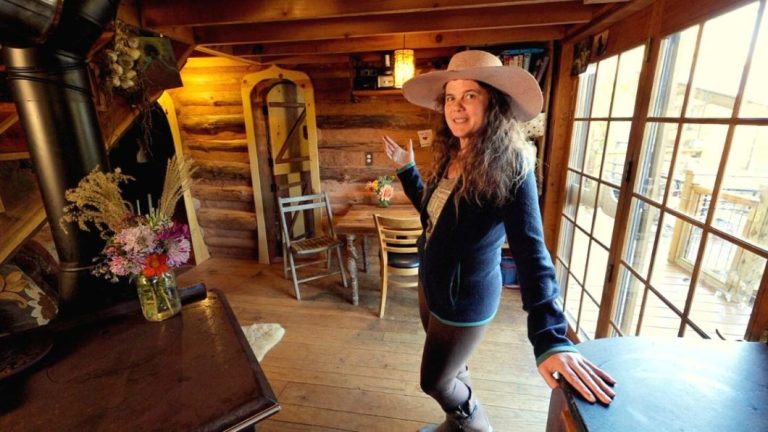
Lyle Congdon a graphic designer who runs her business, Wild Spirit Designs in Colorado is also stepping into the tiny house and cabin business and will soon be opening Jalopy Cabins. She contacted me the other day to tell me about this jalopy cabin.

Jalopy Cabins gets its name from the old jalopy truck pictured at the bottom of this article. Lyle has one completed cabin pictured here and it is for sale. Here is how Lyle describes it:

cabin4

This cabin is 140 square feet. We are asking $10K and can finish it out however someone may want.

I personally think it would make a great guest cabin or art studio/office as is. Currently wired with electricity, and does not have plumbing. We would consider selling it with some of the items in the picture (ie. wood stove, counter/storage).

We’ve moved it once before on a flat bed trailer so I feel pretty confident we could ship anywhere, will just be a matter of cost depending where the person lives. We are located in Southwestern Colorado (Pagosa Springs to be exact!) for a point of reference.

The Jalopy Cabins website is still being developed, if you are interested in getting more information you can email Lyle at info@jalopycabins.com.

Jalopy Cabin Kitchen/Desk

Jalopy Cabin Kitchen/Desk

Jalopy Cabin Stove

Jalopy Cabin Stove

Jalopy Cabin Bed

Jalopy Cabin Bed

Jalopy Cabin Deck

Jalopy Cabin Deck

The Jalopy the cabin is named after

The Jalopy the cabin is named after

If you enjoyed this post, subscribe to our feed

Pine Hollow Log Homes

Posted June 22nd, 2009 by Christina and filed in Log Construction
Tags: , , , , ,
3 Comments

On my road trip to the Grand Canyon and Zion National Park, I had to stop and take some photos of this darling little log home just outside of Cedar City, Utah. The Mini Pine Hollow log home by Pine Hollow Log Homes is 11 by 16 feet with a full loft and a 4 by 16 foot covered deck.

Pine Hollow offers this tiny cabin as a kit and will deliver it within 250 miles of Cedar City. It takes about two weeks to have a kit delivered. This particular home was unfinished inside, but the Pine Hollow website should have updated photos of the Mini log home soon.

pinehollow-front

pinehollow-front2

The Basic Package includes:

  • Blueprints
  • Treated skids
  • Floor framing
  • 6″ starter/finish logs
  • 6″ wall logs, gable ends
  • 8″ oly screws/construction adhesive
  • Calking for windows and doors
  • Loft floor joists
  • 2×6 rough sawn window/door bucking
  • Windows and door
  • Deck framing
  • Roof framing with OSB sheathing
  • Porch posts
  • Porch framing with OSB sheathing
  • Milled 3×2 handrail
  • Dormer framing with 1×6 tongue and groove siding

Cost: $8,781.00 (plus 6% Utah sales tax)

The Deluxe Package includes:

  • All of the above items
  • 1×6″ tongue and groove soffit
  • Batt insulation
  • 1×6″ tongue and groove ceiling
  • 2×6″ tongue and groove loft floor
  • 1×6″ tongue and groove porch sheathing
  • Tar paper
  • Steel roof, trims, flashing and screws

Cost: $10,865.00 (plus 6% Utah sales tax)

Pine Hollow offers other log home kits, most around 1,000-2,000 square feet.

By Christina Nellemann

pinehollow-side

pinehollow-roof

If you enjoyed this post, subscribe to our feed

Forest Classics Portable Cabins

Posted June 4th, 2009 by Kent Griswold and filed in Log Construction, Tiny House Concept
5 Comments

As many of you know I am a big fan of the old fashioned log construction. My dream for years was to have a log cabin in the woods. I just discovered a company in Colorado who just might make it possible and I wanted to share it with those who have a similar dream.

Forest Classics Log Homess portable cabins are the perfect addition to any property. Easily place these cabins anywhere you want-usually with no building permit required. Our portable cabins are real, hand-crafted log homes mounted on a permanent trailer frame. Starting at just $12,000 and up.

dsc00947_sm

Here at Forest Classics Ltd., we understand building small and portable. We originally built our little cabin as a “show cabin” to take to Expo’s and Home/Living shows to demonstrate and promote our custom homes and craftsmanship. As it turns out this little portable cabin turned into quite a “hit.”

Since Forest Classics Ltd is a completely custom builder, we do not have any other “models” or plans.  However we do have several clients that we are helping to design their own little cabins. If you have an idea that you drew on a napkin, we can take it from there.

This particular cabin is an 8 ½ x 20 170 square foot with a 8 ½ x 4 ft covered deck, Dovetail Style Full Log, hand hewn, with an Adze finish. The ceiling is Aspen T&G, the door & windows are Sierra Pacific and the flooring is a beautiful Hickory. Since this one was built for show it does not have any plumbing or heating, however it is wired for electricity. This size of a cabin is perfect for any size lot.

The weight of the cabin is approximately 10,000 pounds.  Our custom cabins can be made lighter if needed.

As far as the chinking is concerned we use and are a provider of Sashco Products. This is a high quality acrylic rubber variant that is made to look like cement. This life time product is very flexible and durable. The Cabin is held together by structural notches.

Please view more of our beautiful projects on our website: Forest Classics Log Homes. If you have any questions or just would like more information please contact: Brandon Horner, President or Matthew Boisen, Construction Manager.

19911 Hwy 550 S
Montrose, CO  81403
970-249-8678

Portable Cabin Construction

Portable Cabin Construction

Completed Portable Cabin

Completed Portable Cabin

Interior Portable Cabin - more photos coming soon!

Interior Portable Cabin - more photos coming soon!

Portable Cabin at the Show

Portable Cabin at the Show

At the Show Entrance to Cabin

At the Show Entrance to Cabin

If you enjoyed this post, subscribe to our feed

Alaskan Log Cabin

Posted April 6th, 2009 by Christina and filed in Construction Articles, Log Construction, Tiny House Concept
Tags: , , , ,
5 Comments

Aaron and Jill Bork have done what many of us dream of, running off to the wilds of Alaska and building a log cabin.

The couple fell in love with each other and the state and decided to build their own home. Armed with only a book and no prior knowledge of log cabin building, they purchased five acres of land with a spectacular view in their favorite area of Alaska and began to build a log cabin by hand with trees from their property. They built the cabin over the course of one summer, and spent the next year finishing up the inside.

aaron_i_cabin

hpim3351

Just about everything in the cabin came from the land: the countertops were built with rocks from a local creek, the deck from local saplings, the spiral staircase going to the loft is made of local timber and even the toilet seat is made of a tree trunk.

In order to simplify their lives and live in the area they loved so much, they decided to do without some of the luxuries. They built an outhouse, do their laundry in a Wonderwash, and warm the cabin with a donated woodstove. They don’t have running water and use a cooler and dry ice to keep their food cold. They also cook on a Coleman stove and use a generator for their electricity.

concretework

The cabin is furnished with furniture the couple built themselves and decorated with found objects. They own a small company called Alaska Antler Works where they create furniture and home accessories out of antlers.

This beautiful, hand crafted home is an impressive example of what can be done with determination, a few friends and love and knowledge of the outdoors.

hpim3386

kitchen

hpim3509

scrubbing

hpim4123

hpim3322

outside_outhouse

By Christina Nellemann

Photos by Aaron and Jill Bork, Alaska Antler Works

If you enjoyed this post, subscribe to our feed

Old Place Cabin

Posted March 10th, 2009 by Kent Griswold and filed in Log Construction
Tags: ,
13 Comments

One of my own dreams was to have a log cabin in the mountains, for me the dream has not been fulfilled but for David Harell from Mississippi his dream has become a reality.

David originally alerted me in a comment that he was building his cabin and had started a blog to follow the process. Thinking I would let him get a good start, I waited to write a post on his progress. Now David has the cabin completed and I am finally telling you about it. Thanks for your patience, David. Here is the link to his Old Cabin Place Blog and following are some pictures and a few comments to explain his experience.

march_snow-4

The cabin is located in Northeast Mississippi, on the edge of the Holly Springs National Forest which is abundant with wildlife and other natural resources. The cabin is 12′x24′  and is located in the woods and was built by David and his friend Casey Cappleman.

december_logs-0

Another great Saturday for log building, Got the cable for the hoist raised up high enough probably to finish the walls now. We peeled three logs, placed two of them.

top_of_walls-1

Saturday we woke up to about 2-3 inches of snow on the ground! Although it didn’t last all day, it was really nice to see it all white outside. We went out an installed the cedar rails we made this week in the shop.

rafters-7

roof_finished-0

We were able to install the remainder of the tin on the roof Saturday, a wonderful accomplishment that will keep our work safe and dry from now on!

window_and_water_tank-1

ambers_cam-4

counters-0

This is the story of a kitchen. Once upon a time there was a lonely bare spot in the corner of a cabin, far, far away in the deep woods. Within the course of one week, however, this lonely bare spot was magically transformed into a functional, usable kitchen. The cabinets are made from cedar slabs (leftovers from the sawmill). It provides a very rustic look.

ambers_cam-3

ambers_cam-1

If you enjoyed this post, subscribe to our feed

Sing Log Cabin

Posted January 1st, 2009 by Kent Griswold and filed in Log Construction
Tags: , ,
3 Comments

In an earlier post we looked at the SingRV, their portable tiny home. In this post I want to show you Sing’s Log Cabin. Sing logs are made with Patented Sing honeycomb core for insulation that provides a warm, natural, comfortable and energy efficient home.

Sing has two type of logs, the Sing Square Log and the Sing Eco Log. The Sing Square Log wall has eight-inch thick wall with 3 inch insulated Sing Honeycomb sandwiched between two pieces vertical grain heavy plank cedar or Fir it is the most straight hi precision log ever made in log home history.

Sing Log Cabin

Sing Log Cabin

The Sing Eco-Log is made of a patented 3 inch thick urethane honeycomb core sandwiched between kiln dried cedar or Douglas fir double Tongue and Grove heavy plank. It is the most dimensionally stable, insulated, lightweight log ever designed at low cost.

With Sing Eco-Log you get a log-home feel at a lesser price with the same easy to build building system as the original Sing log.

To learn more visit the Sing Log Home site and visit their gallery and learn all details of this construction alternative.

Sing Logs

Sing Logs

Log Construction

Log Construction

Walls and Roof

Walls and Roof

Almost Completed

Almost Completed

If you enjoyed this post, subscribe to our feed

UK Log Cabins

Posted November 10th, 2008 by Christina and filed in Log Construction, Stick Built, Tiny House Concept
Tags: , , ,
2 Comments

For our friends across the pond and for ideas for the rest of us, I found this website for Tay Log Cabins in Scotland that sells and builds small Finnish pine cabins. Most of these cabins are meant to be used for camping or as an income generating property, but I can see myself living in one of these pretty cabins. Tay Log Buildings are made from the very best slow growing Finnish pine from the forests of North Karelia, Finland.

The Hobbit

These cabins are another example of when you build smaller, you can build with beautiful details. The Hobbit cabin with the use of reclaimed tree stumps and branches really fits in with the surrounding area.

Tay Log Cabins offer:

  • Custom made cabins from wood so any design can be achieved
  • Planed logs (95mm x 120mm) which can be assembled in standard designs measuring – 3m x 3m or 4m x 4m
  • Precision manufacturing for ease of building and come complete with all wooden components and shingle roof
  • Free design service

Most of these homes can be built for between £13,000 and £35,000 or $20,000 and $55,000.

By Christina Nellemann

Also in the UK is the Log Cabin and Offices Company which builds cabins out of Baltic timber from managed and sustainable forests. Their cabins can be used for summer houses, fishing lodges, garden buildings or offices.

All the cabins are available as supply only, supply and erect, or as a fully finished “Turn Key” project.

If you enjoyed this post, subscribe to our feed