Unique Houseboat on Ebay
Jared alerted me to this unique find on Ebay at 5:00 A.M. this morning. Tiny houses and floating homes are a passion of mine and this one a real find.
If you are in the Portland, Oregon area I would run down and check this out right away as I am sure it will go fast. I am in the process of duplicating the Ebay ad as I know it will go away in a few days and I want this available for all to see for a long time. At a Buy Now price of $28,900 it can be yours today.


I am also trying to get in touch with the owner to see if plans are available for those who might want to build one themselves. This is a long post so hit the more link below. Here are the details:
You are bidding on a 28-foot long, steel-hulled, river barge boat. If you are considering a small houseboat or floating home for a retreat on the water, this might be a perfect alternative. It could be the perfect bachelor’s pad, artist’s or writer’s studio, weekend or vacation spot, or whatever you would like it to be! It could be a great liveaboard situation for a single person, who is also handy in finishing up some undone work.
This is NOT a fixer. Just not quite finished yet. Pride of ownership shows!
Unofficially named the “Gypsy Ark”, but the name is nowhere printed on the hull or siding, so you could rename it easily. (It is only painted on one horseshoe lifering) Continue Reading »
Tiny Houses on Tiny Islands
In celebration of Canada Day and the 4th of July, I thought I would do a post on the tiny houses of the Thousand Islands, which is the name of an archipelago of islands that straddle the U.S.-Canada border in the Saint Lawrence River as it emerges from the northeast corner of Lake Ontario.
Many of these islands house small castles and large estates, but it seems the most admired of these islands are the tiny islands which have their own tiny houses…and not much else!
The islands, which number 1,793 in all, range in size from over 40 square miles (100 km2) to smaller islands occupied by a single residence, to even smaller uninhabited outcroppings of rocks that are home to migratory waterfowl. This area is very popular among vacationers, campers, and boaters, and is often referred to as the “fresh water boating capital of the world”.
Photo by Don Beck
The smallest of the inhabited islands is called ”Just Room Enough” and only when the water level is low enough is there room for the outdoor furniture to be put out.
Because of the beauty of the area and the romantic aspect of living on your own rock, these cottages are highly coveted and can run into quite a bit of money. However, many of these tiny homes and cottages can be rented for vacations. And most of them can be viewed while sailing the St. Lawrence.
If you enjoyed this post, subscribe to our feed
Houseboat for Sale
Chris over at Small Footprint Living is selling his houseboat. Here is what he has to say about it:
Here is your chance to own a cute little water getaway and finish it the way you want it. I have $5,000 in it so the price is firm. I was hoping to finish it this summer but time will not allow it. The boat is 70% complete. Hull is glass over wood and fully bottom painted, the sides are partially painted. Interior is framed and ready for paneling and finish work. It would take a flatbed trailer to haul it off. Specs can be found here http://glen-l.com/designs/hankinson/waterlodge.html

Go visit Small Footprint Living if you are interested in this neat little houseboat.

If you enjoyed this post, subscribe to our feed
Millie Hill Floating Getaway
Ok, I know this blog should be called the Tiny House Blog and the Tiny Floating House Blog. I am enthralled with both and when ever I see a new or exciting floating home or getaway I want to share it with everyone.
This one also comes from Chris from Small Footprint Living and it is similar to some of the previous posts I have done on tiny houseboats or floating homes. This is Devlin’s, Millie Hill version 2 and you can view more pictures of the construction and read more about it at the Devlin Boat website.
Here is a little of what Devlin has to say about the Millie Hill:
Have you always wanted a waterfront getaway but couldn’t afford the luxury? This cozy retreat is our answer to the problem. Winter, spring, summer or fall imagine yourself anchored in some beautiful backwater in this little vessel. Equipped with a wood cook stove and galley you can catch or bring in the ocean’s bounty or something from Safeway.
She sleeps four with the settees converting into double berths. The head has a shower and private entrance with a wet hanging locker. There is a dry locker closet near the front deck area. The galley has full standing headroom with comfortable sitting headroom in the settee area for reading, writing or card-playing. The front deck has screening for ventilation in the summer and canvas awning for covered dry storage while on board. The Millie Hill has a 10 hp Yamaha hi-thrust outboard, she powers at what I would guess is 5 knots top speed.
Plans for Millie Hill are available at the Devlin Store for $100. This just might be the floating getaway you have been looking for.
If you enjoyed this post, subscribe to our feed
Flagler Houseboats
Chris from Small Footprint Living shared this site with me and I thought all you floating home enthusiasts would appreciate this small floating home.
Flagler Bridge Boatworks and Marina in Flagler Beach, Florida, hired Sponberg Yacht Design in 2005 to develop a series of houseboat designs for their marina.
The Prototype Flagler Houseboat has rounded corners and an arched roof, which will be optional on future models.
The prototypes shown in the first series of photographs were built on plywood and fiberglass barges, and a newer model has been developed for a molded fiberglass boat hull.
The Flagler Houseboats shown here are in two sizes: Small, 16’ x 40’ or 16′ x 44′, with about 550 sq. ft. of interior living area on one level; and Medium, 20′ x 40′, 20′ x 44′, and 20′ x 48′, with about 1,400 sq. ft. of interior living area on two levels.
Each living unit is built on a rectilinear plywood and fiberglass hull that is subdivided into several watertight compartments.
While the curved corners and curved roof are quite attractive, they are more expensive to build than square corners and roofs. These features are not included in the standard designs, but an owner may request them for a correspondingly adjusted price.
Each houseboat has complete electrical and water services. There are shore power connections for electricity, television, telephone, and the Internet. To read all the details go to the Flagler site.
Photo Credit: Flagler Houseboats
If you enjoyed this post, subscribe to our feed
Narrowboats
The United Kingdom is a land of canals and waterways, and narrowboats are right at home on these placid waters.
The “narrow boat” refers to the original working boats built in the 18th, 19th, and 20th centuries for carrying goods on the narrow canals. The term is extended to modern “narrowboats” used for recreation and occasionally as homes.
The key distinguishing feature of a narrowboat is its width: it must be no more than 7 feet (2.13 m) wide to navigate the narrow canals. Modern boats are usually 6 ft 10 in (2.08 m) wide to guarantee easy passage everywhere. Because of their slenderness, some narrowboats seem very long. The maximum length is about 72 feet (about 22m), the length of the locks on the narrow canals. However, modern narrowboats tend to be shorter than this, so that they can cruise anywhere on the connected network of British canals.
Modern narrowboats are used for annual holidays, weekend breaks or as permanent residences. Usually, they have steel hulls and a steel superstructure, but they can also be made of fiberglass or timber. They are usually powered by modern diesel engines. There will be at least 6 feet (1.8 m) of internal headroom, and similar domestic facilities as a small landward home: central heating, flush toilets, shower or even bath, four burner stove, oven, grill, microwave oven, refrigerator, satellite television and mobile phones. Externally, many narrowboat owners will brighten up the linear shape with bright paint, designs or crests.
They can be owned by individuals or groups, rented out by travelers, or used as cruising hotels. A few boats are lived on permanently, either based in one place (though long-term moorings for residential narrowboats are currently very difficult to find) or continuously moving around the network (perhaps with a fixed location for the coldest months, when many stretches of canal are closed by repair works or “stoppages”).
On most narrowboats steering is by tiller, and the steerer stands at the stern of the boat, aft of where a person emerges from the hatchway and rear doors at the top of the steps up from the cabin. The roof of the narrowboat is usually used for lounging or storage space.
Just like anything that is in or near the water, upkeep is constant. Many narrowboat owners need to be familiar with engine and hull repair. Also, because of the small size and it being a floating home, clutter and excess stuff has no place on a narrowboat. In fact, there is quite a funny video about a very messy narrowboat and how the ladies from How Clean is Your House? make it shipshape.
We would love to hear from our readers in the UK about their experiences with narrowboats, if you live on one, even better!
Our Day on the Narrowboat Charlie
National Association of Boat Owners-UK
If you enjoyed this post, subscribe to our feed
Aqua Casa Houseboat
Aqua Casa Houseboat, The Boat of Your Dreams!
In an earlier post we featured the berkeley-engineering’s Cape Codder and I have been wanting to feature another one of their tiny house boats the Aqua Casa.
The Aqua Casa Houseboat is the result of years of boat design and building experience. These boats can be built by the amateur builder with little or no boat-building experience.
The are fully trailerable. This boat can double as a self-contained travel trailer, which you can use for any purpose, whether it is a weekend getaway or an extended trip on the road. The Aqua Casas are easy to transport anywhere that you can take your tow vehicle. You can camp in a campground or sleep on the lake! This boat gives you great versatility!
You will find a complete galley, a bright and airy cabin, full headroom, plenty of storage and storage space, complete with RV appliances, a private enclosed head, a fold-out bed, and inside or outside helm.
The Aqua Casa houseboat comes in a 16 foot model or a 20 foot model. Photos are of the 16 foot. There is a scan below of the spec sheet for the 20 foot Aqua Casa houseboat.
These houseboats easily carry 2-6 people. They can be outfitted with a 3 to 30 HP outboard motor. These boats cost about $3,500 to build, excluding motor, trailer and controls.
The Aqua Casa 20 is a larger version of the 16 foot boat. It has more spacious cabin room, and all of the features of the 16 foot version. The controls are also accessible from inside or outside the cabin. The 20 foot boat has room for a small dinette set.
To learn more go to berkley-engineering.com
If you enjoyed this post, subscribe to our feed
Float Cabin Moving Day
One of the most frequent questions I get about our float cabin on Powell Lake in Coastal BC is, “Does it move?
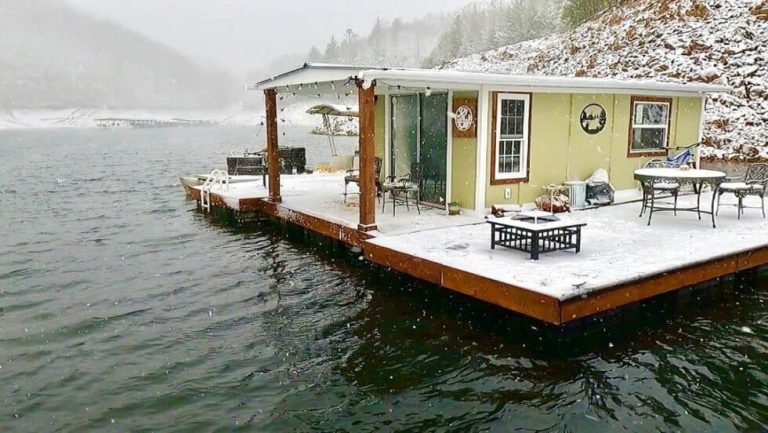
I’m sure that’s because the closest thing most people are familiar with is a houseboat. We have a few here on Powell Lake, but a float cabin is permanently anchored to the shore. In the case of Powell Lake, there are about 200 cabins on Crown water lots leased from the BC government. Fortunately we have a big lake, so it isn’t crowded.
Now that I’ve told you that the float cabins are permanently anchored in place, maybe I should say semi-permanently. On rare occasions a cabin needs to be moved. As you can imagine, moving day up the lake is a big deal.
Cabins are often remodeled at the Shinglemill Marina at the lower end of the lake. To do this, the cabin is towed down and moored outside the marina’s log breakwater. This makes construction much easier since our lake sites are water access only. When renovations are done, it’s moving day.
You don’t see it very often, but recently we were involved with a moving day when our friend sold a cabin and moved it to a different site. Even though a cabin with its float is very large and heavy, it can be easily moved with a small boat. It’s best to go early in the morning when the lake is calm. Travel is slow, so you will see people having BBQs and picnics aboard along the way.
After the cabin is in its new location, it’s reattached to the shore. A log boom is then moved into position for added protection from wave action. Now the cabin’s new owners, Margaret and Art, can enjoy their new floating home away from home.
For more information about float cabin living, you can refer to previous posts here on the Tiny House Blog. You can also visit my blog at http://PowellRiverbooks.blogspot.com or read Up the Lake and Farther Up the Lake by my husband, Wayne J. Lutz. Both books have lots of information about life in an off the grid cabin. Ordering information for the books and Kindle formats is available at www.PowellRiverBooks.com.
By Margy Lutz, Powell River, BC
If you enjoyed this post, subscribe to our feed
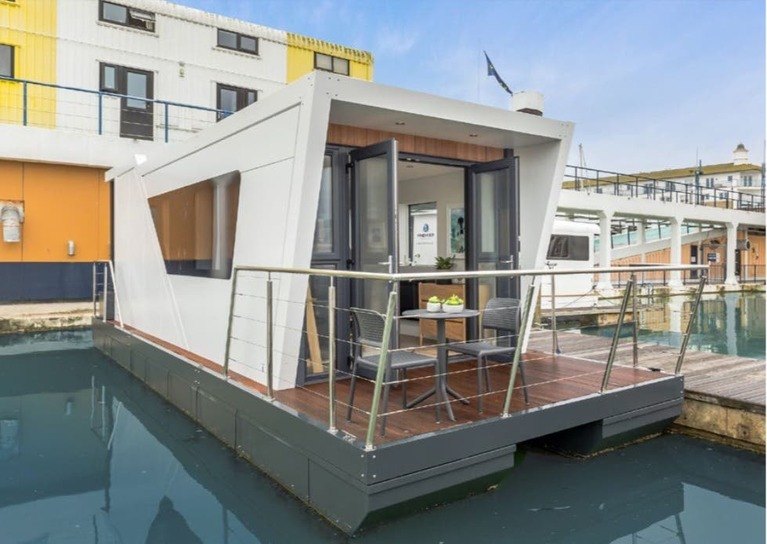
Floating Pods
About a week ago we covered the Green Pod company based in Washington. For you floating home enthusiasts, myself included, you will be excited to know that they also offer floating homes, based from their pods. You can view the previous post here.
Greenpod has joint ventured with P & T Fabrications, Inc., the purveyors of nautical homes to produce these fine quality floating homes.

Greenpod started on a simple idea: to offer a new type of affordable and sustainable home, respectful of the environment and incorporating the works of local craftsmen. Pods are built using conventional construction methods and can be financed with a conventional home loan.
Floating pods range in size from 300 to 800 square feet.
To experience a green pod in person, stop their showroom at 236 Taylor Street, Port Townsend, WA, 98368. To learn more go to the GreenPod website.
If you enjoyed this post, subscribe to our feed
Cape Codder the Ultimate Tiny Floating Home
If you are looking for the perfect tiny floating home, take a look at berkeley-engineering’s Cape Codder. Built with a 10 foot beam and either 20 or 24 foot length this cool little home is neat to look at and very practical and easy to build.
The Cape Codder is the result of many requests for a liveaboard/cruising houseboat. The Cape Codder makes it possible to have you own private waterfront home.

The Cape Codder is a home. It has a couch and end tables, a diningroom set, a complete galley and a head with a shower and toilet! There is plenty of cupboard and drawer space. The inside ladder leads up to the sleeping loft, which has room for full sized mattresses and more storage space. The forward wall opens up to enjoy your own private sundeck. A roof skylight lets you sleep under the stars.
Plans are available for the Cape Codder for $225 and you can buy them at the berkely-engineering site. Click on the Order Here link. Berkely-Engineering also makes a smaller trailerable houseboat called the Aqua Casa. I will feature this tiny floating home in another post.

Cape Codder Rear View

Cape Codder Open From Dock

Back Door

Living Room

Dining Room and Kitchen

Upstairs Bedroom

If you enjoyed this post, subscribe to our feed