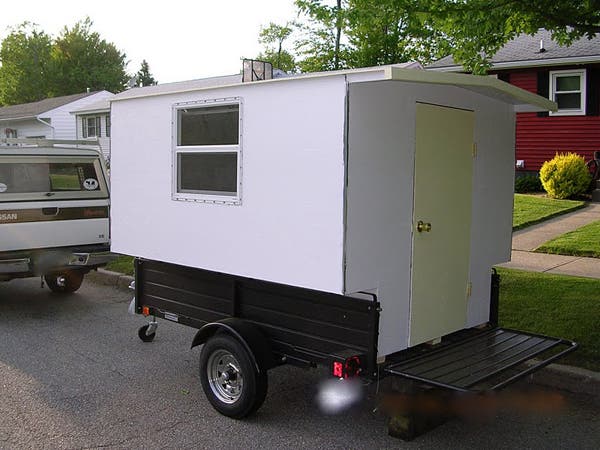
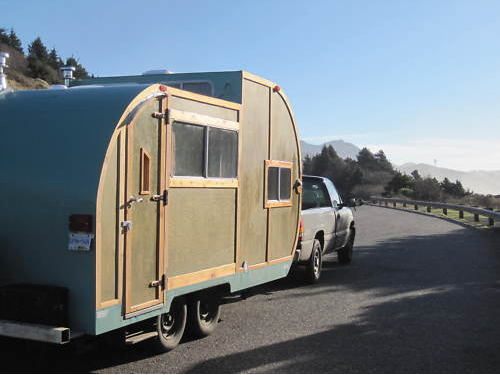
How-To determine trailer weight for your Tiny House

Perhaps there is no Tiny House subject (or trailer subject, in general) that causes more arguments and confusion than that of weight. Between the cryptic way that RV weights are reported by the manufacturers, the lack of clear standards by the DOT and the often deliberate misinformation spread by dealers; trailer weights are confusing at best. Because of our recent trailer purchase I have been motivated to try and really understand this often mystifying issue. The following is what I learned, and in my humble opinion, an authoritative explanation of what the truth really is.

Now, our trailer got its beginning as an RV, of sorts. So much of my research has a travel trailer/RV bend to it. If you purchase a trailer from a specific trailer/hauler dealer they should be able to give you specific weights for the axels, trailer, tongue, and hitch. If not, immediately turn around and go see someone else. For our purposes though, I am going to walk you through our process (and one that is becoming more popular with each small home.)

Let’s start with the 2 stickers that are required by law on every RV sold in America. The RV manufacturer is required to include a Weight Sticker on the RV that details all the important weight ratings and maximums. This sticker is usually located on the inside of one of the kitchen cabinet doors. If your trailer has no camper portion (let alone cabinets or cabinet doors) you can simply forego this step and hope the other steps lead you to the same result.

Read more

How-To sandblast a trailer

Crystal has some serious focusBecause we bought our trailer used and it was formerly a 1981 (camping) travel trailer it had some signs of wear and tear; namely rust. Structurally it is as sound as the day it rolled off the assembly line. But because it spent some time on the east coast the salinity of the air made it prematurely age and the paint/primer at some point gave way to rust spots and “age spots.” Luckily we own both an air compressor and a sandblaster – the very tools needed to prepare the trailer for primer.

Sandblasting is a general term used to describe the act of propelling very fine bits of material (play sand in this case) at high-velocity to clean a surface. A sandblasting setup usually consists of three different parts: the abrasive itself, an air compressor (seen below), and a blaster nozzle. By launching small bits of abrasive at the surface at a high speed, all imperfections are knocked loose and can then be easily washed off, creating an incredibly smooth surface upon which to lay the new layer of paint. Before we can do that though (which will come much later, I imagine) we need to prime. Why? Primer spray (in this case we used Krylon grey primer) stops rust and prevents corrosion.

Read more

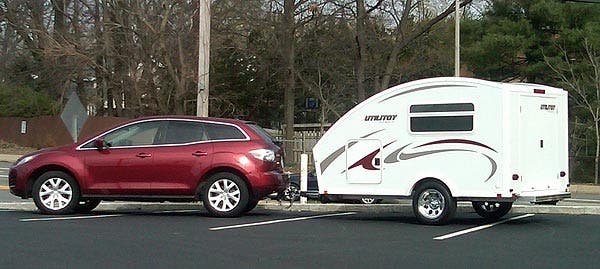
Utilitoy Trailer

With gas prices so high these days and not likely to go down anytime soon. The idea of towing your vacation home down the road may soon be a thing of the past. Like the Utilitoy site says, if you want to vacation in your home, than camp in your home, if you want an adventure go in a Utilitoy.

Though not a tiny house the Utilitoy would make a great extra bedroom for a tiny house or hop in your small car and attach it and go on a vacation to the beach, or the woods, or mountains.

The Utilitoy is made to be ultra lightweight and is very versatile and practical. It is designed to fit into a standard garage for easy storage and unlike most teardrops will easily sleep a family of four. It also can be used as a utility trailer, so you can haul around kayaks, mountain bikes, lumber or furniture. It can be cleaned out with a garden hose. At a base weight of only 962 pounds it really is a light trailer.

Read more

Living in My Extreme Tiny House

Peter has been living in an extreme tiny house, the size is 4′ x 7′ which measures out to 28 square feet. Peter recently started a blog and goes into the details of living this small and I am going let Peter tell you a what it is like to … Read more

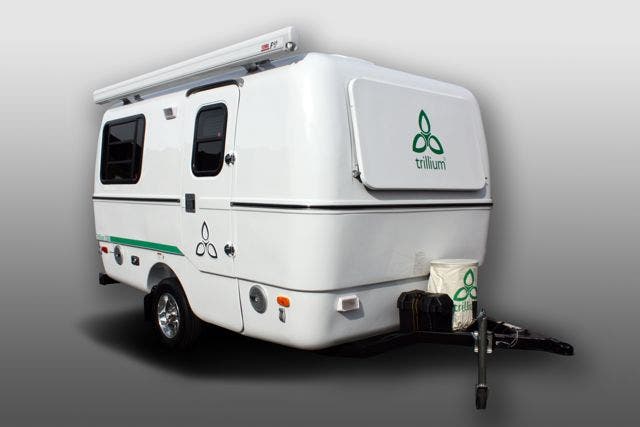
Trillium RV 1500

Last year I wrote about the re-emergence of the Trillium 1300 travel trailer. The brand has recently expanded with the introduction of the Trillium 1500. This trailer is different than the 1300 in that it has two extra feet added to the middle, larger counter space and a larger dinette which converts into a bed. Four floorplans are available for both the 1300 and the 1500 including a corner restroom and a restroom/shower floorplan.

The Trillium is unique to the fiberglass trailer market in that the company bonds all fiberglass components, uses no wood in the structure, uses closed cell foam ceiling and wall insulation, provides upscale, contemporary interiors and builds each unit to the owner’s specifications. The stylish interior of these trailers is what attracted my attention.

Read more