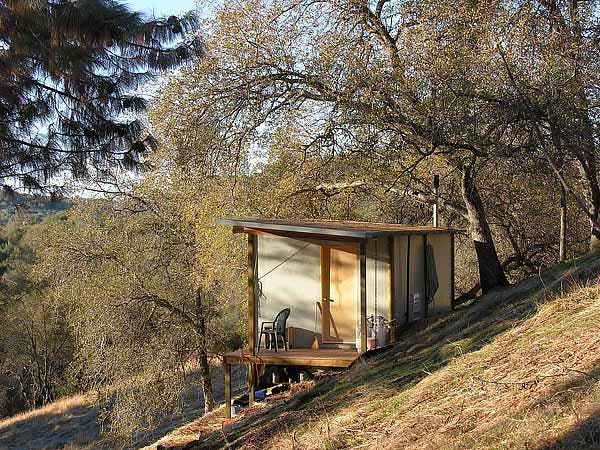
Paul’s Tiny House in the Woods

Guest post by Paul Mittig

I built my 10 x 20 house in 2005 for about $10,000 in materials, including all furnishings. It is built on six poles set two feet into the ground, that support the floor and roof. There is no framing in the walls except at the door and the large window. The walls are rigid foam insulation, R21, covered with ½ inch sheetrock and all glued together. The ceiling has R38 fiberglass insulation, and the floor has R19 fiberglass insulation. I spend about $100 a year on propane for heating, cooking, and water heating.
The house is located in the hills of Northern California. I live in it full time. The house is set up for one person, but you could easily put a double bed by the door where the tall bookcase stands. If you did this you might want to move the window.

Read more

Build Your Own Tiny House in Los Angeles

Hi, I’m about to begin construction on a tiny house and I’m hoping to find someone in the Los Angeles area who wants a chance to build their own tiny house at reduced cost, and, if needed, to have someone (me) to team up with, lend each other a hand, … Read more

Arogel Insulation in a Tiny House?

Erik sent me an email asking if anyone had considered Arogel insulation for a tiny house? I personally had not heard of it before so with Eriks help did a little investigation. If you are not familiar with it I’ll give you a small overview and than you can decide if this might be an option when you build your own tiny house.

Here is a brief description: Nicknamed “frozen smoke,” aerogel is extremely lightweight material, with a density only 3 times that of air. Only a small fraction of a volume of aerogel is the material itself. Most of the volume is filled with air. This makes aerogel an excellent insulator. (Aerogel provides nearly 40 times the insulation of fiberglass insulation.)

It is very expensive so has not made a big move into the building industry. NASA and other high tech companies have used it extensively up to this point.

A company called Themoblock is one company trying to bring it to main stream construction. Thermablok material is available both in sealed strips for stud insulation, and in bulk roll form.

Thermablok’s thin 1/4″ (6.35mm) profile allows it to fit between framing and sheathing without altering standard construction. It is applied in strips with a peel-and-stick adhesive backing or staples. It can be customized to fit on headers, rim joists, corners, rafters, window flashing and other hard to insulate areas. This makes ThermaBlok aerogel insulation an effectively universal solution for enhanced insulation value in any building partition.

Read more