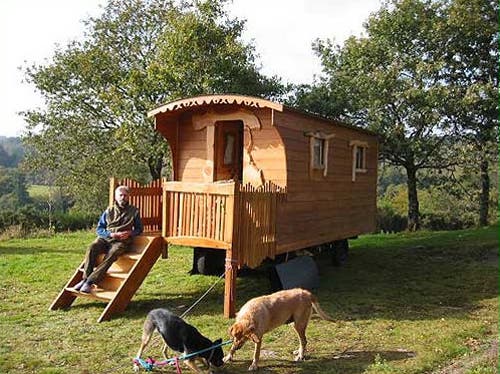
When I was a child, my favorite book was “Danny, the Champion of the World” by Roald Dahl. Danny and his father live in a gypsy caravan in the English countryside in the 1950s and run a small gas station. Adventure ensues when Danny finds out his father is secretly poaching pheasants on a wealthy neighbor’s land. I loved the story, but loved the idea of living in a colorful gypsy caravan even more.
Dahl had a caravan in his garden that was the inspiration for Danny’s home. The typical gypsy caravan has been around for over 100 years and they still evoke a feeling of romance and adventure and can be a tiny, beautiful, ornate house on wheels.
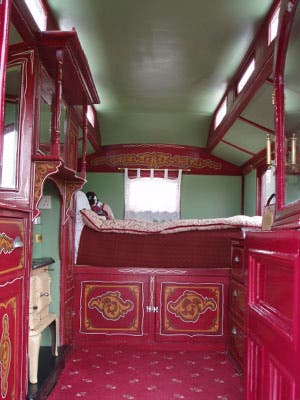
Caravans or wagons built to live in were developed in France around 1810. Gypsies have only been using caravans as their main living and working space since 1850. The gypsy name for a caravan was vardo, from the Iranian word vurdon or cart. Newly married couples would commission a coach builder to create their colorful home on wheels. They took between 6 to 12 months to build and were made of oak, ash, elm, walnut and pine. They were then ornately painted carved and decorated with gold leaf.
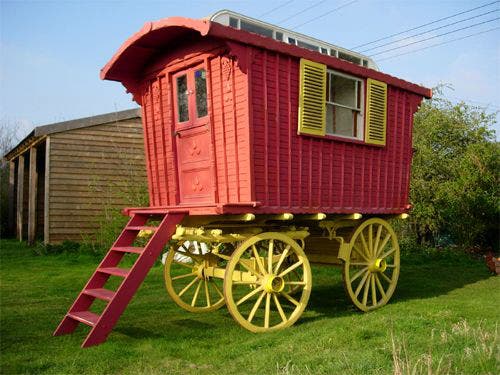
There are six main types of caravans: the Brush or “fen waggon” which lacks the ornate wooden carvings, the Reading with sloping walls, the Ledge with a narrower floor and more elbow room, the Bowtop and the Openlot, which use a stretched canvas top over a wooden frame, and the Burton which was for more wealthy travellers. Most caravans were, and still are, pulled by draft horses, but you can design and build a caravan to be pulled by a car.
Though few people would choose to travel in one today, you can experience a fully functional caravan on your own property as a romantic getaway or guest accommodations, a creative studio, a personal meditation or healing space, or just an exquisite conversation piece. If you are traveling in Europe, you can rent a gypsy caravan (including the horses) and travel between campgrounds. Some hotels even have gypsy caravan “rooms” that you can stay in overnight.
If you are looking to build a gypsy caravan or have one built for you, there are several builders and plans available. Again, most of these builders are in Europe.
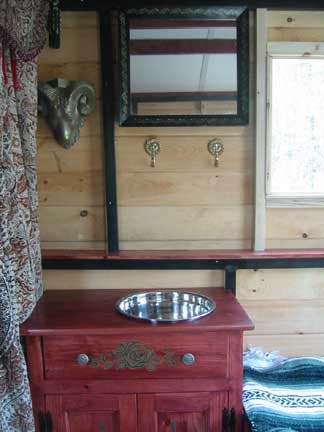
Gypsy Caravan Built by Brian Schmittling




If you enjoyed this post, subscribe to our feed
these are absolutely FANTASTIC!! thanks for sharing:)
smiles
lori
I really like this post because it’s a great reminder that living light is not a new idea at all. We are all just rediscovering it and adapting it to modern life. Great post! Great little caravans!
You can still visit the orginal caravan at Dahl´s home near Great Missenden in the UK (and also the shed where he wrote). It´s not open very often though (usually just a couple of weekends during the summer when it´s open for charity) so you have to plan ahead.
Thanks shedworking! I was in Great Missenden to visit a family friend about 12 years ago. I had heard that the caravan was available for tours, but was not able to go see it. 🙁
These little gems are beautiful and inspiring and well crafted. Thank you, Christina!
I myself have loved tiny eccentric homes since my hippie days in Marin County, California, where I remember fondly the wildly creative (in both ornamentation and space farming) in handmade houses, buses and trailers of friends, boyfriends and Neil Young’s…
The largest collection of Gypsy wagon in the world can be found at the Gordon Boswell Romany Museum Spalding Lincolnshire. You can have a day out on a tradition ‘vardo’ with an open air ‘Gypsy meal”. Open March to October. weekends.
info@boswell-romany-museum.com
The museum is run by the Romany Boswell family and is the best introduction to Romany life and history. Well worth a visit and will make you question the racist opposition whenever a legal Gypsy site is proposed.
Hi,
theres a photo of the wheels on some sort of frame. I would love to d.i.y my own caravan. Can you tell me where you purchaced the wheel gig photoed above and where i could get the same type of set-up from. So that i can build my own caravan.
thanx
This site becomes more interesting the more I read. Vardo, is derived from an Iranian description given to Gypsy housing originating from India?!. The elaborate Vardos are very similiar to the original “painted ladies.” I know painted ladies as derived from the religious revival tent meeting shelters, that over time became permanent camp housing, then regular public housing. Some of our painted ladies became huge behemoths 3,000 square foot and more from the turn of the century as people progressively tried to outdo oneanother… Perhaps the contemporary Vardos can bring us back to scale. This too much reminds me of tiny reptiles becoming huge dinosaurs, only to die off, leaving the smaller more efficient reptiles and mammals to survive. Is this a case of the golden mean, biomimicry or Fibonacci repeating itself??? I hope not, or if so I hope we learn to quickly adapt rather than hold on rigidly to our present system of bigger is better until it is too late.
alex –
Gregs Gypsy Caravans in Bristol builds gypsy style bowtops on an Alko caravan chassis. Their website has a photo of the wooden framework.
hi like the sheds and things, some interesting stuff, if you love romani caravans worth a visit wwww.gypsywaggons.co.uk has loads of colourful waggons etc.
parruka tu boro bokti /best luck my friends
thanks
Thank you for the link, those look really neat and we may need to do another post sometime in the future…Kent
just wondering how much a gypsy caravan would be
My husband is wanting to build my father a bow top wagon,does anyone know where we can find the plans to build it?
luv da caravans do ya there fab
I would like to travel across the country (India)n the Nations all over the World, I am looking for a caravan (Bus).
pl help me with the design,15 people will travel with us,for a period of 3 years,all in one caravan i m looking for,
this trip is to create awareness among the youth and the society,
CRUSADE AGAINST HIV AIDS,DRUG N ADDICTIONS.
PL SUPPORT AND HELP US,
THANKS,
Dr Paul
I would love to know of any manufactures of these beautiful caravans here in America thanks
Hello we build custom wagons and traveling trailers from bar to to bow tops for four season living
Pulled by compact cars, horses,trucks,etc.Skeleton frame work of welded lightweight aluminum finished in however our clients like
Please feel welcome to contact us
woolywagons@aol.com
http://www.woolywagons.com
765-513-0931
Steve
Spelling correction
Vardo too Bow top ( sorry)
Hi im trying to buy a gypsy wagon/caravan…
i have know idea where to find one if anyone can help contact me at lovecantsaveyounow@yahoo.com
Hi,
We are looking to purchase a gypsy wagon. If anyone knows where in Ontario I could buy one that would be greatly appreciated.
Thanks,
A
It’s two years later, but did you find a caravan? Want to build your own at a workshop? I’m two hours north/west of Toronto.
Hi There Tinyhouseblog,
Interesting Post, Many beginning crossbow owners are not even aware of an significant fact which crossbows use a differing ?draw? fat to accommodate the type of game being hunted. The draw weight varies within the 50 pound draw fat of the pistol crossbow to the 200 pound +, full size crossbow. The difference inside the resistance could indicate the difference of the crossbow bolt being ejected at a range from 130 feet per 2nd to over 330 feet per 2nd. Let you say you are strolling thru the woods plus see a rabbit or 2. Based on the size of the animal we wouldn?t require anymore than 150 pound draw weight. This would give you a typical bolt speed of approximately 220 to 250 fps. Believe me this is plenty of killing energy to bring down not only that little rabbit, and a turkey or deer, providing you wait to create the proper shot to hit which kill zone. You have to know the chances of we killing those rabbits is a stroke of luck, considering of their relative size plus are prone to be crouched, bouncing, or darting whenever they hear that familiar twang of your crossbow releasing that lethal bolt. Additionally, the tiny size consequently a small kill zone compared to bigger animals, it is the speed of the bolt which is a bit more important. Speed is less important for the greater animals. The faster bolt speed is need for the rabbit to hit inside a target zone the animal would be inside quite than the empty grass where it utilized to be. Now for greater animals with that thicker hide and more fat density like you elk, bears and caribou, you’ll wish which crossbow that has a draw fat of at least 175 pounds or even more. Larger animals are a bit slower to receive out of the method of that speedy crossbow bolt heading towards them. You require the added draw fat for the raw force to penetrate into the kill zone quite than the speed, even though you’ll have over enough speed to work with. Many of the crossbows of this size have a bolt speed of 300 fps or more. And in the event you want to become a big game hunter, hunting buffalo, grizzly bears, or a moose, you would want to consider a crossbow with a minimum draw fat of 200 pounds. That additional draw fat usually give your crossbow bolt speed exceeding the 330 fps providing you plenty of speed plus knock down power. Most crossbow owners will ?cock? a crossbow with a 150 pound draw weight. Anything higher than 150 pounds or should you have any physical disabilities we might wish To look at investing into a device to aid we cocking the crossbow. Also, consider a feature obtainable in most crossbows that is located at the front of the crossbow that looks like the nonworking end of the shovel. This really is a handy food device to aid in the cocking process which is big enough to receive those muddy hunting boots of yours into while you pull the crossbow strings into the latching device of your crossbow. Lastly, I may leave we with a piece of information. Try to begin with something that usually not kill or eat we. However, in the event you insist it will be wise of we to work a way carefully downwind to get as close to them as you can without spooking them. You just cannot afford to miss especially a large bear at 45 yards away from them. It would take you at a minimum of five to ten seconds to prep and cock a crossbow to get your 2nd shot off. Simply realize a large angry bear may cross a football field inside approximately six seconds. Be secure out there! I hope this info was helpful to you for your hunting experience. All that?s left is to choose a crossbow to use. Visit you at: http://www.beginningcrossbowreviews.com.
Kindest Regards
salve,vorrei sapere,ma dove si possono comprare queste bellissime carrozze gitane? grazie
I really like your blog, but can you please stop tagging posts with & using the word “gypsy”. I am a real ethnic Romani “gypsy” woman & that word is a slur. It’s not a lifestyle, but a hurtful word for our ethnicity. It’s a pejorative that has been used to demean, oppress, enslave, and murder us for centuries. I would really appreciate it if you could refrain from using the term. Najis tuke. But baxt thaj sastipe.
Very difficult to break those old habits. I think most don’t even realize it is a slur! Good for you for speaking up!
Nice blog right here! Additionally your website rather a lot up very fast! What web host are you the usage of? Can I am getting your affiliate link for your host? I wish my web site loaded up as fast as yours lol
hi,
I am building a gypsy wagon but I wanted to build it over the top of the tire like in the first photo . does anyone know if this makes the wagon top heavy?
thanks,
doug
Thanks for finally talking about >Gypsy Caravans <Loved it!