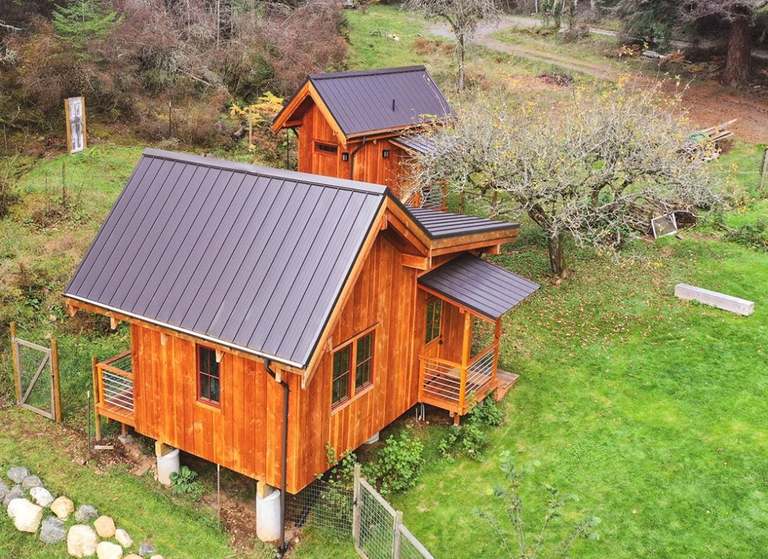
Build Locally with Roundwood Timber Framing
Dimensional lumber — 2x4s, 2x6s, etc., are about as ubiquitous as suburban sprawl is in America. (Maybe there’s some kind of relationship there..?) 2x4s are an industrial product, only becoming a dominant building material in the last century. As priorities have shifted to speed, uniformity, and ease of production, more traditional building styles have fallen out of favor.

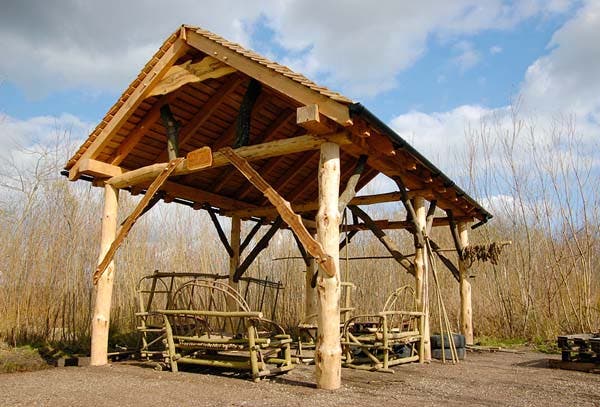
However, it is almost certainly time to rethink how we build our homes, addressing not only downsizing possibilities, and the size and efficiency of spaces, but how we build houses themselves, and what materials we use. I believe timber framing, and specifically roundwood timber framing, fills a great need, enabling more holistic and sustainable home construction.
Building Locally?
Here’s a great passage from the USDA Forest Service’s “History of Yard Lumber Size Standards” (warning: PDF link) that hints at industrialization beginning to seep into the world of construction:
Until the middle of the 19th Century, building lumber was usually produced in a locality close to the place where it was to be used. Sizes were not a problem. The needs of builders in the locality were well understood and carpenters were accustomed to much more hand fitting on the job than they are today. As the forests were cut back from the centers of population, lumber had to be shipped greater distances. By the last few decades before 1900, lumber was no longer a locally made commodity. It then became apparent that the sizes used in different trading areas were not uniform and as a result sawmills had to cut lumber for the markets they wished to serve. Continue Reading »
Small Timber Frame House Plans and Workshop
Brian Liloia also known as Ziggy to his friends and well known for his cob house, which I have covered in the past here on the Tiny House Blog, is building a new home using a timber frame structure.
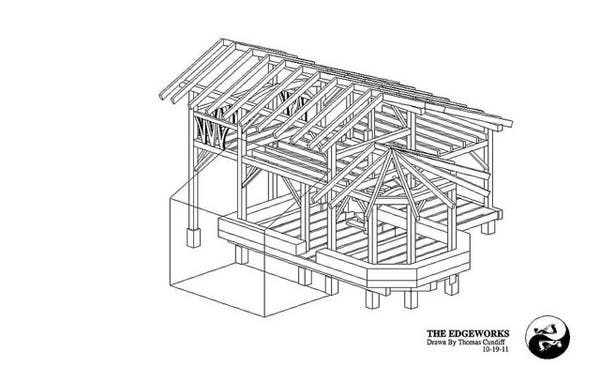
The house, code named Strawtron, is designed to be a passive solar, straw bale-insulated house using timber frame as the main structure.
The interior living area is 13 ft x 24ft which is about 300 square feet, it also has a loft and a green house area that is used to bring in passive solar heating.

Brian is making the small timber frame house plans available for free.
As a side note if you would like to help build this house Dancing Rabbit is offering a Natural Building Workshop in the summer of 2012. This includes two workshops one a Timber Frame Workshop and the second a Straw Bale Workshop. Only 12 spaces are available so click here to learn more and to apply.
P.S. Ziggy just sent me the full details so I am including them below.
10′ x 12′ Timber Frame
by Jon Anderson
Over the years, I’ve built a few log structures and along the way, timber framing got into my blood. I love the beams, the posts, and the tight fitting joints made by a builder using mortise and tenon.
I remember the first time I viewed the clean lines of a timber frame structure. The frame was draw pinned together with Red Oak pegs that were cut by hand on a shaving horse—I was hooked. And, for framing, you don’t need fancy or high-tech tools—framing square, hand saw, chisel, and auger bit have performed quite well for hundreds of years.
![WP_000303[2]](http://tinyhouseblog.com/wp-content/uploads/2012/01/WP_0003032.jpg)
When I decided to build a timber frame, I was clueless in regards to technique. Of course, like always, this didn’t stop me. Normally, I just plod blindly ahead (or in the case of the TV remote—I just mash every button randomly on the four separate remotes that are clearly critical to the operation of my cable system—something is bound to happen). However, in this case I decided to at least gain a basic understanding of the process, as there is a certain liability associated with handing big heavy things, like timbers. So, I read a few books that described traditional timber framing techniques and I took a framing class at the North House Folk School in Grand Marais, Minnesota. Continue Reading »
Diana’s Innermost House
Guest Post by Diana Lorence
*New photos added below of loft, kitchen and bathroom
This is Innermost House, my home in the coastal mountains of Northern California. It is the latest of many very small houses my husband and I have occupied over twenty-five years, all for the same reason–to make possible a simple life of reflection and conversation. I am delighted now to be a part of Kent’s public conversation with others who share my love of tiny houses, and I’m grateful to Michael Janzen of Tiny House Design for introducing us.

Innermost House is about twelve-feet square. It faces directly south beneath an open porch that shelters our front door. A hill rises to the north behind us and the forest lies all around. The house encloses five distinct rooms: to the east is a living room eleven feet deep by seven feet wide by twelve feet high; to the west the house is divided into kitchen, study, and bathroom, each approximately five feet wide by three feet deep, with a sleeping loft above the three of them, accessible by a wooden ladder we store against the wall. Continue Reading »
Tiny Timber Frame Update
I’ve been wanting to do an update on Ian’s timber frame tiny house that he has been building in Worcester, Massachusetts. You can view the original post here and get Ian’s story. Ian has been building the house in a firehouse building and just moved it to its permanent location. Here is what Ian says:
I just finished moving my house from my shop at the Firehouse to a spot in the woods on the other side of the city. There is still work to do before I move into it, but it is a huge relief to have finished the move. There are many pictures and a short video of the first part of the move on my blog

Tiny House Moving Day (Ode to teamwork) from pvander on Vimeo.
Seattle’s Timber Frame FabCab
Logan, Tammy Strobel’s from the Rowdy Kittens blog husband brought this new company to my attention recently. I have been in touch with Maura a partner in the business to learn more about this unique timber frame pre-fab product.
FabCab designs and sells pre-fabricated and kit-built environmentally-friendly homes and accessory dwelling units (ADUs).

Maura says: “We launched our company in March and we have had an outpouring of support and interest in our products. We are passionate about designing environments that marry “green” design, design that supports people with a range of ages and abilities and prefab design. Therefore, our environments are designed to be flexible, open and easy to use and live in.” Continue Reading »