Shopping Cart Shelter
by Cristo
I like questioning ideas and concepts that most of us take for granted.
We usually accept them as a basis for our mind-frame or for how we are looking at our world and sometimes how we live our lives.
I love twisting things that are so deeply integrated into daily life that we don’t even see them anymore. For me, it’s all about investigating different for common objects. With a little imagination new possibilities are limitless.
Take a stupid shopping cart for instance. Apart from strolling thoughtlessly along sad supermarket-isles what are they good for?
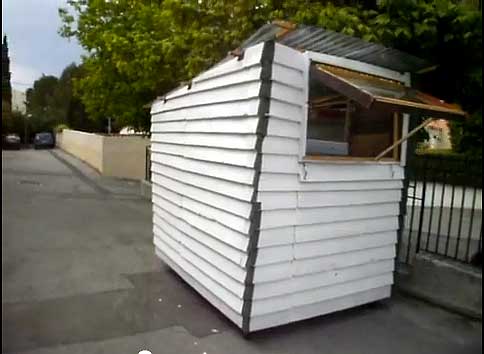
Well, it could turn into a small shack as shown.
And voilà!
This shack could be used as a unit for dreaming, for thinking…Instead of, “Shop shop shop!” I could then turn this into, “Think think think!”
It could also be used as a cheap and decent shelter for homeless people. I like the idea that a consumption-system symbol could be helping those who have been expelled or denied access to the system. And now there’s just one more thing to do. Build it!

Opportunity Village Eugene and the Conestoga Hut
by Andrew Heban
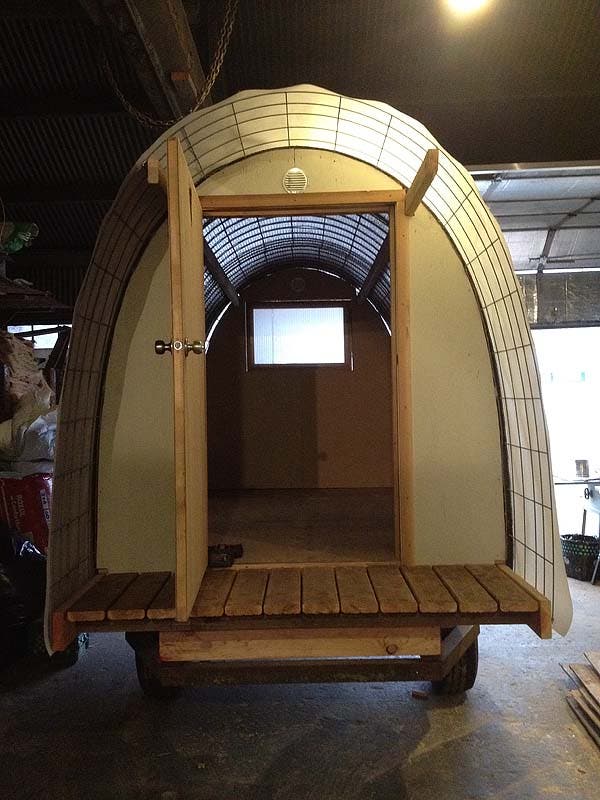
I am with the non-profit Opportunity Village Eugene and thought you might be interested in posting about our newly developed 60 sq. ft. Conestoga Hut here in Eugene, Oregon.
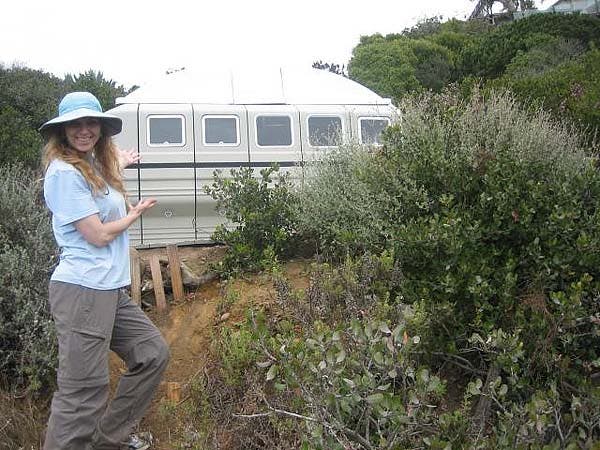
The Conestoga hut is 6 by 10 foot shelter that can be built for between $250 and $500 depending on the utilization of re-used or donated materials. While this price is similar to a quality tent, the Conestoga makes significant improvements upon the tent – most notably an insulated and lockable space – while minimizing the cost, skill and labor required by a more conventional, four-walled structure.

There are four components to a Conestoga hut: a basic 6 by 10 foot insulated floor, two solid, insulated walls that line the short sides of the flooring, and a metal wire roof that is curved to connect to the long sides of the floor. The roofing frame is then covered with insulation and outdoor vinyl that is attached to the base of the structure.
The result is a structure that resembles the Conestoga wagons used during early American westward expansion. The components of the shelter can then be easily assembled or disassembled on site, drawing a reference to the rugged individualism again linked with the Conestoga wagon. Continue Reading »
River Guide Tiny Houses
This last summer, my husband and I took a three day whitewater rafting trip on the South Fork of the American River in central California. This area of the state has a culture of its own. While the mountains and the coast have the ski and surf bum, the American River is home to the seasonal river guide. Many of these river guides come from all over the country to raft and kayak one of the most popular rivers in the West and they live from May to October in a hodgepodge of dwellings.
The river guides we rafted, ate and played in the water with lived in tents at nearby campgrounds, in temporary buildings on land leased by various rafting companies or in VW buses in the parking lot. One of the guides even lived the entire summer in a hammock strung up between two live oak trees. The guides used the campground bathrooms and showers and cooked in outdoor kitchens. Around the river, and in the massive, thorny blackberry bushes these free spirits squat in what might seem like terrible living conditions, but what they see as the best way to experience the river. Continue Reading »
Tiny House in Bay Area
Jan Sturmann wrote me recently to share a tiny house he has built in the Bay area of Northern California. I’ll let him tell you about it.
Imagine a house that has everything you need, but nothing more. Walls and a roof that shelter, but do not entrap you with false promises and hidden costs. The Dutch have an untranslatable word: gezellig. The Germans have a similar word, gemütlich. It’s a combination of comforting, welcoming, cosy, and inspiring. I built this house in the spirit of those words, to be efficient, practical, and aesthetically nourishing.
The house was created spontaneously, by hand, and using simple tools. Each piece is imbued with the memory of its making and it cost no more than a few months of work. It contains only objects that give tangible pleasure, or are inherently useful: fire, water, food, clothing, a couple books, and a sharp knife.

It provides space to eat, play, read, dream. It’s a refuge, but not a fortress. It lets the outside in and gives imagination flight. Falling asleep under this curved roof evokes memories of our ancestral cave with lines of sight to the rising and setting sun, and a skylight to the stars. This essential shelter leaves nothing wanting.
Foot print: 49 square feet
Usable space: 98 square feet
Cost to build: $5,286
Time to build: Three months
Location: Bay Area
Design wise, probably the most interesting element is the curved rafters. Basically, six foot 2 x 6′s ripped to 1/4 inch then bent, glued and clamped over a plywood jig. Not wanting to loose the look of the rafters, or the extra space between the rafters to insulation, I screwed 2 x 6 T&G over the top of the rafters for the ceiling, then bent two layers of 1inch rigid foam over that, then 3/8 in. ply, then tar paper, and finally asphalt shingles for the roofing. The skylight of course gives a wonderful sense of spaciousness. The two east and west windows are located to let in as much light as possible, whilst still maintaining full privacy in a dense urban environment.
All walls are insulated and have a layer of soundboard beneath the ¼ in. sheetrock, which are plastered using a mixture of clay, sand, and flour paste with a natural dye added.
Originally, the shack was built off-site as separate panels, transported in a U-hall, then assembled on site, with the idea that it could be easily disassembled should I leave. But now with the complexity of the added roof, disassembling is no longer an option. During the remodel I realized that I can hire a crane to pluck the house out and put it onto a trailer to move to a new location. This utterly changed my attitude about the building from it being just another temporary structure that I leave behind (as I have so many in the past) to my permanent own home that I can take with me.
Except for a couple of back-of-the-envelope sketches to think through ideas, I worked without any plans or scale drawings. Working alone, I’m able to engage in a form of dialogue with the building as it grows, with each element growing on the next. I lived in it the whole time I was building the loft and roof and then slept in the loft as I was building the kitchen/living room. By living in it as it grows, design solutions present themselves in a way that designing abstractly with with pen and paper never can. It helps that I have extensive building experience to draw on as I engage in this improvisational construction dance.
Personally, the most rewarding aspect of this was having my 2 ½ year-old-son participate. To engage in this kinesthetic exchange of learning to use tools, construction, balance, and the danger dance.
Thanks Jan for sharing your tiny home with us.
The Shack from Jan Sturmann on Vimeo.
The Tiny Houses of Black Rock City: Fertility 2.0
The theme of this year’s Burning Man had a few people scratching their heads. However, the idea of fertility taken to the next level describes the burgeoning annual event very well. Burning Man is a completely fertile location where spontaneous creativity and ideas are allowed to naturally flourish without any kind of expectations. The Burning Man website described it, and the community of Black Rock City, as a kind of giant petri dish. This year, out of that petri dish sprang a nice new crop of tiny structures and shelters that various Burners took with them out to the Black Rock Desert in Nevada to live in for a week.
There were several actual “tiny houses” out there this year, including this one across the street from our own camp. Continue Reading »
Tiny Homes Simple Shelter
I have a new favorite tiny house book and I have been anxious to share it with you. It is Lloyd Kahn’s Tiny Homes Simple Shelter Scaling Back in the 21st Century. Lloyd contacted me about two years ago and said that he wanted to do a book on tiny houses. He asked for contacts to a lot of people I had written about on the Tiny House Blog.
In a way this book is like a printed version of the Tiny House Blog but with Lloyds great writing ability and layout. Plus he has added many tiny houses that I have never seen. He has pulled together a book I think every tiny house enthusiast will want to own.
I recently visited Lloyd and his team at Shelter Publications and saw where these wonderful books are put together and distributed.
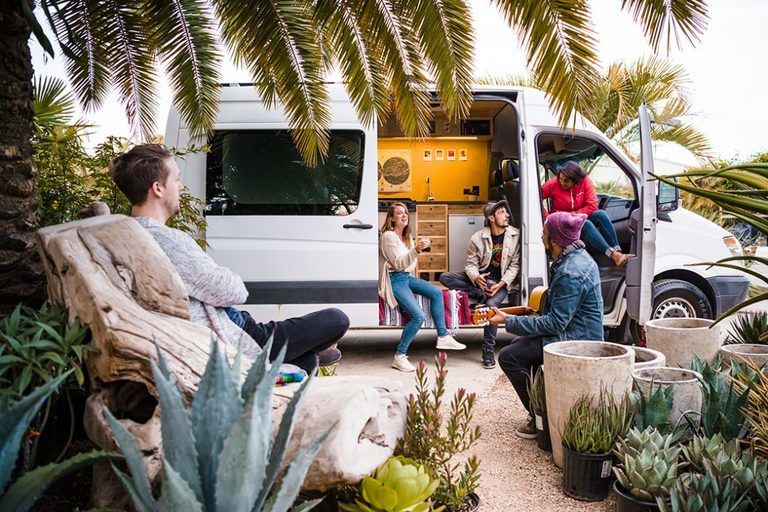
In this book there are some 150 builders who have taken things into their own hands, creating tiny homes (under 500 sq. ft.). Homes on land, homes on wheels, homes on the road, homes on water, even homes in the trees. There are also studios, saunas, garden sheds, and greenhouses.
There are 1,300 photos, showing a rich variety of small homemade shelters, and there are stories (and thoughts and inspirations) of the owner-builders who are on the forefront of this new trend in downsizing and self-sufficiency.
Lloyd just released a new video where he takes you through a two minute walk through of the book and Shelter Publications.
You can purchase the book through Shelter Publications or at Amazon.
Thank you Lloyd for sharing your talent with this wonderful new book.