Dee Williams Lives Large in a Tiny Footprint
By Alyse Nelson
How much house does it really take to be happy? Some people are taking a hard look at the question, and discovering that the answer is: not much.
These “tiny housers” are bucking the idea that “bigger is better.” Their homes, ranging from 800 square feet to less than 100 square feet—a far cry from the 1000 square feet per person that has become the North American norm—take many shapes and sizes. And the people who live in them are as diverse as the homes themselves. Some hope to save money on housing; others hope to “live green” by choosing a smaller space; some are trading living space for a neighborhood they love; and others want to live closer to family or friends.

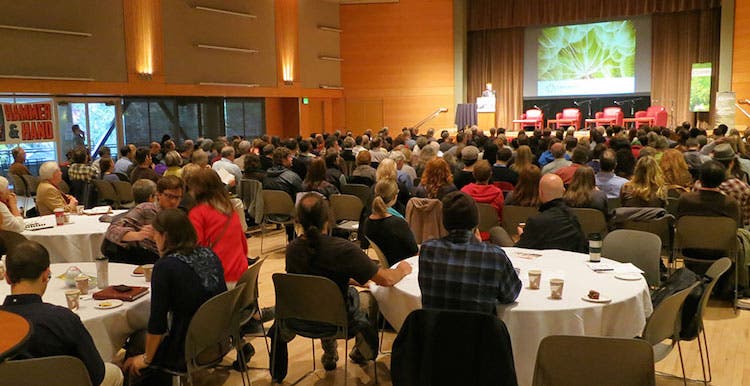
Dee Williams talking to a group outside her tiny house
Photo by Flickr user irooshka
Dee Williams’s story starts with her questioning her lifestyle choices. After helping build a school in Guatemala and watching a close friend fight cancer, Williams reevaluated her priorities. “He was getting sicker and sicker, and I didn’t have the time or the money to really throw myself into helping him. I was spending a lot of time and money on my house. So the house was the easiest thing to try to get rid of,” Williams told Yes! Magazine.
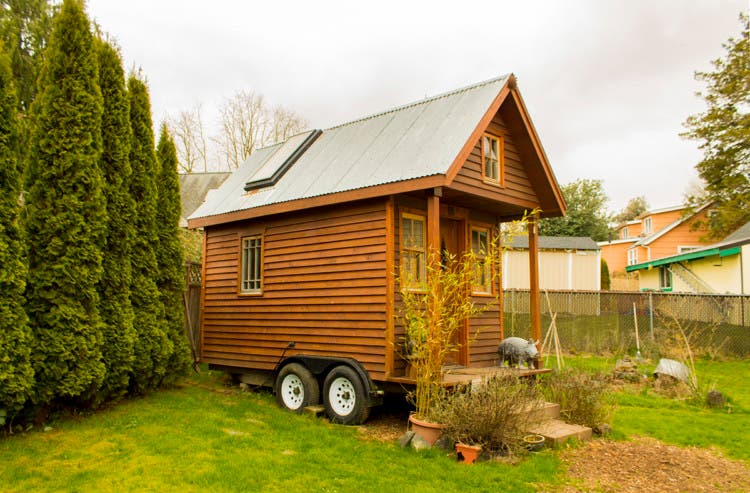
“I started really wondering if the cost of owning a house, of maintaining a house, of remodeling my house, was really kind of socially what I wanted to be about. So I decided to bite the bullet and go for it!” Williams said in this video. So she sold her 1,500 square foot Portland home and built an 84-square foot tiny home for $10,000.
Her 8-foot by 15-foot home is parked in a friend’s backyard in Olympia, Washington. She helps out with household chores in exchange for the space and drinking water. She lives with just a few outfits and shoes, but also is mortgage-free. This has allowed Williams to work less and spend more time and money investing in giving back to her community.
Williams’s story has spread far; because she’s been featured in national news more than 20 million people have viewed (in person or via video) her tiny home. She received the 2008 Governor’s Award for Sustainable Practices in Washington State. Now she co-owns PAD—Portland Alternative Dwellings—a tiny house company that holds workshops to help future tiny housers get their start.

Dee Williams shows off her tiny house.
Photo by Flickr user irooshka
But the help tiny housers need most isn’t advice about building or living in a small space; it’s navigating the maze of regulations they’ll confront as they downsize.. Some cities set minimum size requirements for dwellings. Others say a recreational vehicle can’t count as an ADU, which is typically how a tiny house is categorized. This means “you can camp in your little house, but not live in it,” writes Williams. Williams helps other tiny housers navigate the regulatory barriers that come with tiny house living.
Through her activism—and her lifestyle—Williams is helping create a wave of interest in tiny homes that local governments cannot ignore for long. Williams proves that even if your house has a tiny footprint, you can still live large.
Bio: Alyse Nelson is an urban planner for a small town in Kitsap County, Washington. She is a Writing Fellow for Sightline Institute. This post is adapted from a full article published here:
Tiny House Powermover
Holly recently contacted me and had a question about moving a tiny mobile house once you had it near it’s final location. She had seen an article somewhere and was looking for it. I knew right off she was talking about the Powermover that Dee Williams and Logan Smith have used to move homes in the Portland area.

Photograph by Tammy Strobel
I wrote to Logan and he filled me in on what they use. Logan says: I believe the tool name is an “electric dolly” but the commercial name of the tool we purchased was “Powermover” from a fellow named Brady outside of Los Angeles, CA. The website for the Powermover is http://www.powermoverinc.net/ Continue Reading »
PAD Tiny House Design Workshop
I received a note from my friend Dee Williams about an upcoming workshop and wanted to share it with you as the time is fast approaching. I wish I could make this one personally as it would be a lot of fun and is near where my daughter lives. Here is what Dee has to say.
Hey there!
I wanted to drop a note to ask a favor. I know you’re swamped and in the middle of your normal awesome life, but I wanted to let you know about some up coming workshops being hosted through Portland Alternative Dwellings (www.padtinyhouses.com). It seems there’s a rush of activity right now with great workshops on the horizon, hosted by Jay Shafer’s new company Four Lights Houses, Yestermorrow Design Build School, Tumbleweed, Deek Deitrickson’s Relaxashacks, and others.
PAD is excited to be a part of such a dynamic community of tiny house enthusiasts. VIVA LA TEENY TINY!!
PAD is hosting a two day Tiny House Design Workshop on February 23 and 24th in Portland Oregon. This same workshop will be repeated in April. We’re focusing on the nuts and bolts of tiny house construction, codes, moisture control and energy efficiency and systems (meaning poop, showering, turning on the lights and cooking up a meal… not necessarily in that order). Our classroom discussions will be anchored by a half-day tour and discussion at POD 49, a pocket community that includes a tiny house and two big houses. Folks can sign up for one day (Saturday or Sunday), or both.
In June, we’ll be hosting a hands-on Tiny House Building Workshop complete with tools, sunscreen and a big o’ can of LET’s DO THIS!
Would you please consider helping to get the word out about the workshops… blog it, blab about it, bang a drum or otherwise broadcast our work, and send folks to our website (www.padtinyhouses.com) for more information? Also, if you’re interested in attending, we’d love to have you there… just let us know ASAP so we can reserve a spot for you and immediately begin to ice down the beers (or other appropriate celebratory libation).
Again, we appreciate being a part of the tiny house world that was in part created by YOU!
Dee Williams
Portland Alternative Dwellings

Build Small | Live Large Housing Summit
A couple years ago Jordan Palmeri of Portland, Oregon’s Department of Environmental Quality conducted a study that showed that building small is the single best building strategy for energy and resource efficiency. Over the past year a group of us have been working to create a forum to share information about the benefits, strategies, and challenges of building small.
I’d like to cordially invite you to the upcoming Build Small | Live Large Housing Summit on October 26th in Portland. Additional information is available here: http://living-future.org/cascadia/buildsmall. I will be presenting in the Biggie Smalls: The Notorious Tiny House session with Dee Williams of Portland Alternative Dwellings and Derin Williams of Urban Nest NW. We would love to see familiar faces in the crowd!
The 2012 Build Small | Live Large Housing Summit will gather leaders in the development, real estate, building, and design sector from across the bioregion for an intensive day of inspiration, project case studies, and peer-to-peer learning. Industry professionals will see innovative designs and learn about the financial success stories emerging across our area.


Dee Williams lives in a tiny house with her dog — Is size what green living is all about? Photo: nau/edenbatki 2010
PAD Update from Dee Williams
Following is a letter from my friend Dee Williams.
Hope you are well and enjoying this October! It is beautiful out! I’m forwarding this to you with the hopes that you might consider posting a notice about it on your blog, or with your tiny house network.
In the past couple of months, my company Portland Alternative Dwellings (PAD) has been working on a new look and focus. We recently reorganized, and now will offer more workshops and consulting services.
Our first ‘Build it Tiny’ workshop is coming up this November 10th. We’ll focus on practical solutions for some of the more challenging little house conundrums: where to place/park your tiny house, code enforcement, insurance, electrical hook-ups, wastewater and (drum roll please…) toilets! The workshop will provide detailed information from local experts, and a great opportunity to meet others in the tiny house community. It will be an awesome opportunity to further flesh out the details for your little house, and to sort through some of the hard-knuckle decisions associated with a tiny house.
In the spring, folks can join us for another workshop: a hands-on, tool wielding weekend workshop focused on building a little house!
Our new website: www.padtinyhouses.com offers more information about PAD and the up-coming workshops.
Hope you are well and enjoying the last bit of summer!
Be well,
Dee

You Can Buy Happiness and it’s Cheap
I have been friends with Tammy Strobel for several years now and I did a post awhile back on when we first met in person. Tammy is the founder of the blog Rowdy Kittens and has been simplifying her and her husband Logan’s lifestyle over the last few years. She has also started her own business and recently moved into a tiny house.
Tammy has become a very good writer and I am excited to introduce her new book that is officially out today. Tammy sent me a pre-publication copy of the book and I have had a chance to read it and I highly recommend that you check it out too.
I really enjoy Tammy’s writing style and found it hard to set the book down. I basically read it in two sittings. Tammy shares her and Logan’s journey from being in debt and a shopaholic to now where they have removed all debt accept for a small payment to buy their new tiny house. Each chapter she shares ends with a Micro-action which gives you little challenges to move forward in your own experience.
I enjoyed lunch yesterday with Tammy and Logan and than they went to a book signing last night in Sebastopol. The book is officially out today and it can be purchased through this link at Amazon or from the publisher listed at the bottom of the introductory chapter below. I would encourage you to purchase it and read it soon if downsizing is one of your goals.
Thank you Tammy for sharing your journey with us!
You Can Buy Happiness and it’s Cheap – Book Excerpt
INTRODUCTION
Rethinking Normal
Compared to what we ought to be, we are only half awake.
— WILLIAM JAMES
Have you ever experienced a turning point? Where the tide beneath your feet completely shifts and you start thinking in a brand-new way? On December 31, 2007, I experienced a turning point — an idea that caused me to wake up out of a deep haze. It all started with a short YouTube video featuring Dee Williams. In the video, Dee talked about the idea of downsizing, or what she called “smart-sizing herself,” and why she decided to build a small, cozy dwelling on wheels.
After watching the video, I became completely intrigued by the idea of simplifying my life, and subsequently I read other articles about Dee and her little house. In one article, she described a trip she took to Guatemala to help build a school. When she returned home she realized there was a lot of stuff in her life she simply didn’t need. In a small zine called The Little House Dee described her trip by saying, “I met some incredible people. They were generous and kind and very, very poor. They didn’t have running water or electricity in their houses. They cooked outside and shared a bathroom with their neighbors. And still they seemed happy…at least, they made our work fun and helped me feel happy.” When Dee returned to Portland, Oregon, she sold her “big house” and decided to downsize dramatically by building her own tiny, 84-square-foot home on wheels, a dwelling similar in size to the homes she saw in Guatemala.
Dee’s story resonated with me on a number of levels. She was the kind of person I wanted to be; she prioritized what was most important in life, like building strong relationships, giving back to her community, and doing what she loved for a living. She wasn’t focused on the acquisition of material goods and was authentically living her ideals. Most of all, she seemed happy.
Dee’s story inspired me to go small and start thinking big. After reading a lot of blogs and books focused on simple living, my husband, Logan, and I decided to start downsizing our living space. We gave away most of our belongings. Interestingly, the more we gave away, the better we felt. Happiness researchers call this a “helper’s high,” in which helping others through volunteering or giving reduces stress and releases endorphins.
Prior to this turning point, I had been living a “normal life” and I wasn’t happy. Logan and I were thirty thousand dollars in debt, living paycheck to paycheck, and felt stuck in a rut. Something had to change, especially if we wanted to make our dreams a reality.
As I was doing background research for this book, I wondered what a “normal life” looked like in the United States. I discovered some very disturbing trends. For instance, in September 2011 the nation’s poverty rate rose to 15.1 percent — its highest level in seventeen years. According to the US Census Bureau, household income declined between 2009 and 2011, and the number of people without health insurance increased. In September 2011, National Public Radio reported, “Income declined for just about everyone — surprisingly — at a faster rate overall than it did in 2008, when the recession was in full swing.” In addition, a variety of reports indicate the average American carries over eight thousand dollars in credit card debt and has 6.5 credit cards. Like many Americans, Logan and I had good intentions — we wanted to pay down our debt, improve our health, and contribute to our community. Until we made a shift in our lifestyle, none of these things would happen.
Living simply enabled us to make our dreams a reality. The lifestyle changes we made improved our marriage and relationships with friends and family members. For instance, by selling both our cars, we’ve lost weight — we get around by bicycle now — and we aren’t worried about earning enough money to pay for our cars every month. Instead, we used the money we would have spent on car payments to pay down debt. Continue Reading »