The Tiny “Houses” of Black Rock City
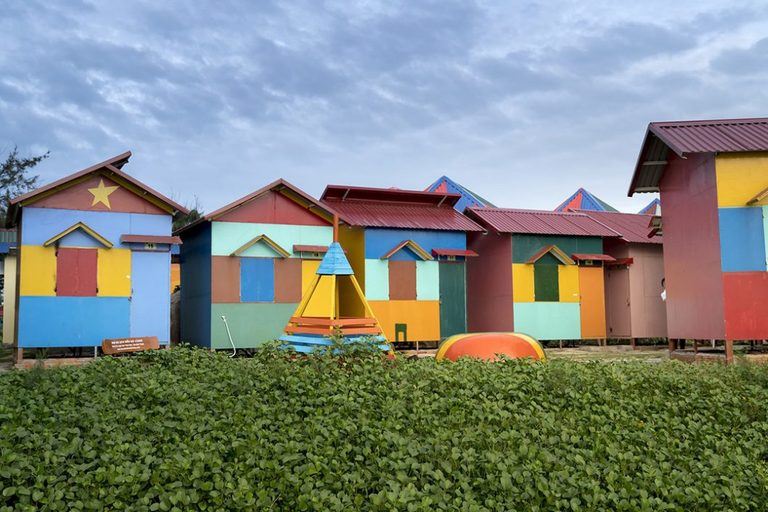
For only a week out of each year, Black Rock City, the home of Burning Man, is the fourth largest city in the state of Nevada. While the festival participants’ camps are only temporary, a lot of work goes into creating a comfortable, beautiful tiny shelter. These tiny “houses” have to be able to withstand up to 80 mile an hour winds, have to protect their inhabitants from the desert heat and cold, and the notorious dust storms of the Black Rock Desert. It also helps if they are colorful and attract attention. It makes them easier to find in the mass creativity that is Black Rock City.
While at Burning Man, you “live” in the city. When someone asks you where you live, you say something like, “On the corner of 7:00 and Chaos, right next to the giant spaceship.” (referring to the horizontal “C” street and vertical number street of the Black Rock City map). This year’s city was 9,460 feet in diameter and included 44 miles of streets. It helps to know exactly where your tiny house is located.
To the un-Burned eye, Black Rock City looks a little beat up and run down, but when you are in one of the most inhospitable places on earth, any little bit of comfort is appreciated. The inhabitants of Black Rock City are an amazing group of people with extremely creative ideas and skills who create little laps of luxury in the desert.
These are some of my favorite tiny houses of Black Rock City:
And my all-time favorite…
Natural Bathhouses
Because of the lack of space in a tiny house, a separate bathhouse can be built nearby to hold a bathing area, hot tub or sauna.
This is not only for necessity, but as a tranquil space for relaxation. On my search for tiny bathhouses I kept running into these examples built from natural materials that I thought looked so beautiful in their environments.
One of my favorites was this cob bathhouse and its accompanying yurt created by Oasis Design.
Oasis Design is a family owned, home-based design consulting and publishing business near Santa Barbara. They’ve been developing original designs for living better, cheaper, and more ecologically since 1980. Their focus is mostly on water, wastewater and energy systems.
This bathhouse at the Chinati Hot Springs in Marfa, Texas is made of adobe and dates back to the 1930s.

And this bathhouse has a living roof and is located at the Center for Whole Communities in Fayston, Vermont.

A natural bathhouse can be a celebration of tranquility and privacy, but also can make us more aware of where our water is coming from or where it should be going.
Copyright © 2009 Tiny House Blog
If you enjoyed this post, subscribe to our feed
A Living Home
Some days, don’t you feel the world crumbling around you? Financial crises, world hunger, war, poverty. It seems unending. Some people may feel that one way to escape is to have a small, comfortable place to come home to. A home that is like a hug, warm and alive.
Some people have found that feeling in a cob house. A hand sculpted structure that curves and comforts like the earth it is made from. The House Alive! company is offering workshops for 2009 on how to create your own small structure.
House Alive!, which was started in 2001 by Coenraad Rogmans, James Thomson and numerous volunteers, teaches workshops about natural building, natural design and appropriate technology. They also offer consulting services, do presentations and seminars and work to promote natural building as a real alternative to conventional construction methods.
Cob is a building material that is made of a mixture of sand, straw and clay. The materials are mixed wet, by foot or with a tractor or mortar mixer. The word “Cob” comes from an old English word meaning “Lump” or “Loaf.”
The wet cob mixture is used to build thick earth walls; the building technique is very similar to sculpting with modeling clay. Because cob building requires no forms, you can build your walls into any shape you choose. Curves, niches, arched windows and built-in furniture are common features in cob buildings.
Because cob can be labor intensive, it is best if a cob structure be kept on the small side.
House Alive! will be offering a workshop in May of 2009 on how to build a complete shelter. Participants of the workshop will leave confident that they can design and build their own natural home. The building techniques will include:
- Making cob by foot
- Rubble trench foundations
- Stem walls out of recycled concrete, earth bags, and stone
- Natural sub-floors for earthen floors
- The materials sand, straw, and clay: How they work, what to look for, where to find them
- Wall building: tapering, keeping it plumb, trimming, shaping
- Electricity: How to put in wires, how to build a circuit
- Plumbing: Water and gray water systems
- Windows, doors and hanging cabinets and other things on cob walls
- Hybrid buildings: The interfaces of cob with other materials
- Earthen floors
- Earthen finish plasters
Lectures and demonstrations will include
- The economy of building
- Passive solar design
- Natural design
- Composting toilets
- Solar hot water
- Solar electricity
- Codes, hybrid buildings and natural renovations
- Straw bale construction
- Light straw clay, adobe brick and waddle and daub.
- Roofs and roof insulation
- Simple living and community
One thing that cob building lends itself to is cohousing. Cohousing communities attempt to be as self-sufficient as possible, by building their own homes from sustainable materials like cob and straw bales and by growing their own food. The Emerald Earth Sanctuary in Mendocino County, Calif. makes decisions by consensus, and they value direct, open communication and conflict resolution. They also offer work parties, natural building workshops, and a work trade program.
If you are interested in learning more about cohousing, the 2009 cohousing conference will be in Seattle, June 24-28, 2009.
If you enjoyed this post, subscribe to our feed
Straw Bale Women
There is something feminine about straw bale homes. The warmth, curves and color of these natural spaces act like a hug when you walk in the door. While these profiled straw bale homes are small rather than tiny (most are around 400-800 square feet) they were envisioned, designed and built by women that I feel epitomize the beauty of the straw bale house.
Most followers of strawbale building and other natural building techniques know of the Canelo Project and Athena Swentzell Steen.
She and her husband Bill run this small non-profit organization that is dedicated to the exploration and development of living systems, including growing food and building homes that creates friendship, beauty and simplicity.
Their latest book is Small Strawbale, which covers everything from building walls and open shelters to small and exquisite homes built out of straw bales.
Carolyn Roberts also wrote a book detailing the trials and triumphs of building her own straw bale home outside of Tucson, Ariz. A House of Straw: A Natural Building Odyssey profiles the challenges of passing her county inspections, the issues of building a house as a single woman while trying to raise two children, and the wonders of creating her own space and the friends she made along the way. Her website breaks down the cost of each part of the building process, and her total for the home (land not included) came to approximately $50,000. Because of the thick walls and use of passive solar, her electric bills average about $35 a month.
Caroline Coalter Wilson built her house, Paca de Paja, to also serve as a small bed and breakfast. She works at the Arizona-Sonora Desert Museum and runs the B&B part time. She was previously a park ranger and naturalist with the National Park Service and has written several publications on natural history.
I really admire these women who have tackled the building process from the ground up and utilize the beauty of natural products in their homes. More information for my fellow female dreamers and builders can be found in the book
The House That Jill Built.
If you enjoyed this post, subscribe to our feed