Tumbleweed Backyard Sheds & Tiny Houses Book Review
Today I received from Tumbleweed Tiny House Company, Jay Shafer’s latest book called Tumbleweed DIY Book of Backyard Sheds & Tiny Houses. I decided to do something different with this review and have put together a video book review.
The drawback is for those with slow internet connections as you will not be able to watch it. Simply click on the graphic below and it will take you to the Tumbleweed sales page, there you will learn how to build a backyard cottage Tumbleweed Style. Okay here goes, it’s not perfect so be kind to me
Pocket Neighborhoods – Book Review
Pocket Neighborhoods: Creating Small-Scale Community in a Large-Scale World
I recently received Ross Chapin’s new book called Pocket Neighborhoods to review and share with you. This is a beautiful coffee table style hard bound book written by Ross Chapin. Ross Chapin is an architect and long-time advocate for sensibly sized houses and vibrant neighborhoods. He leads an architectural and planning firm on Whidbey Island, north of Seattle, Washington, where he has lived and worked since 1982.
This book covers modern day pocket neighborhoods across the country and includes the fascinating history of this type of neighborhood which Ross Chapin discovered while researching the book. The book is published by The Taunton Press in 2011.

What is a pocket neighborhood? Pocket neighborhoods are clustered groups of neighboring houses or apartments gathered around some sort of shared open space — a garden courtyard, a pedestrian street, a series of joined backyards, or a reclaimed alley — all of which have a clear sense of territory and shared stewardship. They can be in urban, suburban or rural areas.
These are settings where nearby neighbors can easily know one another, where empty nesters and single householders with far-flung families can find friendship or a helping hand nearby, and where children can have shirttail aunties and uncles just beyond their front gate. Continue Reading »
Island Year Finding Nova Scotia
Last year Anne Yarbrough shared with us her Nova Scotia Fish House. After living on the island for a year Anne’s husband Greg Brown has written a book called Island Year Finding Nova Scotia. I just completed the book and wanted to give you an overview.
Greg and Anne lived a very busy life and Greg served for twenty years as a pastor in The United Methodist Church in Washington DC. As they neared retirement Greg and Anne decided to make some drastic changes in their lives. Greg had roots in Nova Scotia and they started researching real estate in Nova Scotia.
Discovering property on McNutt’s Island with a home that needed restoring it seemed like the perfect place to use Greg’s passion for restoration and a nice quiet place to call home.
The book covers their first year on the island as they learn how little they know about life on an island. They discover new challenges that come along with island living. Meet Skipper and Radar, lobstermen who become Anne and Greg’s teachers and guides. Discover the ongoing battle of the Zulu Spruce that grows like weeds on the island.
Meet the wild sheep that they thought were a romantic part of the island but have some very different sides to their character also. Discover the difficulty of dealing with garbage and making the crossing to the mainland in fog and stormy weather. Learn about some of the ghosts of the island haunting past. Learn about the lighthouse and the history of pirates. See how Anne and Greg divide the daily labour to keep life going on the island. Join in the festivities of the First Annual McNutt’s Island Pirate Festival and enjoy the wild raspberries scattered across the island.
This is a book for dreaming and relaxing and sharing a simpler life. I highly recommend it and you can purchase the book from Nimbus Publishing for $19.95. Thanks Greg and Anne for sharing your story with us. Stay up to date with their daily life with Anne’s blog here.
Alex Johnson’s Shedworking: The Alternative Workplace Revolution
In the early days of the Tiny House Blog, I followed and learned a lot from Alex Johnson of Shedworking which regularly features shed designs, builders, and people who work from home in their own garden offices. Alex has recently introduced a new book called Shedworking: The Alternative Workplace Revolution and it is now available.
Featuring shedworkers and shedbuilders from around the world who are leading the alternative workplace revolution, Shedworking looks at why having a shed office is a greener way of working, improves the work-life balance, and accelerates one’s productivity.
Below are a couple of videos of Alex introducing his new book.
Learn more at Amazon.com: Shedworking: The Alternative Workplace Revolution
![]()
Simply Car-Free
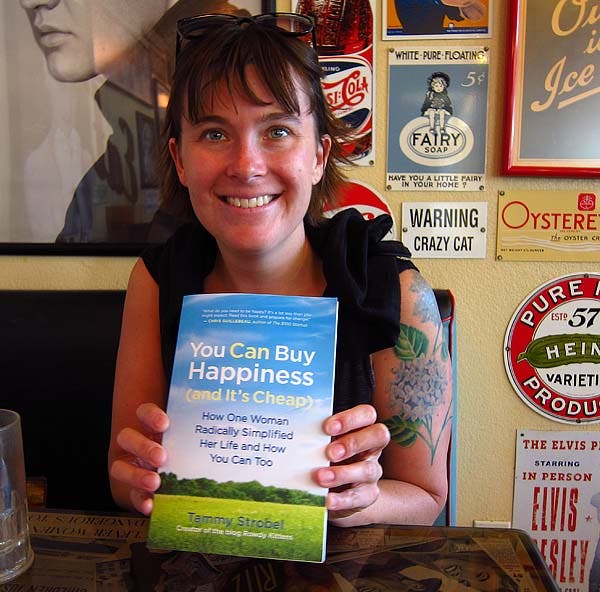
Though not directly related to tiny houses, Simply Car-free is right on when it comes to simplifying your life, which in my opinion is part of the tiny house movement. My friend and fellow blogger Tammy Stobel who publishes the RowdyKittens blog has written a wonderful ebook that I would highly recommend to you. Quoting Tammy from a portion of her book on Rethinking Necessities & Overcoming Fear I think this can be applied to a person looking at downsizing to a tiny house.
“Our simple living journey has taught me that less is more. Having less stuff and no car in my life has helped me establish the priorities of building solid relationships, being debt free and living with less stress.
Success is not defined by whether or not you own a car. In fact, I think it’s just the opposite. The intended function of cars is comfort and convenience. However, cars represent an enormous amount of time and money. Because of the work stress I endured to maintain this depreciating investment, I felt inconvenienced by my cars. By selling the cars, I have more time and money. A surprising side effect of selling our cars was becoming debt-free.”
Five years ago, we lived the “normal middle class” suburban lifestyle. We were newlyweds with flashy rings, living in a two-bedroom apartment, driving two cars, commuting long distances to work and living well beyond our means. The idea of living without a car didn’t seem possible.
By changing our perspective and planning small steps, we learned lessons that simplified our lives and got us out of debt. Going car-free was part of our downsizing process and was one of our first big goals toward living intentionally.

Humble Homes, Simple Shacks, Cozy Cottages…
I just ordered a copy of this new book by “Deek” Diedricksen so cannot do a personal review yet. In the meantime I thought I ought to get the word out and Amanda Kovattana wrote this wonderful review over on flickr and I thought I should pass it on. Here is Amanda’s review of the book.
I felt so compelled to merge with “Deek” Diedricksen’s uber building gene, after reading his self-published book, that I got out my highlighter pens and helped him out by adding some color to the cover.

Printed at a local Ma and Pa printshop, then assembled by hand with a garage sale velo binder, this is a true Do It Yourself venture in bookmaking, financed, he points out, by dumpster diving the trash of others to sell stuff people were too lazy to fix. The marketing he leaves to us micro housing enthusiasts for there is a growing population of would-be tiny home dwellers who can’t get enough of this under the wire lifestyle.
Thus Deek’s book is important not so much because it is another entertaining zine produced by an overly creative young person, but because he is both fed by a movement and contributing a large chunk to it with his mind bending, Houdini like acts of radically small, home-built shelters.
The casual observer might have suspected that there was a backlash to the decades of MacMansioning, embodied by the books of Sarah Sussanka and her Not So Big House concept, but on closer inspection I was personally aghast that most of these books were about living well in less than 2,500 sq. ft. I beat a hasty path back to books published 20 and 30 years ago for it was there, in the wake of the counter culture movement, that I was first informed of the idea that what held people enslaved to corporate jobs were their mortgages. Thus the path to freedom lay in finding a way to live without one.
The live-lightly-on-the-earth simplicity movement revived this concept, most popularly exemplified by Jay Shafer’s Tumbleweed, a tiny house on wheels making the rounds of eco minded publications and fairs. And while Jay argues that $150 per square foot is justified in light of the quality of materials used in his beautiful handmade house, the $10,000 to $30,000 cost of materials, plus copious amounts of time aspiring to such perfection, imposes restrictions on the mind that, practically speaking, have more in common with a mortgage.
Freedom being as much about where the mind can go as how one actually manages to escape the shackles of one’s obligations, it shouldn’t be surprising that so many are fascinated by the possibility of truly accessible housing even while living comfortably in a suburban ranch. Enter the DIY backyard tinkerer and consummate recycler constructing tiny free houses from discarded pallets and sidewalk trash much like those who convert gas cars to electric while awaiting a more affordable Tesla roadster. Carpentry, however, is the domain of conventional thinking. We all know what a house is supposed to look like. Scores of books fill the need for constructing sheds, playhouses and tree houses that look just like big grown up houses.
Derek’s book is a far cry from anything so conventional. He aims to inspire with his ideas, ideas that may well earn his book a place in tiny house history. What he ends up doing is reconstructing the mind into accepting what constitutes shelter. Could I sleep in that I asked myself of several drawings that borrowed quite a bit from Japanese capsule hotels. On the other hand I could certainly build it with the space, time and materials I had available.
Having, himself, been inspired by a copy of “Tiny Tiny Houses” by Lester Walker, which he received for his tenth birthday, he understands the importance of such books at a young age and includes a number of whimsical structures and indoor forts that would appeal to a child builder.
On his website, the drawing that convinced me to order the book (which he will mail wrapped in recycled cardboard or whatever lying around) was one showing a tree house platform with a ladder enclosed in a shaft so as to have a locked door for security. Such attention to detail, I realized with delight, promised practical follow through that would further my search for a hut I would be able to and want to build.
In the end it is his more loosely worked out ideas that compel my mind to take up pencil and paper to figure out how I could work it up into something I could use. My mind needed the exercise, but my soul needed the freedom of such thinking to expel the limitations of a system that does not aim to set us free. For such an experience at $15.95 (for a limited time only) this book was a bargain.
by Amanda Kovattana
Compact Cabins Book Preview
Recently I was contacted by Michelle from Storey Publishing asking me to preview a book that is coming out in December.
The book is called Compact Cabins and subtitled Simple Living in 1,000 Square Feet or Less. It is written by Gerald Rowan has taught art, ceramics, architecture, and graphic design for more than 30 years. He is currently a visiting professor in the art and architecture department at Lehigh University in Pennsylvania. He has a strong personal interest in “building small,” and he lives in Pennsylvania.

Okay this is one neat book and really covers a lot. Besides having 50 unique designs that will inspire you, the book is full of useful construction information and the book is divided into three sizes of cabins. Micro, below 300 square feet, mini 300 to 500 square feet and compact from 500 to 1000 square feet.
- It covers ways to include RV materials into your small cabin to make it more efficient.
- The book has a section on using shipping containers in your cabin construction.
- Another section on living off the grid and cabins/houses designed to take advantage of off the grid design.
“Most of us dream of having a small place on a lake, in the mountains, on the shore, in the woods, or even in our back yard. Some dream of a place for privacy and solitude.”
Below are a couple of examples of the cabins and artwork in the book. Floor plans for each cabin are included. You can also pre-order the book from Amazon and will be available December 6, 2009. There timing is perfect for a gift for the tiny house lovers library. Pre-order here: Compact Cabins: Simple Living in 1000 Square Feet or Less; 62 Plans for Camps, Cottages, Lake Houses, and Other Getaways

This tiny cabin is based on ideas gleaned from the travel trailer industry to utilize space very efficiently. In a cabin this small, electric space heat makes sense. This is a 162 square foot Micro Cabin.

380 Square Foot Round House Cabin. A round cabin – how unique! Curved cement blocks are available for building cisterns and farm silos and adapt well to building round cabins. This design calls for a custom-built curved sofa and fold-up table to make the most of the interior space.

Off-The Grid Passive Solar Cabin A
This cabin is only 322 square feet, but the loft ceiling height makes it feel much larger. The passive solar feature is a large glass window opening into the living space. Space heating is provided by a wood-burning stove.
Reprinted with permission from Compact Cabins, published by Storey Publishing, LLC., December 2009.
by Kent Griswold (Tiny House Blog)
If you enjoyed this post, subscribe to our feed


