Gerry Shaw’s Epu
Well, I’m finally getting this post up. I’ve wanted to for quite a while and somehow it got put aside. I had been in communication with Gerry Shaw while he was building his Tumbleweed Tiny House Company Epu, which is the same home that Jay Shafer lives in and wanted to tell you more of his story. Here is what Gerry has to say about his build:
Well the move was a bit hairy as it was full on winter when we started then a huge rain storm when we arrived in Victoria. The distance was ~800 KM and we did it over a full day leaving at 4 AM. We had one ferry crossing. We wrapped the house in leftover home wrap and padded the front and pack with insulation panels to prevent any windows from breaking and keep as much muck off the house as was possible. When we arrived everything was intact.
I haven’t had much time to ‘finish’ it but it’s very livable. My plan wasn’t to complete the bathroom as I’m still not sure how I want to prevent water freezing and what sort of toilet system I’m going to use so that will be a summer project along with the porch roof and some trim. I might redo the cabinets at that time as well since the ones I built were done in hours on the last day before the move.
The closest thing I’ve built before this was an end table that didn’t turn out that well
Hiring an experienced friend to mentor and help me was the best decision I made and the house would not have turned out as well as it did without her help.
Living in it has been great. The proportions are amazing and the layout gives the impression of it being much larger than it is since you have about 4 distinct rooms in the house (great room, kitchen, bath/closet – tiny, and a very private bedroom.
Costs are about $15,000. Trailer, windows and labor were about 2/3rds of the cost. I still need to install the bathroom and hot water system.
Here are three galleries that are open to the public to view. I’ll reply (in time) to any questions people ask me.
To view Gerry’s gallery of pictures go to the three links below.
- http://www.facebook.com/album.php?aid=71737&l=649fc&id=563415667
- http://www.facebook.com/album.php?aid=70976&l=c733e&id=563415667
- http://www.facebook.com/album.php?aid=58669&l=dd438&id=563415667
If you would like to get plans to build your own Epu, visit the Tumbleweed Tiny House Company website.
If you enjoyed this post, subscribe to our feed
The Airy – Joel Tanner Design
Joel Tanner is an architectural technologist, living in Nelson, BC in Canada and he designs homes for a living. His true passion is small homes such as this one. Joel would love to transition into providing affordable design services to clients all over North America via the internet.
This home called the Airy provides you with a total of 136 sq.ft. of finished interior floor space. The home is built on an 8′ x 20′ tandem axle trailer with a total height not exceeding 13′ 5″. The exterior features horizontal lap wood siding, a long lasting shingle roof, vinyl windows and a lot of modern character.
The living room doubles as a sleeping area, as the futon mattress is a couch by day, and bed by night. There is plenty of storage including all built in furniture, as well as the exterior accessed storage compartment below the raised living/sleeping area. The bathroom features a stand up shower and low flush; “rv-style” toilet while the kitchen includes plenty of shelving, a full kitchen sink, 20” stove and 2 burner induction cooktop. The mini fridge is built in beside the stair/book case. The dining room has a neat feature – the table slides in and out as needed – hiding under the living room floor when not in use.
Plans are available for purchase at Joel’s website and he plans to sell completed homes also. Visit Joel’s website JT Abodes to learn more or to buy his plans.
If you enjoyed this post, subscribe to our feed
The Spite House
A Tiny, Beloved Home That Was Built for Spite
Fred emailed me this story from the New York Times written by Steve Baily. Below are short quotes from the article, to read the full article go to the New Your Times website.
Photo above: Circa 1924. “Ford Coupe at ‘little house’ in Alexandria, Virginia.” National Photo.
The Spite House (in blue), built in 1830, is 7 feet wide, about 25 feet deep and a whopping 325 square feet in two stories. It is located on Queen Street in the Old Town district in Alexandria, Va., just across the Potomac from Washington.
Jack and Colleen Sammis, shown with his son, Jake, own the house now.
Although the couple who previously owned the Alexandria house for 25 years used it for most of that time as a full-time residence, Mr. Sammis has used it mainly as a pied-à-terre since buying it for $135,000 in 1990.
Structurally, it’s more of an enclosed alley than a house — the brick walls of older houses on either side form the painted brick walls in the living room. It’s called the Spite House by some because John Hollensbury, the owner of one of the adjacent houses, built it in 1830 to keep horse-drawn wagons and loiterers out of his alley.
“The area loves the house,” Mr. Sammis said. “It’s on napkins and cards that show Old Town scenes. It’s always on the Christmas tour.”
The house has drawn attention out of proportion to its size.
Beneath the stairs is a cupboard with a small microwave oven on top. On the other wall is the kitchen counter with a small sink, a small four-burner gas range and an under-counter Sub-Zero refrigerator and freezer.
Upstairs, a bathroom with a claw-footed tub/shower is at the rear. Storage space lines a narrow hall beside the stairs.
A full-size double bed is pushed sideways against a wall; it is made up as if the side against the wall is the head.
Mr. and Ms. Sammis also entertain at the house. “Unless we put some of the people upstairs,” Ms. Sammis said, the house can hold only “about 12” guests.
Again you can read the full article by going to the New Your Times website.
Photo Credit: New York Times
If you enjoyed this post, subscribe to our feed
Reclaimed Space
More Than Just Green, Reclaimed Space is Delivering Sustainable Living
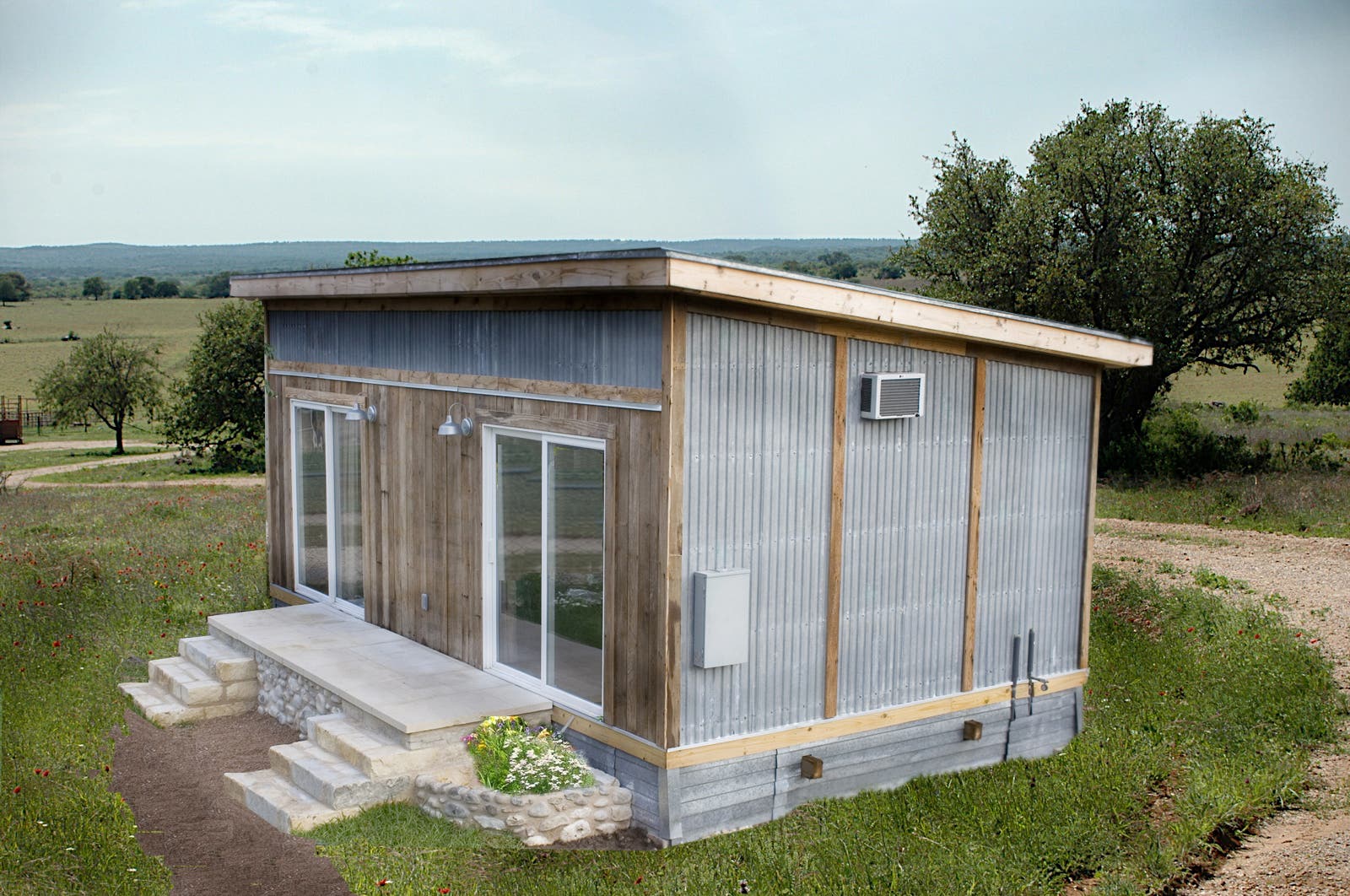
Austin-based builder Reclaimed Space is turning a new leaf in the green building industry. Designing, building and delivering fully-sustainable “Spaces” out of reclaimed materials, Reclaimed Space is building sustainable, not just green.
Each unit is custom-built using locally sourced materials taken from deconstructed homes. Rather than letting good materials go to waste, they are recycled and put to good use after thorough inspection and restoration.
Reclaimed Spaces are solar and wind energy compatible, making much of the energy it takes to power the Spaces renewable, and adding off grid possibilities. The single-pitch roof makes it easy to use filtered rainwater for the Space’s water supply, and gives the solar panels a full day of sunlight. Built on skids and beams, the Spaces are re-locatable; upon completion, they are delivered to any site.
Reclaimed Spaces have endless functions and possibilities. Remote living becomes simple, with the off-site construction and sustainable design. For land owners or real estate brokers, adding a Reclaimed Space increases property value and desirability by introducing livable space. The units’ cost-effectiveness and small size allows for affordable community living or temporary lodging. Whether it’s accommodations for a weekend retreat, guest or workspace, Reclaimed Space has a solution.
Reclaimed Space makes eco-friendly, sustainable living affordable. Pricing starts at $25,000 and ranges from $115 to $160 per square foot, depending on each Space’s individual features. These living quarters start at 240 square feet and can be configured modularly for larger designs.
Potential buyers can visit www.ReclaimedSpace.com to learn more about the company, browse photo galleries and view sample floor plans. With the combination of its sustainable building practices and their use of renewable energy, Reclaimed Space is delivering sustainable living, anywhere.
If you enjoyed this post, subscribe to our feed
Laurel Creek Park Models
Park models seem to be attracting a lot of attention lately and one that caught my eye recently was the Cedar Creek model by Laurel Creek Homes, and is sold near my home in Washoe Valley, NV by Clayton Homes. I stopped by one weekend to get a few photos since I really admired this park model’s use of space, spacious kitchen and front porch and the cozy feeling inside.

Laurel Creek offers 13 different floorplans for this cabin style park model, and each of their models comes with a 10 year warranty. Laurel Creek also offers several “green packages” to make your park model more energy efficient and environmentally friendly. Prices of the models vary according to the size and amenities, but the park model that I toured was being sold for $59,900.

Laurel Creek’s website gives more details on their park models and their benefits including:
- Affordability. A park model typically costs less than a 5th wheel or motor home.
- Financing options are available.
- RV Zoning required (Private property accepted in some states and counties).
- Move-in ready in less than 30 days.

Recreational park trailers or “park models” are 400-square foot cottages with peaked roofs that sit on a chassis and are typically placed on rented, leased or purchased sites in campgrounds or RV resorts and used as weekend retreats or vacation cottages. Park models can also be placed on private property and used as a part-time residence, subject to local zoning ordinances.
Typically upscale in appearance, Laurel Creek park models are available in many styles, from cedar cabins more suburban style homes with vinyl siding. The Laurel Creek park models feature solid frame construction, residential cabinets and full size appliances as well as optional bay windows and lofts. Interiors feature either a wood or tape and texture finish.
Laurel Creek was the first of 46 companies in the park model business to offer overhead heating and cooling systems. They have also introduced 9-foot flat coffered ceilings, tiled kitchen and bathroom flooring and marble lavies in our highline models.
All Laurel Creek park models are built to the ANSI 119.5 building code, which is administered and enforced by the Recreational Park Trailer Industry Association (RPTIA). The code requires that park models meet or exceed more than 500 building and safety standards. Respected park model manufacturers build to this code yet it is not a requirement.


Photos by Harry Thomas
If you enjoyed this post, subscribe to our feed
Oregon Cottage Company
Oregon Cottage Company, LLC
The chic little cottage in architect/builder Todd Miller’s yard has hand-stained, locally milled cedar siding, a striking forest-green metal roof and wood-framed windows designed for energy efficiency. Inside it’s a “green” and teensy 140-square-foot model of efficiency with designated areas for showering, cooking, relaxing and sleeping.
“I have a lot of interests as far as building in an alternative way, in a different way, and thinking outside the box,” says Miller, who has been certified as an architect since 1996.
Oregon Cottage Company, LLC is based in Cottage Grove, Oregon. Todd Miller foresees people ordering models based on the prototype, but with modifications meant to suit their particular needs.
“Right now we’re trying to get a feeling of what people want,” Miller says.
Some options, Todd says, are to use the cottages as art studio, guest house, office, kids’ clubhouse — or even a pint-size home for someone wanting to live simply. Though on wheels, Miller expects future owners to camouflage that with a skirt or shrubbery.
The bungalow is energy efficient and built with sensitivity toward the environment. It has a standard RV utility hook up or can be connected to public sewer and water. It includes a full kitchen, sleeping loft, shower and toilet all built on a 10,000lb GVWR dual axle flatbed trailer for portability. It is priced at $37,000 and has the following green features:
• Eco-Batt wall insulation (R-16.9 assembly)
• R-23.5 roof assembly
• R25.7 floor assembly
• Paperstone counter tops
• Landark Natural interior oil finish
• Locally milled cedar siding
• Reclaimed wood flooring and interior door
• Natural pine paneling
• SFI certified wood windows
• FSC certified pine trim
• Energystar refrigerator/freezer
At a starting price of around $22,000 Oregon Cottage Company, LLC can also build a “shell-out”option of this Bungalow where we provide a watertight exterior and sound structural framing.
You can learn more by going to Oregon Cottage Company, LLC site, also check out a press release at the Register-Guard.
If you enjoyed this post, subscribe to our feed
Flat Pack Cowboy Cabin
Form & Forest Flat Pack Cabins
If you have ever dreamed of getting away to a contemporary piece of design your moment has arrived. Form & Forest have worked hard to bring stunning design together with prefab manufacturing techniques that allow you to build a cabin and enjoy it sooner.
Form & Forest offers a range of cabins that have been designed for how you live at the cabin, both inside and out. Generous indoor and outdoor living spaces group the eating, entertaining and relaxing together while offering seclusion for sleeping and quiet reading.
The generous decks and large windows are designed into the plans with the full expectation that you will be building your cabin in a pretty fantastic landscape. A Landscape whose vistas, trees and rocks should be appreciated and embraced.
You might be wondering what is a flat pack cabin exactly? Form & Forest builds prefabricated panelized walls and components based on architectural plans in their indoor manufacturing facility and deliver them to your job site. These components are shipped flat along with siding, doors, windows, and roofing materials.
The Cowboy shown here is 635 square feet and the price for the kit is $68,100 excluding shipping and taxes. To learn more and see more designs and download a brochure, visit the Form & Forest website.
If you enjoyed this post, subscribe to our feed
The Taliesin Mod.FabTM
Stephanie Reiley of Coming Unmoored pointed this great find out to me on facebook the other day and I wanted to share with you this neat prototype that I personally hope will go into production one day.
The Taliesin Mod.FabTM is an example of simple, elegant, and sustainable living in the desert. The one-bedroom, 600-square-foot prototype residence relies on panelized construction to allow for speed and economy on site or in a factory.
It can be connected to utilities or be “unplugged,” relying on low-consumption fixtures, rainwater harvesting, greywater re-use, natural ventilation, solar orientation, and photovoltaics to reduce energy and water use. The structure is dimensioned and engineered to be transportable via roadway.
The Taliesin Mod.FabTM was designed and built by graduate and undergraduate students at the Frank Lloyd Wright School of Architecture with the faculty guidance of Michael P. Johnson and Jennifer Siegal, project manager Christian Butler, recent M.Arch graduate, and assistant project manager Nick Mancusi, current BAS student.
You can view the construction of this home at the PrairieMod blog and more pictures at the Taliesin Mod.FabTM site.
Photo Credits Bill Timmerman
If you enjoyed this post, subscribe to our feed
The Whole Picture Show
Peter King at “The Whole Picture Show”
Meet Peter King of Vermont Tiny Houses at the Whole Picture Show; Green Exposition located at the Sheraton Conference Center in Burlington Vermont on February 21 and 22. Here is your chance to meet Peter and view his work and chat with him.
Walk through a full scale frame model of his 10 x 10 tiny house design. Go to The Whole Picture Show Green Exposition website to learn more.
Peter has also opened a website site that you will want to bookmark and visit often. You can see a short video of him working with a class and keep tabs on his workshops.
You can now email Peter at peterking (at) vermonttinyhouses.com or phone him at 802-933-6103. Visit Vermont Tiny Houses here.


If you enjoyed this post, subscribe to our feed
Trailers for Tiny Houses
Michael Jones brought to my attention an area that has not been covered here on the Tiny House Blog and that is what kind of trailers to use for a tiny house on wheels or a gypsy wagon type home.
Steve Weissmann, Jay Shafer’s business partner at Tumbleweed Tiny House Company wrote a very good article on their website. I am going to republish it here and than do some followup research to see if I can learn more as well. This article is geared to Tumbleweed Tiny Houses but could be applied to your own design as well. Here is Steve’s article:
A typical flatbed trailer is ideal for building a Tumbleweed Tiny House. They are available at many trailer and RV stores. The picture is a typical flatbed trailer.
Often when you purchase a trailer, it will have sides or ramps. That’s okay, you will just need to remove the sides and ramp. It’s actually pretty hard to find a trailer without some sides built in. Sometimes they are referred to as utility trailers.
Trailer sizes are listed as the size of the actual trailer bed. It does not include the hitch or the wheels. For example, a 7′ x 14′ trailer would be 7′ between the wheels. Almost all trailers are 8′6″ wide when you include the wheels; and as it turns out, this is the widest possible width for road travel without a permit. The bed of the trailer would be 14′ long, and when you add the hitch, it would probably measure 17′ long.
Except for the New Popomo, all of our portable homes require a flatbed trailer where the wheels are taller than the trailer bed. The maximum legal road height in the US (without a permit) is 13′6″. None of our homes are taller than 13′5″. But more important than the legal road height is the height of the bridges. Most bridges are in fact much taller than 13′6″, but to be safe, you can not build on a trailer where the entire bed is above the wheels.
The New Popomo does not have a loft, and therefore is designed to fit on a trailer bed that is “over the axle”. The advantage to that design is that it provides for a wider house, albeit shorter.
Most trailers come with a double axle. Usually, each axle is rated to hold 3,500 lbs. However, some axles are rated for 5,000 lbs each. Therefore, a double axle trailer will have a total rating of 7,000 lbs or 10,000 lbs. This rating will have a large impact on the price. It is referred to as “GVWR”, which means Gross Vehicle Weight Rating. Keep in mind that the GVWR includes the weight of the trailer. So if the trailer is rated for 7,000 lbs and the trailer weighs 1,000 lbs, you can put 6,000 lbs on it. On our website, we list the weight of our houses including the weight of the trailer.
Except for the XS-House, all of our homes require a double axle trailer. The XS-House can be built on a single axle trailer if the axle is rated for 5,000 lbs.
Trailers usually include brake lights, a license plate, and a breaking mechanism. The lights and brakes attach to your car/truck, and when you use the brakes, it will also apply the brakes to the trailer.
There are many sizes for hitch balls, but almost all are either 2″ or 2 5/8″. The hitch ball on your car/truck is easily changable, and probably around $30.
Because the trailer is roughly 18% of the material cost, saving money on the trailer is the easiest way to control construction costs. Consider buying a used trailer. craigslist.org is an excellent place to look for a used trailer. Prices for used trailers range from $500-$1500, a savings of $1000-$2000.
Here are some websites that sell new trailers:
Big Tex Trailers
Trailers for Less
Trailers Plus
By Steve Weissmann – Tumbleweed Tiny House Company
Foot Note: Bill Kastrinos at Tortoise Shell Homes is now selling the trailers separate. Tortoise Shell Homes will sell the 8×16 7000# G.V.W. without ramps or side rails or ramp recepticles for $1950, add $100 for the safety break away kit.
They are very clean and easy to put a house on because the ramp recepticles, and rails just get in the way. They also have 1 1/2 inch doug fir planks, which can be used as the sub floor. The lowest prices locally is $2800.
They are not on his website so give him a call or email him (Click Here). Make sure and tell him you heard about it at the Tiny House Blog.
If you enjoyed this post, subscribe to our feed