Tali Wee of Zillow
Transitioning to life in a tiny home is on trend, but isn’t for everyone. Simply downsizing to an apartment is challenging for most modern Americans. To move your life from an apartment or house into a tiny home requires the ability to part with your excessive material belongings. Plus, you’ll have to let go of any hyper-organized or claustrophobic tendencies, as tiny homes require overlap between work spaces. One moment, your counter is a kitchen space and the next it’s an office desk.
However, most tiny home lovers greet these changes with pleasure. The minimalistic lifestyle can alleviate much of the stress or burden of caring for unnecessary keepsakes and simplify daily life. House cleaning suddenly becomes a quicker task; you don’t have to dust all your trinkets or vacuum rooms of carpets or rugs. You can also limit the habit of spending frivolously to decorate your home. Your tiny home will be chuck full of necessities, requiring little décor, unlike a 2,500-square-foot home with countless blank walls and surfaces.
Most tiny home residents make the move to either reduce the stress of their current rat race lifestyles, to test themselves with a new, minimalism lifestyle or to tighten their spending. Think about heating 500 square feet instead of that single-family home – huge financial savings. Or, contemplate the electrical costs for a tiny home verses your current home? Clearly, the tiny home lifestyle provides some financial benefits aside from the obvious lack of a mortgage payment.
Does this all sound perfect for you? Some considerations you’ll need to think about before following a whim to live in a tiny home are listed below. Carefully walk through the checklist before giving away your possessions and pursuing the tiny home lifestyle. Is it truly for you?
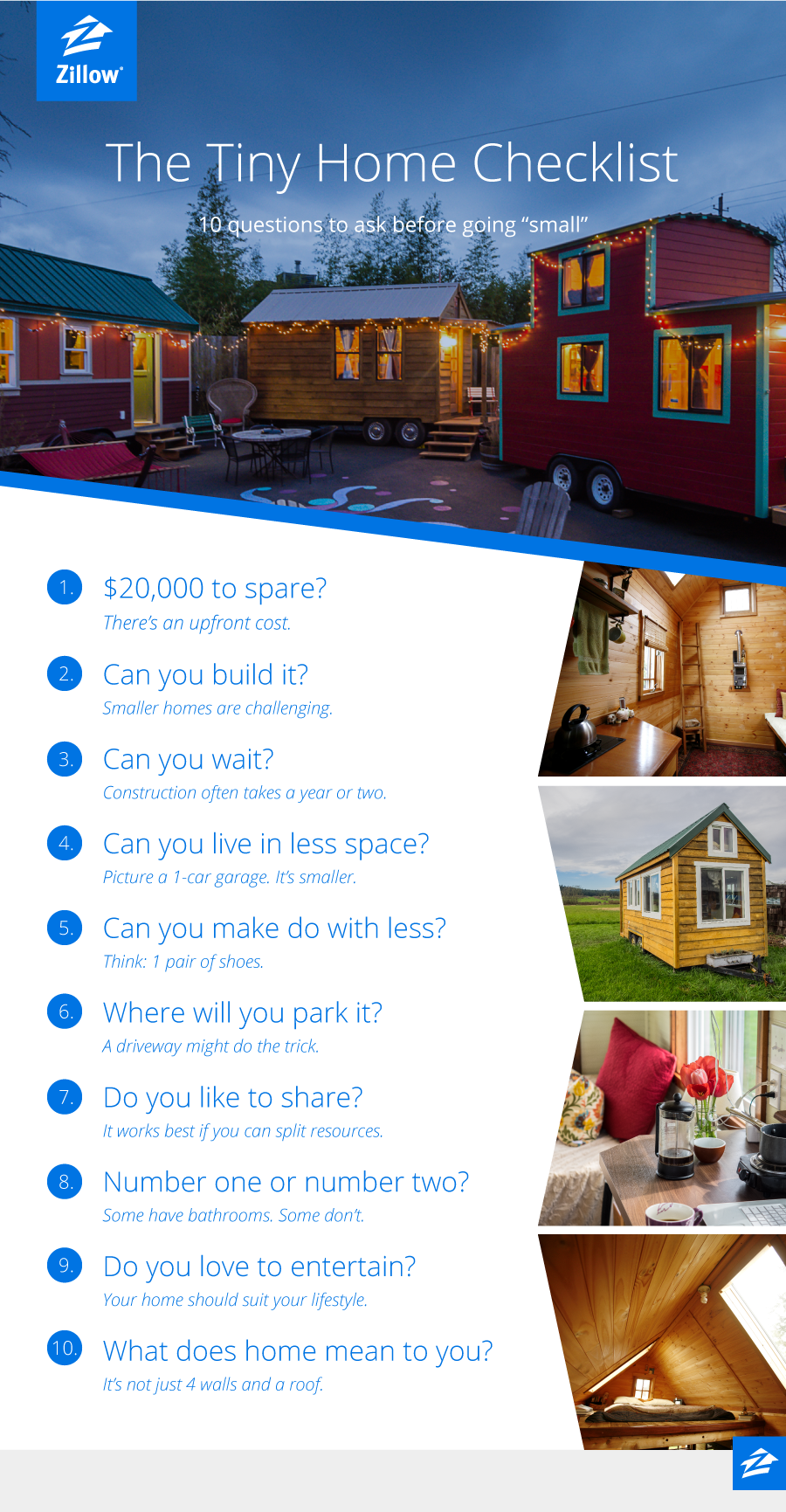
Checklist graphic here.
Making this transition even as I read this article. The process is definitely a PAINFULL one. However, as each piece of furniture or bag of clothes leaves my life, I feel better! The memory of those items quickly fades to anonymity. No regrets of missed belongings.
The most difficult, though, are “important” papers. That’s taking much longer than I thought.
Me too- The paperwork and piles of files are the worst! Even as it goes out, more seems to keep coming in. I’m going to look into the online sites like Evernote or similar to pare down even more.
I have been intrigued with the tiny house life since I found out my cousin is building one with his soon-to-be wife. It is perfect for them as they love to travel and want to live simply. I have 2 kids so, for us, it seems a little more difficult. We may never be able to be in an actual tiny house but we are trying to make our life as simple as possible and keep “tiny house principles” in mind when we start looking for a home. I do enjoy reading about families with kids making it work.
The vast majority of angst caused by considering ‘downsizing’ is due to the constant refrain we’ve all been exposed to since teevee took over propagandizing a consumerist mentality – a thing I gave up in no uncertain terms ~20 years ago when I was reading an article in the NY Times about people starving to death in Bangladesh and right next to it was an ad for Tiffanys and next to that, their ‘Homes’ special, touting the joy of an obscenely grandiose 5 million dollar house in the Hamptons. I’m sure that same house is for sale now by the hapless owners who finally figured out that the taxes, upkeep and yeah, the mortgage on a 5 million dollar house isn’t worth the snob appeal but I’m also sure that Tiffanys is still selling plenty of ‘oh shiny!’ things in pretty blue boxes.
For godssakes people, just resist the Madison Avenue army of corporate whores and you’ll be fine. A file box for your important papers, treasured photographs rotated into nice frames, the rest stored away carefully, one of everything you may really need in a minimalist kitchen and a listing of nearby restaurants that would love to host a crowd, and a wardrobe of what you really wear times 12 months of the year combined with a great mattress, and you’re gold. The vast majority of people now living on the planet as well as our own ancestors made do with far, far less.
Not everyone who has a lot of “stuff” is the victim of a consumerist lifestyle. Some people have essential tools for their trade or happen to engage in various activities that require equipment and supplies. Sharing works for some situations, not for others. I agree that most people have a lot of useless junk they don’t need to keep but not everyone can fit their life into a tiny space.
There’s no need for the angst engendered by trying to squash your life into a smaller space than what actually works or having unrealistic expectations of what any level of downsizing will do for you. Figuring out what helps or hinders the way you actually prefer to live is the key, not trying to adhere to a plan that works for someone else.
While I appreciate not being delusional the tone of the checklist provided by Zillow (a real estate MLS listing agency who makes money off of realtors and their ads selling big houses) is somewhat tongue in cheekly poking fun at tiny houses and isn’t appreciated. Perhaps it shows they are a bit scared of the movement!
I’m so glad you shared this. While I could probably never actually live in a tiny home, I do dream of it. The lifestyle adjustments would be too great, and it’d be too difficult with more than one person (ie. my family). We do live in a very small 2 bedroom home though, so for now that’s my version of a tiny home. Some of the stuff presented in this infographic I didn’t realize, like the $20,000 cash you should set aside before starting this kind of project. That’s a big investment, and one I hope people think about before jumping into such a huge change. Thank you again for sharing!
Kind of surprised ” How many people? ” did not make the list since that’s kind of a big thing. Many people buy a house in anticipation of starting/raising a family, and depending on how big your family is trying to live in <500 Square Feet may teeter between being chaotic and impossible. Pivoting ladders and careful ascents on a small staircase to get to a loft might make sense for an adult, but not so much for a small child.
That said, I remember two families that made it work for them. Both had a slightly bigger Tiny House than the standard-trailer size and had it on a foundation incidentally. One family had the kids sleeping on the ground floor — and were going to upgrade to a larger house anyway. The other had a child old enough to work the ladder. I'm curious if anyone is attempting such a thing with a very small (under 5 year old) child and how they make it work for them.
I think the Tiny House on the trailer that's so common is optimal for 1-2 people as a permanent residence. A young, childless, or retired couple could certainly make it work. For people who had or are looking to start a family they might want to take out a mortgage on a small reasonable Starter Home instead.
The $20,000 start-up cost is inaccurate. If you have space to build and park on you can just buy the trailer base and gradually buy the materials for your build. If not, then you'll have to factor in the cost of accommodation for your trailer while you're building. It can also be much more or less depending on what amenities and finishes you use. A higher-end Tiny House can easily be twice that.
#3 also isn't accurate. If you have all the tools, materials, some extra hands, and good weather you'll be able to go from start to finish in about a week. The average build seems to be less than a year even working alone in any case.
I realized since first finding out about the movement that a Tiny House on a trailer isn't right for me, but I do like the concept and will be applying that in my search for a Small Home on a foundation, I don't need a great many things and I'm fine with a reasonable mortgage. The keyword being " reasonable ". If nothing else, the movement has taught me that most live in excess and well beyond their means.
Tiny home, less expenses right?