Designboom’s Container Office

Designboom is a publication and blog that focuses on design, architecture, art, photography and graphics. Their main offices are located in Milan, Italy, but for the hot summer months, the crew of Designboom recently moved their offices into a series of cargo containers on the island of Sardinia. Their DIY … Read more

Livin’ Large, Living Tiny

Guest Post by R Blank (this is a repost from his original blog)

My wife and I have now been living tiny for several months. For those who don’t know, tiny homes (living units under roughly 200sq’) have become increasingly popular in the past couple of years. When we researched many options for different types of tiny homes, we found a lot of information — but very few first-person accounts of the experience.

And, after all, that’s what tiny living actually involves — a fundamental shift in thinking about consumption and space utilization — the rest (what type of tiny home, whether its mobile, how its built, etc) is all just details.

Our Shipping Container from LEED Cabins, in Place, with the Completed Porch and Privacy Fence

Given the increasing popularity of tiny homes I thought it might be valuable to someone out there considering the same to read some of my thoughts on what this experience has been like for us.

In our case, this isn’t a tiny home, so much as a my home-office. But we decided to place this small office structure on the land first, before building our home. Our land is 30 miles away from the nearest town (where ‘town’ is quite loosely defined; we’re literally 20 miles away from the nearest service at all, which is our post office), which makes development quite challenging. So we started small, so we could establish a base of operations without too much trouble (that it took us a year to even get this far, is an entirely separate story).
Read more

Daniel Sokol’s Container Cabins

Guest Post by Daniel Sokol

I started my container business because I wanted one for myself. My goal was a practical, well designed, cost-effective living space. Being an interior contractor, I had the skills for the finish work but never worked with a shipping container.

Everything I saw online was either an extremely expensive “one off unit” or renderings of proposed containers. My research didn’t yield enough useful construction information so I learned as I went along and made a lot of mistakes. The learning curve was a wonderful experience and, after building several containers, am still learning and experimenting with different components and designs.

A shipping container, used as the primary construction unit, has almost unlimited possibilities for any living environment (desert, mountains, forests, etc.) Although the
housing industry is in a major transition – along with our country – I believe there is a future for small, energy efficient, well designed living.

Read more

Sri Lanka Shipping Container Retreat

A friend and fellow tiny house lover recently sent me this link from Container Home on this shipping container cabin retreat in Sri Lanka. The house was constructed with local reclaimed material in about a month by architect Damith Premathilake. The tiny house is located on an Army base and was built for a lieutenant colonel.

The 700 square foot retreat is constructed of two shipping containers, timber strips from old bunkers and weapons boxes and used railway sleepers. It is designed to embrace the views and climate of the surrounding environment, and create a place of relaxation and beauty while using already available resources.

Read more

Cargotecture by HyBrid Architecture

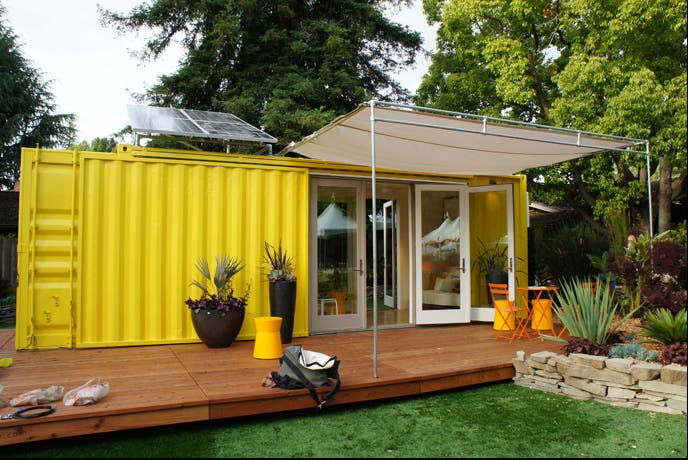
Sunset Magazine’s Celebration Weekend in Menlo Park, Calif. was held at the beginning of June, and one of the stars of the show was the cargotecture c-series Sunset Idea House by HyBrid Architecture. The c-series represents a group of pre-designed, factory built units made from recycled cargo containers that can be combined or customized as desired by the owner.

Hybrid coined the term cargotecture to describe any structure built partially or entirely from recycled cargo containers. The c-series consists of five models ranging in price from $29,500 to $189,500. The home featured at the Sunset show was the c192 nomad which costs $59,500.

The prices of the c-series include:

  • Recycled ISO cargo container with new paint
  • Soy based spray foam insulation
  • Aluminum clad wood windows and doors (one 10 feet long opening and one side door)
  • Bamboo finish floor
  • 5/8 inch drywall ceiling and walls
  • Panelized wet room bath with redwood decking.
  • Duravit bath fixtures
  • IKEA cabinets and kitchen fixtures and lighting
  • Summit appliances
  • 30 gallon electric water heater (gas if available on site)
  • Convectair Apero heat
  • Factory plans, State L&I permits and inspections

Green and off-grid options are offered including solar panels, composting toilets and “green machine” sewage treatment and roofwater harvesting.

All the models are insulated about 15 percent above IBC and UBC building codes in the floors, walls and roofs. The building can be placed in cold climates as well as moderate to hot climates. The recycled plastic and soy sprayed-in insulation creates R24 walls, R44 ceilings, and R32 floors. The roofs can handle 60psf snow loads.

The HyBrid homes are shipped complete. A local contractor will need to be arranged for electrical and sewage hook-ups as well as foundation work. In many jurisdictions, if your project is less than 200sf there is no permitting process required. HyBrid has completed residential and commercial cargotecture projects in California, Oregon and Washington and has designed over 20 projects on 5 continents. They will ship their cargotecture homes worldwide.

Read more

Shipping Container Guest House

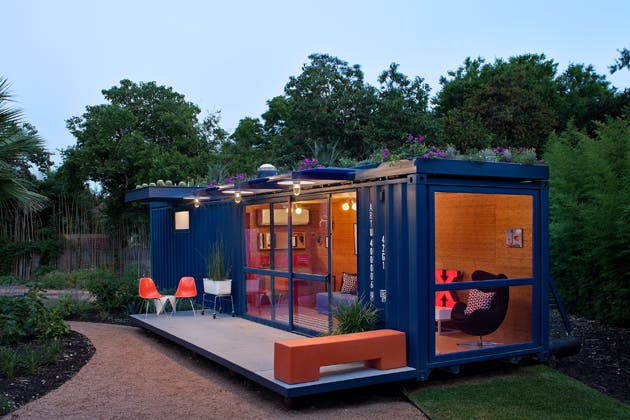
Poteet Architects in San Antonio, Texas recently constructed this shipping container house for a local client to use as a tiny guest house in her artist community. The plan is to also use it as a summer house, an art house and for entertaining. The owner enjoys the shipping container house for its uncluttered, sunlit appeal and the wonderful blue color.

The shipping container was chosen specifically for its bright color. Shipping containers are a readily available resource for building because they are usually abandoned by shipping companies. The architects mounted the container on recycled telephone poles, and the floor and walls were covered with bamboo. Sliding doors, windows, heating, air conditioning and an 8 foot by 4 foot bathroom with a composting toilet and red sheet metal walls were also added. A garden storage room was also added at the end of the container, which retains its original access doors. A patio with a cantilevered overhang was added to the front of the house and a rooftop garden with a drip system was installed by Madrone Landscape Architecture.

Read more