
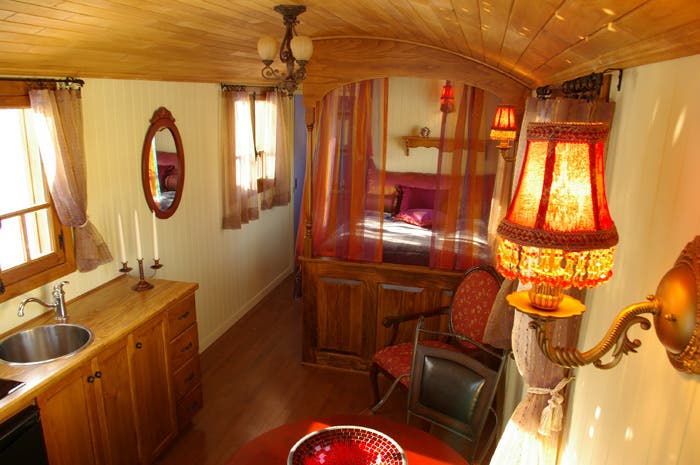
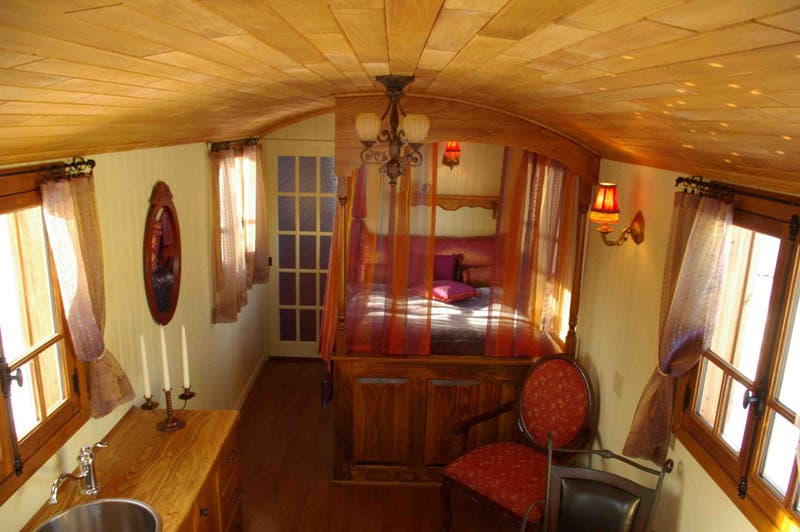
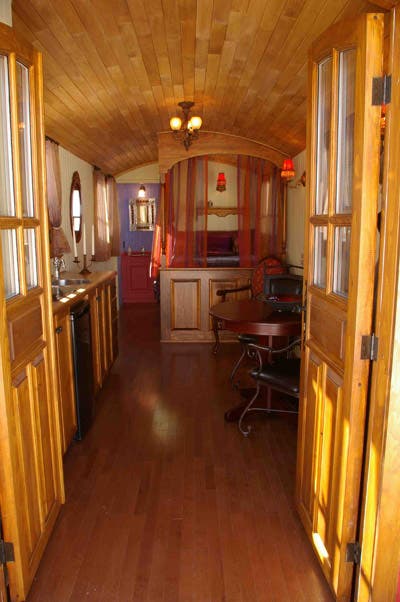
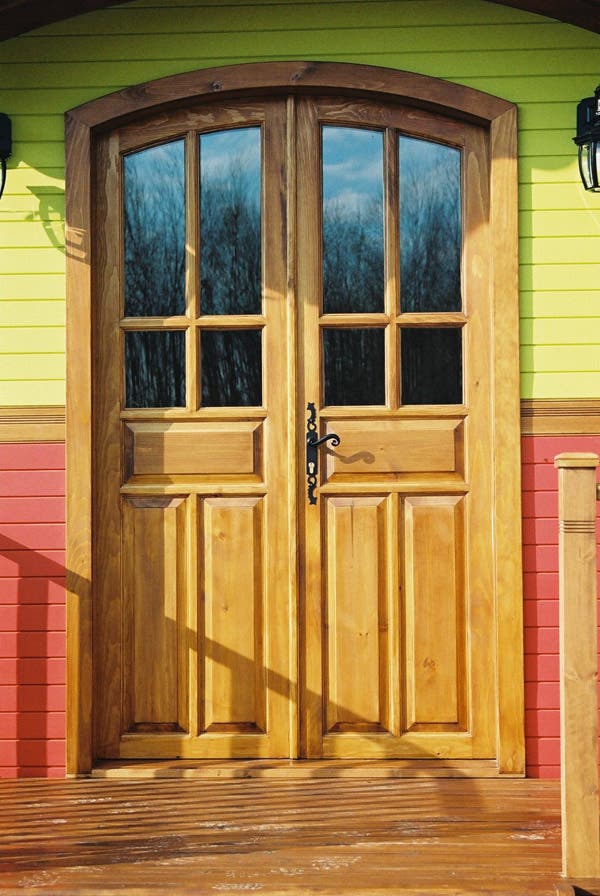
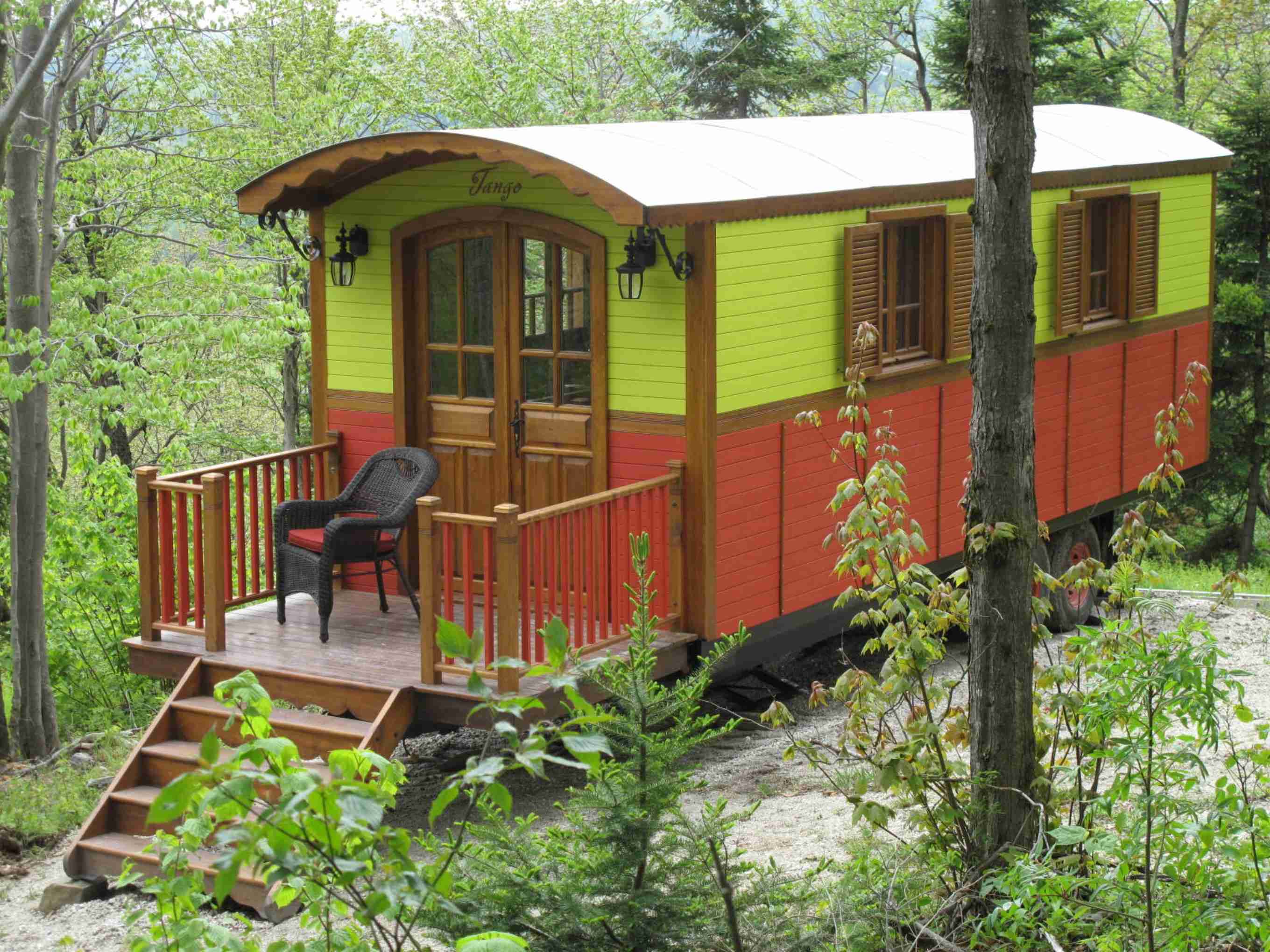
Guy Lemieux in the Eastern Townships of Quebec, Canada offers a unique modern take on the gypsy-inspired transportable wooden 4 seasons cottage adapted to modern living with a carefully decorated and furnished interior.
As a cottage or guest house, a workshop, boutique, café, welcome centre, kiosk, camper, base camp, or addition to a tourist accommodation, the Tango caravan comes fully equipped or made to measure, adapting to your needs and blending beautifully with the environment where you use it.
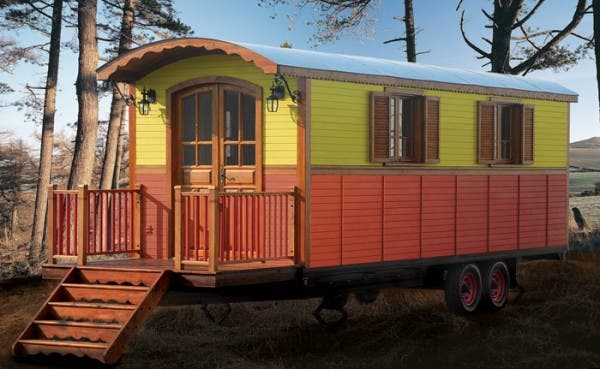
Tango caravans are available in different versions: basic, finished, equipped and decorated, or made to measure. The caravan you see on our site is 24 feet long, Tango now has added 26 and 32 foot as well.
Tango builds the caravans to measure, the price of the base model without furniture (no bathroom and kitchen) are starting at 29,000$ cdn (26 feet) 32,000$ cdn (32 feet) and the full equipped starting at 37,000$ cdn (26 feet) and 49,000$cdn (32 feet). The 32 feet version has two rooms.
This is a new company just started in February of 2009. I had the opportunity to talk to Guy’s wife the other day and they hope to bring these to the United States as soon as they get all the importing details worked out. Go to the Roulottes en bois Tango website to learn more.


If you enjoyed this post, subscribe to our feed
Absolutely incredible. I’m pleased to see the world of tiny-house building moving beyond the usual scaled-down cottage.
Kind of reminds me of the Tonke Campers. Pretty neat.
That is gorgeous! Gypsy caravans are how I first became interested in tiny houses!
I’m in love…
Lelly
Great attention to detail in that. Obviously a very skilled carpenter compared to a lot of the other tiny house builders.
Great post Kent!
Amazing detail and a really cool shot of it in the woods.
When you think about it these types wagons were the original tiny-house trailers or RVs from the UK and Europe.
In spit of the owner-built aspect, I suspect most all of these ‘rolling’ homes will end up just like RV’s and trailers of the past- abandoned to the poor and then junked in a landfill. Living small… by building disposable houses.
I absolutely love this. I truly appreciate the scaled down home look of the Tumbleweed homes, but this so whimsical it brings forth memories of youthful daydreams of the gypsy life.
In response to Eric, I certainly hope that is not the case. I see this new trend as being very different than RVs and trailers of the past. Essentially, this new crop of mini-homes is being built with the same quality and eye toward longevity as full sized homes, whereas older RVs and trailers were never meant to stand the test of time. But that is just my two cents worth.
I find this site fascinating. I just think that, should I embark on this, I would do two things:
1. add bigger windows, if not a door that opens to the outside in stead of every window, as it would allow more fresh air inside, and it might give a sense of being bigger;
2. divise it in a way that a tent could be added on (or just opened), should one have guests over.
Carey,
I’m not sure why you believe the quality is better, almost all of these homes are being built with the exact same stick/balloon framing methods as a 1970’s trailer home or any modern McMansion. Two by fours, plywood, aluminum or wood siding, and wood paneling inside. Sure, they look a lot nicer, but the basic construction techniques are largely the same… apart from one being built in a factory and the other under awnings and tents by someone with limited experience that is.
The mere fact that you’ve got them on an portable, exposed, steel foundation is going to dramatically shorten their lifespans. Does anyone really see these things in use by the same owner(s) in 20 years? Heck, most of the trailers they’re built on even have warranty’s that long, many are only one year. They’re certainly not something you’re going to pass down to the next generation, much less a few generations.
Again, I don’t believe you can ‘live small’ by building what is fundamentally a disposable home, no matter how small it may be.
Eric,
I just designed, and am halfway through building one of these little houses. I appreciate that people are lobbing more than just enthusiasm for a fad toward these ideas.
The steel trailer mine sits on was built in 1973. It is as strong as the day it was built, then stiffened by a laminated plywood outer structure. I am treating the exterior better than I would any house I’ve worked on in this climate (Western Washington), so the ply structural shell should last 50 years or more… with normal maintenance (which is easier than a normal house because of the smaller scale).
Most RVs and mobile homes end up damaged by mold and rot, usually because of strange choices of material and difficult to maintain structures. Example: sheet metal over wood frame with plasticised paneling interior and bad airflow and drainage. Yuk.
Anyway, the size of these houses allows great integrity in the design and choice of materials. They are expensive per square foot, but cost is not always the bottom line in the story of our lives. Here’s to living GOOD… not big.
Abel in Olympia
Eric, what ways do you see of building without doubling the cost that could extend a portable or small house cost?
Very interested in long-term construction.
if these smaller homes were built so that they could be easily removed from their trailers to be put on new ones i could easily see these things being passed on for generations.
these look like they are built with quality in mind. no comparison to a crappy rv imo…
I just found your blog on Bing and have been reading along. I thought I would leave my first comment. I don’t know what to write but that I have enjoyed seeing it. Terrific website. I will keep reading this website very often.
I know this is an older post but I just happened to see it now, this is a fantastic little home, it has a very open airy feeling to it, very nice!
I cannot wait to spend a weekend, or week in Guy Lemieux Tango Wagon!! With their lovely choice of decor, and their simply friendly personalities, this couple makes your stay in their homes exceptional. This is gonna be an experience 🙂
Glad to see one that is over 16ft. My current design keeps coming out at plus 20+ ft to accommodate my interests and lifestyle and if I compromise any further I doubt that it would work for me long term.
As to Eric’s comments. RVing is big business here in Australia as the well healed baby boomers are retiring and packing up for a life on the road. Many of the RV’s currently being built are quite luxurious, and built to withstand rough terrain, all weather and to be completely off grid. Costing 100’s of 1,000’s of $’s, As do the vehicles that tow them – which is in my opinion the one big downside to these RV’s.
I know of one couple who have been living and travelling continously for 15 years, their RV being their only home. This particular RV actually appreciates in value over time due to the reputation of the manufacturer and proven durability of the product.
Having said that, yes I have seen the odd tiny house that appears to be substandard and not meeting the needs of the occupier. Some people just arent meant to be builders and its sad to see their dream of financial independence topple over.
However I see no reason why a well built “trailer home” should not last for generations to come. There are gypsy vardos built in the 1800’s early 1900’s that are still going strong.
They are not for everyone but obviously if well thought out and well build they are right for others.
these “Gypsy” wagons are not anything like the origonal Romany caravans of Southern Ireland and the UK. They were hauled by a horse and the family lived a very cramped life indeed.