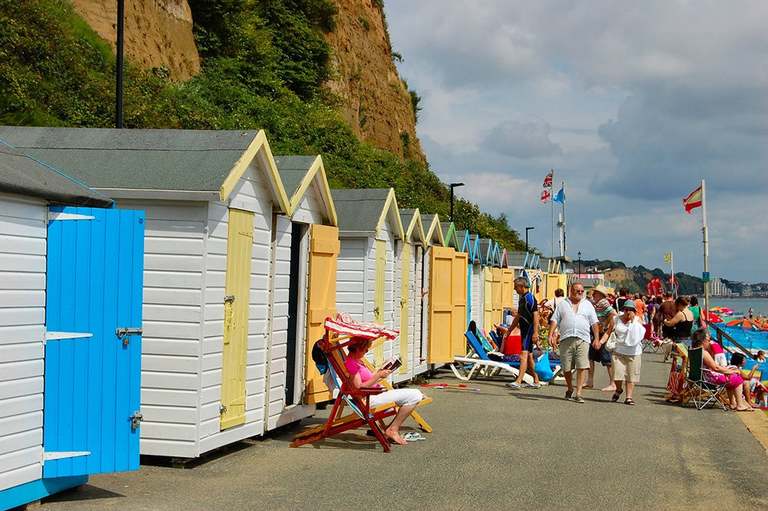
Tiny House in a Landscape

by Kent Griswold on May 24th, 2013. 1 Comment

Today’s Tiny House in a Landscape was submitted by Steven over at Tiny House Swoon. Entitled the Beach Hut. Here is what the owner has to say about the place.

Stay in this unique self-catering beach hut in North Cornwall and discover the simplicity of living in an area of outstanding natural beauty in a Cornish beach shack. Built in the 1920s, the Beach Hut exudes simple seaside chic; clapperboard exteriors and wooden floors combine in this characterful and cosy hideaway. Click here to learn more.

the beach hut

Charles Finn’s Microhomes

by Christina Nellemann on March 25th, 2013. 26 Comments

Charles Finn might just be the ultimate tiny house Renaissance Man. He’s a self-taught woodworker, an author, freelance writer, editor of the High Desert Journal, a literary and fine arts magazine, and his custom microhomes also allotted a full color spread in Lloyd Kahn’s “Tiny Homes, Simple Shelter” book.

Finn

Charles is originally from Vermont, but lived in Japan for a few years and admired the Japanese tea house designs. He eventually found himself in British Columbia living in a 7×12 foot vardo made by a woodworker friend. The vardo had no electricity or plumbing, but did have a 3-burner propane stove, a Jøtul woodstove and a set of deep-cycle batteries to run his laptop. After his first experience in a tiny home, he built his first “microhome” in Potomac, Montana out of lumber dismantled from old barns. The 8×12 foot cabin with a five foot loft became known as the Potomac Cabin. Continue Reading »

Opportunity Village Eugene and the Conestoga Hut

by Kent Griswold on December 19th, 2012. 20 Comments

by Andrew Heban

I am with the non-profit Opportunity Village Eugene and thought you might be interested in posting about our newly developed 60 sq. ft. Conestoga Hut here in Eugene, Oregon.

The Conestoga hut is 6 by 10 foot shelter that can be built for between $250 and $500 depending on the utilization of re-used or donated materials. While this price is similar to a quality tent, the Conestoga makes significant improvements upon the tent – most notably an insulated and lockable space – while minimizing the cost, skill and labor required by a more conventional, four-walled structure.

Conestoga Hut

There are four components to a Conestoga hut: a basic 6 by 10 foot insulated floor, two solid, insulated walls that line the short sides of the flooring, and a metal wire roof that is curved to connect to the long sides of the floor. The roofing frame is then covered with insulation and outdoor vinyl that is attached to the base of the structure.

The result is a structure that resembles the Conestoga wagons used during early American westward expansion. The components of the shelter can then be easily assembled or disassembled on site, drawing a reference to the rugged individualism again linked with the Conestoga wagon. Continue Reading »

Kevin’s Tiny Houses

by Kent Griswold on September 12th, 2012. 37 Comments

by Kevin Mason

I’m a degree qualified engineer and have been involved in a number of industries over the years. I’ve passed numerous caravan parks in the UK full of static caravans. Basically, I always felt they looked like countryside slums and I always figured I could make something which looked a lot nicer from the outside, but I never had the space or the money to do such a big project. I always loved small whitewashed cottages and felt I could replicate one.

hobbit house

Anyway, nothing happened for a few years until by chance I stayed in a friend’s pub on our famous coast to coast walk and he was looking at camping pods to generate some income from his camping field. I now knew people wanted to stay in small houses, at least for their holidays. I could therefore afford to try these out. Continue Reading »

Dan’s Lithuanian Small Home

by Kent Griswold on April 11th, 2012. 53 Comments

by Daniel Combellick

*New Photos added

The house began with ordering 60 logs from the forest service, which they delivered to the site. Common Fir. Some of these I used to build a small hut, which were all hand-hewn, along with some Birch logs taken from my forest. I lived in this small 12 X 16 ft hut the entire time I was building the house.

The foundation was dug by hand, and filled the same… this was one of the three procedures on the house I had help with – the other two were installing the metal roof, and hanging the drywall – besides these all work was completed by me. In my shed there was no electricity or water – the water I brought in containers in a wheel barrow, or on a sled in the winter – from a nearby farmers well, the old kind, drawing the water with a bucket on a chain and dumping into the old milk containers I used for storage. My light was from headlamps, and kerosene lanterns. I had a propane stove, an outhouse, and an outside bathing shelter.

cabin on the lake

When I had completed my lumber take-off I sent the logs to a mill and had them sawn. Then, I commenced building. I was alone almost every day, this is a very remote spot, it is very quiet. Sometimes the loudest sound above that of my tools was the flap of a bird’s wings overhead. Did you know crows are very noisy fliers? Continue Reading »

Tiny House in a Landscape

by Kent Griswold on January 14th, 2012. 13 Comments

This week’s Tiny House in a Landscape is from a link that Margy Lutz from Powell River, BC sent to Lloyd Kahn. Lloyd and another reader Julie Thorne shared the link with me and I thought it was perfect for this feature. I chose the winter shot because it is that time of year and it seemed appropriate. There are construction photos of the cabin at the New Shelter blog http://newshelters.blogspot.com/.

“A series of bluffs up the East Tin Hat Ridge presented better and better views the higher we climbed. This is the last open bluff before Tin Hat summit, a somewhat flat and large, though uneven rock outcropping. We decided to build the cabin here.…Below follows a chronology of the construction of the hut which, complete with upgraded trail, took some 30 days over a period of about three months.”

The photos is titled: The first dusting of snow on Tin Hat Hut at the end of October.

Mike Massulo Photographer