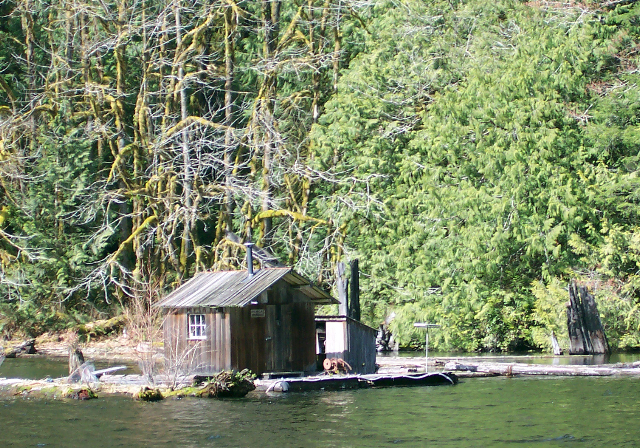
Millie Hill Floating Getaway
Ok, I know this blog should be called the Tiny House Blog and the Tiny Floating House Blog. I am enthralled with both and when ever I see a new or exciting floating home or getaway I want to share it with everyone.
This one also comes from Chris from Small Footprint Living and it is similar to some of the previous posts I have done on tiny houseboats or floating homes. This is Devlin’s, Millie Hill version 2 and you can view more pictures of the construction and read more about it at the Devlin Boat website.
Here is a little of what Devlin has to say about the Millie Hill:
Have you always wanted a waterfront getaway but couldn’t afford the luxury? This cozy retreat is our answer to the problem. Winter, spring, summer or fall imagine yourself anchored in some beautiful backwater in this little vessel. Equipped with a wood cook stove and galley you can catch or bring in the ocean’s bounty or something from Safeway.
She sleeps four with the settees converting into double berths. The head has a shower and private entrance with a wet hanging locker. There is a dry locker closet near the front deck area. The galley has full standing headroom with comfortable sitting headroom in the settee area for reading, writing or card-playing. The front deck has screening for ventilation in the summer and canvas awning for covered dry storage while on board. The Millie Hill has a 10 hp Yamaha hi-thrust outboard, she powers at what I would guess is 5 knots top speed.
Plans for Millie Hill are available at the Devlin Store for $100. This just might be the floating getaway you have been looking for.
If you enjoyed this post, subscribe to our feed
Flagler Houseboats
Chris from Small Footprint Living shared this site with me and I thought all you floating home enthusiasts would appreciate this small floating home.
Flagler Bridge Boatworks and Marina in Flagler Beach, Florida, hired Sponberg Yacht Design in 2005 to develop a series of houseboat designs for their marina.
The Prototype Flagler Houseboat has rounded corners and an arched roof, which will be optional on future models.
The prototypes shown in the first series of photographs were built on plywood and fiberglass barges, and a newer model has been developed for a molded fiberglass boat hull.
The Flagler Houseboats shown here are in two sizes: Small, 16’ x 40’ or 16′ x 44′, with about 550 sq. ft. of interior living area on one level; and Medium, 20′ x 40′, 20′ x 44′, and 20′ x 48′, with about 1,400 sq. ft. of interior living area on two levels.
Each living unit is built on a rectilinear plywood and fiberglass hull that is subdivided into several watertight compartments.
While the curved corners and curved roof are quite attractive, they are more expensive to build than square corners and roofs. These features are not included in the standard designs, but an owner may request them for a correspondingly adjusted price.
Each houseboat has complete electrical and water services. There are shore power connections for electricity, television, telephone, and the Internet. To read all the details go to the Flagler site.
Photo Credit: Flagler Houseboats
If you enjoyed this post, subscribe to our feed
Narrowboats
The United Kingdom is a land of canals and waterways, and narrowboats are right at home on these placid waters.
The “narrow boat” refers to the original working boats built in the 18th, 19th, and 20th centuries for carrying goods on the narrow canals. The term is extended to modern “narrowboats” used for recreation and occasionally as homes.
The key distinguishing feature of a narrowboat is its width: it must be no more than 7 feet (2.13 m) wide to navigate the narrow canals. Modern boats are usually 6 ft 10 in (2.08 m) wide to guarantee easy passage everywhere. Because of their slenderness, some narrowboats seem very long. The maximum length is about 72 feet (about 22m), the length of the locks on the narrow canals. However, modern narrowboats tend to be shorter than this, so that they can cruise anywhere on the connected network of British canals.
Modern narrowboats are used for annual holidays, weekend breaks or as permanent residences. Usually, they have steel hulls and a steel superstructure, but they can also be made of fiberglass or timber. They are usually powered by modern diesel engines. There will be at least 6 feet (1.8 m) of internal headroom, and similar domestic facilities as a small landward home: central heating, flush toilets, shower or even bath, four burner stove, oven, grill, microwave oven, refrigerator, satellite television and mobile phones. Externally, many narrowboat owners will brighten up the linear shape with bright paint, designs or crests.
They can be owned by individuals or groups, rented out by travelers, or used as cruising hotels. A few boats are lived on permanently, either based in one place (though long-term moorings for residential narrowboats are currently very difficult to find) or continuously moving around the network (perhaps with a fixed location for the coldest months, when many stretches of canal are closed by repair works or “stoppages”).
On most narrowboats steering is by tiller, and the steerer stands at the stern of the boat, aft of where a person emerges from the hatchway and rear doors at the top of the steps up from the cabin. The roof of the narrowboat is usually used for lounging or storage space.
Just like anything that is in or near the water, upkeep is constant. Many narrowboat owners need to be familiar with engine and hull repair. Also, because of the small size and it being a floating home, clutter and excess stuff has no place on a narrowboat. In fact, there is quite a funny video about a very messy narrowboat and how the ladies from How Clean is Your House? make it shipshape.
We would love to hear from our readers in the UK about their experiences with narrowboats, if you live on one, even better!
Our Day on the Narrowboat Charlie
National Association of Boat Owners-UK
If you enjoyed this post, subscribe to our feed
Float Cabin Moving Day
One of the most frequent questions I get about our float cabin on Powell Lake in Coastal BC is, “Does it move?
I’m sure that’s because the closest thing most people are familiar with is a houseboat. We have a few here on Powell Lake, but a float cabin is permanently anchored to the shore. In the case of Powell Lake, there are about 200 cabins on Crown water lots leased from the BC government. Fortunately we have a big lake, so it isn’t crowded.
Now that I’ve told you that the float cabins are permanently anchored in place, maybe I should say semi-permanently. On rare occasions a cabin needs to be moved. As you can imagine, moving day up the lake is a big deal.
Cabins are often remodeled at the Shinglemill Marina at the lower end of the lake. To do this, the cabin is towed down and moored outside the marina’s log breakwater. This makes construction much easier since our lake sites are water access only. When renovations are done, it’s moving day.
You don’t see it very often, but recently we were involved with a moving day when our friend sold a cabin and moved it to a different site. Even though a cabin with its float is very large and heavy, it can be easily moved with a small boat. It’s best to go early in the morning when the lake is calm. Travel is slow, so you will see people having BBQs and picnics aboard along the way.
After the cabin is in its new location, it’s reattached to the shore. A log boom is then moved into position for added protection from wave action. Now the cabin’s new owners, Margaret and Art, can enjoy their new floating home away from home.
For more information about float cabin living, you can refer to previous posts here on the Tiny House Blog. You can also visit my blog at http://PowellRiverbooks.blogspot.com or read Up the Lake and Farther Up the Lake by my husband, Wayne J. Lutz. Both books have lots of information about life in an off the grid cabin. Ordering information for the books and Kindle formats is available at www.PowellRiverBooks.com.
By Margy Lutz, Powell River, BC
If you enjoyed this post, subscribe to our feed
Float Cabins on Powell Lake
By Margy Lutz, Powell River, BC
Float cabins on Powell Lake in Coastal British Columbia come in many sizes and styles. Originally they were bunkhouses or working structures for logging camps, or inexpensive weekend fishing and hunting retreats for mill workers. The cedar log floats and cabin materials for these original cabins came from the surrounding forest. A few old timers still remain if you know where to look.
One of the smallest cabins was owned by Jess, a neighbor of ours in Hole in the Wall. He always said, 8X10, just like a picture. He built his very small cabin in his back yard just after he was out of high school. As the story goes, his cabin became part of a Powell River festival parade as he transported it to Powell Lake. Rather than wait, he joined the procession, letting everyone see his pride and joy.
Before 2000, the float cabins on Powell Lake were not regulated. You could build one and place it in a location of your choice. Now the cabins and their water lots are registered with the Integrated Land Management Bureau of British Columbia. There is also a moratorium on the number of cabins, which now stands around 200. Because no new cabins can be added, you will find owners such as Jess replacing or remodeling their old cabins.
While there are a few large and spectacular cabins on the lake, most are modest weekend and summer getaways. The majority are of wood frame construction because weight on the float is a big concern. This style also allows for easy insulation, especially for cabins that will be used throughout the year. Metal roofs are popular, but you will still find some cedar shake shingles. Our cabin is a basic 20 X 21 cabin (see my previous posts “Our Little Cabin Up the Lake” and “Living on the Water” for more details). A peaked roof gives us just enough room for a sleeping loft. Most of the cabins are owner built, so you will find many of this style.
The barn style cabin is also popular. That’s because you get more space and headroom for a second story or loft. This is helpful because most cabins are set up to handle lots of family and friends. We don’t get much snow is our area, so a steep roof isn’t necessary. One thing that is necessary is a covered porch. We call ourselves the Sunshine Coast, but our other name is the Raincoast.
This barn style cabin is one of the rentals available on Powell Lake. You can get more information at www.floatcabins.com. Information about houseboat and cabin rentals is also available at www.lakesidefloatingvacations.com. It can be a very economical way to have a vacation and get a taste of float cabin living.
West coast style cabins have lots of windows for light and lake views. All cabins are off the grid, so natural lighting in all rooms is very helpful. This style also allows for high ceilings in great rooms and lofts with good headroom.
Thanks for coming up the lake with me. We have a unique lifestyle and community. It’s a bit history, a bit back to the land (so to speak) and very relaxing. You can find more information about float cabin and off the grid living at http://PowellRiverBooks.blogspot.com. For information about my husband Wayne’s Coastal BC Stories, come to www.PowellRiverBooks.com. Up the Lake and Farther Up the Lake have lots of information about our cabin life on Powell Lake.
If you enjoyed this post, subscribe to our feed
Our Little Cabin Up the Lake
by Margy Lutz, Powell River, BC
My husband Wayne and I were vacationing in Coastal British Columbia when we discovered something unique and intriguing on Powell Lake, float cabins. It was love at first sight. We had been looking for a place to retire and knew this was it. We laughingly say, when we bought our cabin, it came with John. This was very important. In the beginning we could only visit on holidays. John (the previous owner and cabin builder) agreed to check on our place and help out with odd jobs.
Float cabins are a big part of Coastal BC history. During the heyday of logging and fishing, they were used as support camps that could be moved from place to place. On Powell Lake, float cabins were inexpensive hunting and fishing getaways for paper mill workers. Today things are a little more regulated. Cabins have registered water leases and we pay property taxes.
Cabin construction begins with the float. John lashed huge cedar logs together with ¾ inch steel cable. A winch and hydraulic jack tighten the cables and large railroad spikes hold them in place. Next the deck is added and finally the cabin is built on top. John is typical of many people who live in Coastal BC. He is self-reliant and a “Jack of all trades.” And he has been very patient about teaching us “city-folk” along the way.
Our cabin is small (20×21 feet) but complete. The downstairs has two bedrooms, one of which we use for storage and a bathtub. The main downstairs area is a great room design including kitchen, dining and living areas. The large upstairs loft is our bedroom. It’s plenty of space, especially since we have the whole outdoors at our doorstep. The main float is 40X40 and we have additional floats for a variety of purposes: a dock, a floating woodshed and my floating vegetable garden. The garden is on a pulley. I bring it in to tend my plants and then send it out to our log boom breakwater to protect it from hungry critters. When Wayne wants privacy for writing, he heads out to the Gemini, a renovated boat that is his author’s retreat.
We live up the lake about 25 minutes from the marina. Our power sources are solar and wind, with propane for cooking, refrigeration and additional lights. In winter we use a small generator to give our batteries an occasional boost. Our wood stove keeps the cabin warm so we can live there in all seasons. An outhouse on shore may soon be replaced with a composting toilet. Four flights of stairs up the cliff in stormy weather isn’t always fun.
Now that we have retired, we spend about 75% of the year living in our float cabin. Our lives follow the seasons with wood gathering, gardening, swimming, fishing and enjoying our surroundings. There’s nothing better than getting up early and having a cup of coffee on the deck watching the sun rise over Goat Island to herald in a new day.
In 2001 we purchased our cabin for $35,000 CAD which at the time was about $25,000 USD. We figured we couldn’t go wrong with that. Actually, because there is a moratorium on new cabins the values have risen quite rapidly. John sold another cabin this year (a little larger than ours) for $100,000 and some are going for even more than that. Even so, it is still within the range of many people. Of course, that is because there is no land involved. But we feel comfortable with our 20 year lease that is renewable from the BC government. The lease payment is $500 a year and the taxes the same amount.
You can find more information about float cabin and off the grid living at http://PowellRiverBooks.blogspot.com. For information about Wayne’s Coastal BC Stories, come to www.PowellRiverBooks.com. Up the Lake and Farther Up the Lake have lots of information about our cabin life on Powell Lake.
If you enjoyed this post, subscribe to our feed