The Stannexe
by Benjamin Vine
rdp architects
Hastings, East Sussex, England
When our Octogenarian clients came to us in 2010 with the idea of converting a tired leaky small trapezoidal garage into an artist studio with accommodation we jumped at the chance. The brief was to take the existing unusable garage and create a self-contained, multi-role building that can be used for storage of general items at the front, as a bright artist’s studio and also as temporary accommodation for visiting family and guests.

Located in the Ancient Seaside Town of Hastings, on the south coast of England we are used to dealing with tight sites and designing around listed buildings whilst maintaining sympathetic design, required for most of the town’s conservation areas but this was the first conversion of a garage. Being located in a conservation area we took great care to design the Stannexe [named by the Client, a combination of “Studio” and “Annexe”] to enhance the locality through the use of quality finishes whilst having an individual style.

Despite strong opposition by the local Planning Department, permission was eventually gained for the Stannexe through Planning Appeal.
The Stannexe gets its unique form from the shape of the original garage, it was designed so that when viewed from the nearby street a passer-by would simply see a slate roof and gable end typical of many buildings in the vicinity. The act of maintaining this roof line along the side viewed from the street created the tall side and rear elevations that give the building such an individual character. Continue Reading »
Narrowboats – Historical Tiny Living
Guest Post by Shelley Davis
In England today, narrowboats are floating homes, or holiday cottages, moored on the nation’s inland waterways.
They can range from a small 20ft long day boat to around 80ft long for some liveaboard craft that will never be taken around the whole country, but must always be under 7ft wide to retain the narrowboat name. Inside the boat, this can give up to a luxurious 420 sq ft of space, once you exclude the engine and other ‘service’ areas.

Photo credits - R-P-M
However, historically Narrowboats were working craft, where the majority of the length was dedicated to moving coal to London, chocolate from Birmingham, crockery from the potteries in Staffordshire. This left only up to 10ft of one-room space for living for an entire family with multiple children. Most furnishings were multi functional: Continue Reading »
Mini Caravan
The 2011 ETA QTVan is minimalism at the extreme with a high price to match. The ETA QTVan is Designed and built by an English company called Environmental Transport Association. With the Royal Wedding approaching the company is promoting it as a way to camp in royal style. At $9,000, I sure hope so!
It’s small, just over six feet long. It has just about everything you need though: a full-size bed, a tea service, a full bar, and a 19-inch flat screen television.
On the green side, the ETA says the QTVan is 100-percent carbon neutral, as long as you use the ETA mobility scooter.
Unfortunately the QTVan is only available to English customers, so you will have to go to England to buy one. It’s small enough that I’m sure you could ship it home without adding too much to the high price.
It is neat to see what can be done with minimal space, however with no bathroom or real kitchen it would pose some problems for full time living.

The E-den and the Hut
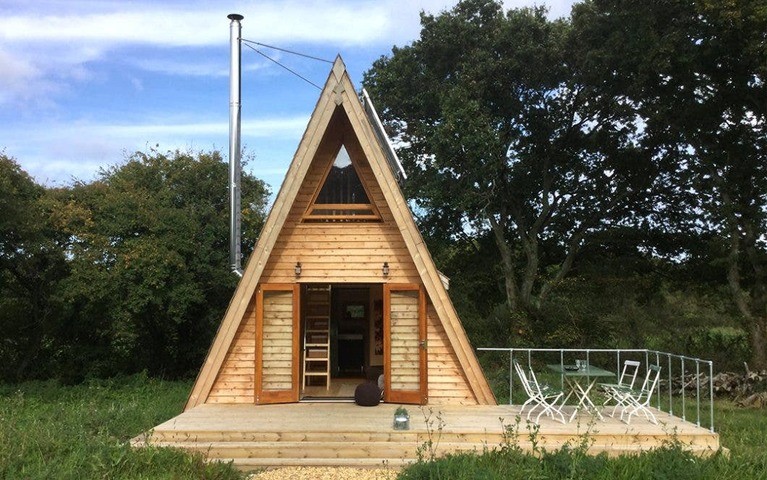
The E-den and the Hut are two new outdoor living/tiny house designs by the UK company Timber Tradesmen. Timber Tradesmen are selling these tiny buildings as alternative options to camping in a tent or trailer, or as a tiny office, but I think they would each make a great tiny house. Both of these buildings have a unique, organic design that fit comfortably in any surrounding, while providing an uncluttered, spacious interior – complete with a large bunk bed, full insulation and storage space. They also include an optional deck and and a canvas canopy for additional luxury and privacy.
The E-den is hand built by skilled craftsmen in Somerset using a combination of timber and steel framework, locally sourced materials and incorporating modern timber frame construction techniques. They each include a wide door for people with mobility problems, a large roof window for natural light, and electricity can be added into each E-den. They are each constructed in a workshop and delivered as a complete unit on a trailer. To launch the project the company has decided to sell the first 10 E-dens at cost to establish them in the marketplace, therefore the prices below are a genuine special offer and will be offered on a first come first served basis. Continue Reading »
The Nutmeg of Consolation – Studio on a Lifeboat
Benjamin Wheeler brought to my attention Tom Dolby’s blog and his restoration of on ships lifeboat that he has converted into a music studio over in England. Though not used as a tiny house there is absolutely no reason that it couldn’t be converted into one.
I’ll let Tom Dolby tell you a little bit about the boat and you can use your imagination to see where you could take a boat like this.

She was built in the 1930′s as one of a pair of ship’s lifeboats aboard the SS Queen Ann, a British merchant vessel serving in the South Seas. If you look at the red stripe down the side, this was her original gunwale: the deck was added in the 1960′s and we built the wheelhouse this year. In the 30?s she would have had a sail, oars and small paraffin engine. It’s carved on her bowpost that she could hold up to 99 souls. Continue Reading »