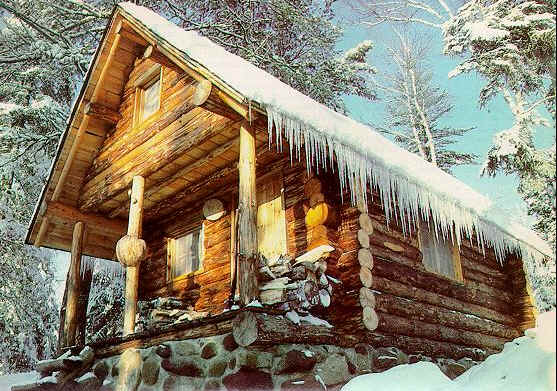
There has been so much interest in tiny and small log cabins that I have found a second article that really fits this area. This is a reprint from a 1983 Popular Mechanics article by Michael Chotiner with illustrations done by Harry Schaare. Enjoy and I hope this helps in your quest for the ultimate tiny log cabin.
BUILD A Handsome, sturdy and affordable Log Cabin. The log cabin is still a great choice if you want to build your own home.
Mankind’s preference for living in structures made of natural timbers is longstanding and well documented. One story from the rich folklore of log building tells how a Grand Master of the Teutonic Knights insisted, around the year 1500, that a wood structure be built onto his stonecastle to provide a homier place to live. Many log structures built in the same period still stand in Scandinavia, Central Europe and the Balkans.Each area developed its own distinct methods, from the square hewn log homes of France to the dovetail-joined cabins of Germany. But when all these influences were transplanted to the New World, the Scandinavian style of round logs with bottom-cut corner notches prevailed. Examples of this method can be. seen.across the United States. Log building has always required a lot of patient, physically demanding work. And for the modem builder, it also requires learning some new skills.Here’s a short course in log building to show you what’s involved.
Opinions about log selection and proper cutting season vary with the individual craftsman and the building locale. In general, just about any type of log can be used, as long as it’s relatively straight, is around 8 to 10 in. in diameter and has only minor tapering-no more than 2 in., in a 16-ft.-Iong log. Conifers such as pine, fir, spruce and tamarack are preferred because these softwoods are workable, durable and relatively lightweight. Hardwoods, particularly oak can also be used, though their sapwood is highly susceptible to infestation by borers and fungus.Trees should be felled in early winter. The cooler temperatures make for slower drying time, which reduces log checking, cracking and splitting. It’s also easier to haul logs out of the forest over frozen terrain.The best seasoning method is to air-dry the logs for one to two years-the longer the better. Logs should be stacked off the ground with stickers-smaller diameter logs-placed between the courses. This allows for maximum airflow around the logs and promotes more even drying. You should also partially peel off the bark using a draw knife before the logs are stacked. This will increase their drying rate and cause only minimal cracking and splitting. However, before building begins, you must remove the remaining bark completely. It is a natural habitat for many different kinds of pests.In part 2 we will discuss the foundation needed for your cabin.
Read Part 2 –
A great way to get a big bang for your buck is to Do It Yourself. You can save up to 25% as an owner builder and you control everything. Our web based owner builder program makes the whole process really easy.
do you build on my site
how much does the 10×14 with a porch cost
i am on a budget but need this really bad
thanks
shirley
The reprint of the 1983 Popular Mech. art. was probably the coolest small log cabin I have ever seen. Any idea were to pruchase the logs needed for this project? I will have this cabin in my back yard. Kevin
Hi Kevin – Not knowing where you are located, it is very hard to give you advice for your area. However, I would check with local saw mills and find out if they have logs available for purchase.
Hey Kent- Thanks for the return e-mail. Now that spring is here I’m ready to start on the cabin. I will check with local saw mills. I live in southern Michigan, Any other thoughts?
Hey Kevin,
Just read this and was wondering if you ever built the cabin – would like to see pics if you have any. I’m planning on cutting down several cedars soon and using them to build a small cabin myself. Any help is def. appreciate. Thanks!
Building your own log cabin is alot of work and it doesn’t stop when you finish the building. Log cabins require a good bit of maitinence even after the construction is over. I would recommend going with a modular building that give you the look of a log cabin without the headache of trying to make it yourself. I’ve been looking at some from http://www.zookcabins.com and the economy and quality of those building looks good.
This is a lovely little wood home. I love the snow hanging off the eaves. Makes you want to live out in the middle of nowhere. We have always wanted a log and have considered doing it ourselves.
very helpful information on building a log cabin
I am at a loss. all items clicked lead to a dictionary or a list of ads. Do parts 2-4 to this story exist?
thnx
mike
Let me check the links sounds like they are not working for some reason. Yes, they exist.
I am amaze with the log homes you have here. I wonder how comfortable it is for a rest house or a vacation place.Please add some more photos of these kind of construction.thanks.
Thanks so much for an educational article. I’ve been hunting for this type of information for quite a while now.
Where is part 2? At the bottom of the article it says read part 2 but I don’t see any live link.
I recently watched alone in the wilderness. An old documentary about this man who moved to Alaska in the 60’s and built a small log cabin alone. It seemed like a lot of work, but my take was that the success of the project depends on the quality of the wood.
I like looking through an article that will make people think.
Also, thanks for permitting me to comment!
I had a large log home 3700 sq ft. built back in 1990 for about $137,000. Now the costs have skyrocketed to 2 1/2 times that amount. Also problems associated with it were carpenter ants and bees drilling holes in the wood that was “treated” for insects. Small log cabins are easier to treat and maintain, and log siding is even better. I miss my old log home but not the maintence and the costs.
I am a Handcrafter of chink style and Scandinavian scribe log homes. I have been in the business for 18 years and also hold a masters degree in civil engineering. Log home living is a lifestyle. It comes with love of wood, structural beauty and tradition. A full log home will stand for many years. Maintenance is required on a log home as with any exterior wood siding. However, every client I have built for says the maintenance is worth the lifestyle! Log home construction is misunderstood by many talented carpenters who misinterpret log building standards. There are many pros and cons associated with any type of construction. Contact me if you are interested in handcrafted log shells. We ship nationwide and they make awesome tiny homes!
Great feature with some really useful links to books on amazon .
Keep up the good work
Great feature i was not aware that to peel back some of the bark would speed up the drying process .
Simple but effective .
has any one got any images of the german dove tailed log cabins mentioned in this article ?
Do it yourself is great- if you have the time and skills to do so. If you don’t have the time and/or the skills, check out http://www.amishcabincompany.com for prebuilt modular cabins built to your choices of style/size/colors/options/layout. Insulated and built to residential codes, not to HUD/manufactured housing codes. No wheels/axles/chassis. Can be placed on your permanent foundation on your land- crawlspace or basement.
This is a great blog in regards to some of the process involved with building a log cabin. (Definitely peel the bark!). If you are interested in seeing our new feature that allows a client to potentially design their log home in minutes (and then send to a builder of their choice!) please go here – https://hearthstonehomes.com/log-home-style-guide
We think that you would find this feature very useful for all builders and clients as well!
Eurodita bespoke log cabins, they can design and manufacture any size and shape cabin, worldwide delivery, check them.
The Popular Mechanics article about the cabin with the icycles hanging from the roof was done in 10 days by students during a log building course at the Great Lakes School of Log Building in winter 1982. The logs were red pine thinned from a CCC plantation from 1939 and were purchased from the former U.S. Forest Service district office in Isabella, MN. In this case, they were not dried before use and good handcrafters usually know that the best place to dry cabin or house logs is in the structure, in other words, build with green logs and make allowances for the resultant settling. Ron Brodigan, former owner of and instructor at that school, which was open 1974 to 2018.