Tiny Re(E)volitions Kitchen
by Andrew Odom
So much time is spent thinking about the exterior build of tiny houses – the trailer, the framework, the weight, the roof, etc – that the interior is often overlooked. But is that wise? Isn’t the interior what transforms an otherwise stark and impersonal trailer or foundation into a home? It is if you ask Stacey Pridgen of Rooms and Spaces and tiny places.
“The interior is what turns a trailer into a home. It is where a person lays their head at night and you want that person to feel like they are in a palace and not an outhouse,” says Pridgen.

A contractor, creator, builder, craftsman, artist, and innovator for over 25 years Pridgen has been putting hammer to nail since he was just 16 years old. “I started when I was 16 years old or so. I got a job with a construction outfit as a framing assistant. I spent a lot of time helping, lugging material, and trying to learn the trade.”
Stacey never remembers wanting to be a doctor or a lawyer or any sort of corporate tycoon. He craved the dirt and the outdoors. College never even appeared on his radar as he went directly from high school onto the job site. Continue Reading »
Trekker Trailers Tiny House
Trekker Trailers in central Florida has been building vintage and retro style teardrop trailers for over four years, but the company’s owner, Andrew, wanted to take his love of simple, tiny living to the next level and built a 70 square foot house on wheels that was recently sold to a 17-year-old student. His mother is also thinking of getting a tiny house.
“I have always loved campers and simple tiny living,” Andrew said. “I’ve been building teardrop campers for 4 years now, have restored many historic homes in my area, and have a love for form, function, and art. It seemed like a good fit for my talents to build a tiny house. Though my wife and I intend to retire in a tiny house, this one was built to sell so I tried to appeal to the lovers of the craft.
Watch a walk-through of the Trekker Trailer tiny house on the company’s Facebook page.
The Tiffany blue house is built with high quality materials like Galvalume roofing, cypress interior and exterior trim and some interesting and unique storage and space-saving details. The small living room couch (with a lovely skylight above it) has storage behind and underneath the seat and what Andrew calls a “hybrid Murphy bed” folds down from the back wall. The bed can be adjusted to sleep one or two people. The kitchen contains a sink, refrigerator, microwave and a slide-out pantry. The wet bath has fiberglass flooring and a composting toilet that can use BioBags. The water heater is a propane powered heater that is mounted on an exterior wall near the deck. Continue Reading »
Pod and Yotel Rooms
I do a fair bit of traveling around the world and my husband and I enjoy staying in tiny inns, hotels, B&B’s and other minuscule accommodations. Some of these rooms have been a little unusual: we had a fun time staying in a fairy chimney cave in Cappadocia, Turkey and at a capsule inn in Tokyo, Japan both of which were tiny spaces.
The latest issue of AARP Magazine recently profiled several chain hotels that are going small. In London, Amsterdam and New York City, micro-hotels are becoming a popular place to stay for travelers on a budget who don’t mind a small space. Some rooms in the Pod Hotel start at $89 a night for a 60 to 170 square foot room. At the Yotel in midtown Manhattan, the tiny, Japanese-inspired rooms include everything you need: flat-screen TVs, media hubs, free Wi-Fi and custom modular furniture. Some of the rooms also have a galley kitchen rather than a mini-bar. In London and Amsterdam, the Yotel rooms are located inside the terminal buildings of Heathrow, Gatwick and Schiphol airports. Both Pod and Yotel plan to open locations in Boston, Chicago, Los Angeles and Washington, D.C. in the next few years. Continue Reading »
ProBuild Cabin
by Matt Scott
I have been researching and following the movement for 2 years now. I have come across a company here in my area that is building tiny cabins that look amazing. I took the liberty to call and get some information on the cabin as well as most of the specs on it. I have some pictures attached and hopefully this can make your blog.
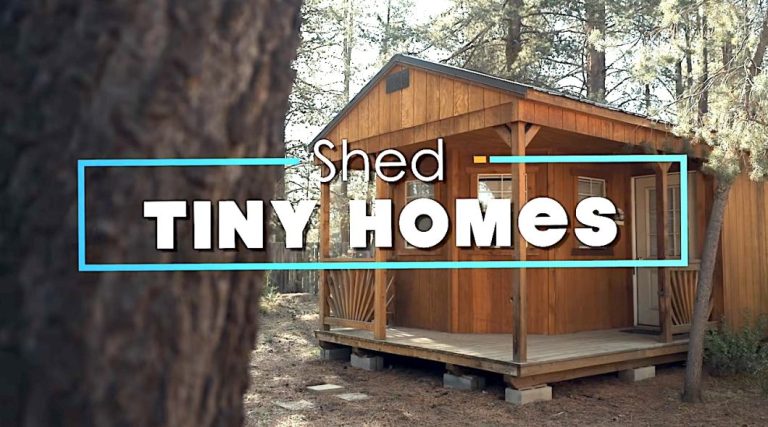
The cabin is build by ProBuild in Rapid City, South Dakota. It’s size is 160 sq ft. inside. It has a 2 sided deck that adds 4ft to front and side for a total foot print of 14 x 20.

Following are some specs on it. It has tongue and groove pine sourced locally in the Black Hills. It is 2×4 construction and has been spray foamed. It resides on 2 x 8′s underneath and has been foamed underneath the structure as well. It has a sky light by Velux. The windows are Jeldwen. Delivery within 100 miles of Rapid City, SD would be somewhere around $400.

The cost of the cabin is approximately $20,000. There was very little expense spared. This is not your typical shed converted to a cabin, this is a livable unit with fireplace insert as well. The contact that I spoke with regarding the cabin is Terry Jensen and the phone number for ProBuild is 605-343-1115.


Sarah House Project
Named after a San Francisco sculptor who could not afford a permanent place to live in her expensive city, the Sarah House Project in Salt Lake City, Utah is one man’s attempt to build an affordable home out of castoff shipping containers.
Sara Putnam, (the “h” for the project had already been added to a banner advertising the building) who recently died from cancer was living at an artists’ colony at the Hunter Point Naval Shipyards — where she wasn’t supposed to be sleeping. Her friend, Jeffrey White is building a 672 square foot home out of two 8×40-foot shipping containers. While visiting the Naval shipyards one night, White noticed dock workers unloading containers and thought about turning the big metal boxes into homes. The Sarah House Project has been funded by grants, donations and money raised by Jeffrey’s custom made funeral urns. He said in a recent Salt Lake City news report that his small, custom urns take up less space below ground, just as he hopes his home will take up less ground — above the ground.
The home will have a combination living room, dining and kitchen, a bathroom and bedroom and a day room. Jeffrey had originally put a 40-foot container on his driveway and started converting it into a house, but ran into trouble with city officials. Now the home is being built on some land procured by a local nonprofit, the Crossroads Urban Center, and when completed, will be sold to a low income family or couple.
Jeffrey estimates the cost of the project, including the land, at $108,000 – $115,000. This, he says, is close to the cost of a conventional home and is higher than he expected, but White hopes he’ll be able to bring those numbers down in future.
“I would love this house to come somewhere in the $60,000 – $75,000 range,” White said.
Photos courtesy of the Sarah House Project
By Christina Nellemann for the [Tiny House Blog]
Happy, Simply – A Lifestyle Model and Education Project.
Debt free – healthy, happy, and with lots of friends. Where the best things in life are not things, where less is more and, where just enough is plenty!
The lifestyle model includes:
- Sustainable living – shelter, food, water, energy, transport, waste, environment
- Community participation – volunteering, active citizenship
- Education – learning, simple sustainable choices, self-sufficiency, and rich experiences
A model for life and an educational project to learn from with information and inspiration.

Of most interest to the Tiny House community this website will be the Happy, simply home – a 10m2 house built by a group of volunteers using mainly reused, recycled, or left-over materials in two weeks for under $8000 NZ ($6700USD).
To live simply is the ultimate sophistication and luckily I have been fortunate to live and learn from the world’s poorest who, unfortunately, don’t get to choose simplicity, but are masters of living simply and being more connected to their families, communities, and the environment around them.
Simplicity has so many amazing benefits to the individual, the people around them, the environment, and towards a more just and connected global community. This was the starting point that I wanted to have a home that implemented these ideologies in a tangible way through a dwelling to live in and be an active part of a community.

After traveling to almost 60 on top of my native home of Australia, I stumbled upon a town named Paekakariki (where the girls are cheeky – as the local rhyme goes) and fell in love with the surrounding beach and mountains and also the community. It’s a small but distinct community that cares about where they live and those who live within the community. I was there this time last year and then had to leave for the remainder of the year. I returned in late January to set up the Happy, simply project and the home. Continue Reading »