SF Craigslist Tiny House for Sale
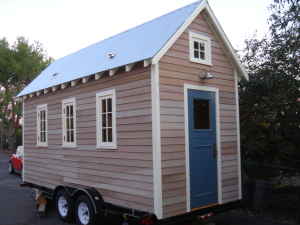
If you are from Northern California or Oregon you might be interested in this tiny home that is for sale on Craigslist in the Cotati area north of San Francisco.
Derek built this home shortly after attending one of Jay Shafer’s workshops in Sebastople back in 2007. He went on to design his own home and Jay gives him high points for his design.
Derek and his wife are growing there family and are having to move out of the home as it will be to small when the next family member arrives.
Here are some features of Derek’s home: The siding, trim, windows, and door were custom made from recycled Cedar. Inside, the floors are made from salvaged Douglas Fir and the paneling is salvaged from old-growth redwood fencing.
The home uses a Dickinson Marine fireplace for heat, has a stainless steel refrigerator. It includes a fold-down eating table for two, a walk-in closet and bathroom with toilet, sink and shower, and of course a sleeping loft.
The house is set up like an RV for plumbing and uses a RV hose connection for removal and includes a 50 AMP service connection. Derek is asking $34,000 or best reasonable offer and the house will be available in May.
I want to thank Hillary from ThisTinyHouse for letting me share this with you. You can visit the Craigslist listing to get additional information and to contact Derek.
If you enjoyed this post, subscribe to our feed
Fencl Update #2
I want to keep you updated on Jay Shafer’s Fencl tiny house build. Jay Shafer of the Tumbleweed Tiny House Company will be taking this home to the east coast in May and has many stops planned along the way.
Jay is also looking for a buyer so if you are interested please contact him, also let him know you have been following the build on the Tiny House Blog.
I was unable to make it out to the site last week as I was out of town most of the week, so I was curious to see how much progress had been made while I was away.
The last time I was out there, the floor had just been completed (see previous post, towards the bottom). During the last week the walls went up, the sheathing was attached, the roof has been framed and the loft constructed. The Tyvek is being installed and they are getting ready to start the roofing later this week.
I plan to go out again on Thursday, so look for a quick update later this week. This is one of my favorite Tumbleweed models and I am looking forward to seeing it completed.
If you enjoyed this post, subscribe to our feed
Lives in a Van
The sad news these days seems to be centered on people losing their homes and maybe having to live in their car, truck or RV. Dave Thorsrud has been living out of his van for over a year, but he is doing it in an effort to live a simpler life.
His website, Lives in a Van, chronicles his year of living richly on the road in his Pleasure Way van. He writes:

“Ironically, I left the full time job to travel in a van because I wanted to maximize possibilities. With a full-time job, a house mortgage, a car payment and various other debts, my only option when the alarm shrieked was to go to work. This was true during the week and frequently true on the weekends. So I craved choices. I needed to know that if an opportunity for a once-in-a-lifetime experience came my way, then I could grab hold with both hands and embrace the new path.”

In order to find his more authentic life, he quit his job, sold all his belongings in five days and packed anything left into his van. During his search, he has traveled across the U.S. and parts of Mexico, met interesting people and has documented it with prose and excellent photography.
Dave lists the best aspects of living in a van as having no daily commute, the overall cost of living is low, all laundry can be done in one load, and every day is a new adventure. He also lists his rules of the road, which can be a metaphor for any simpler life:
DAVE’S RULES OF THE ROAD
- Avoid drive-thru value meals at all costs.
- Take photos of everything.
- Sing along to whatever is on the radio–even talk radio.
- Exercise whenever possible.
- Take care of the vehicle.
- Meet people–especially strange people.
- Drive slower.
- Never hesitate to take an exit, get sidetracked or get lost.
- Take the backroads when possible.
- Take notes, write daily, find the inspiration.

Photos by Matador Travel. Schematic by Lives in a Van
If you enjoyed this post, subscribe to our feed
Float Cabin Moving Day
One of the most frequent questions I get about our float cabin on Powell Lake in Coastal BC is, “Does it move?
I’m sure that’s because the closest thing most people are familiar with is a houseboat. We have a few here on Powell Lake, but a float cabin is permanently anchored to the shore. In the case of Powell Lake, there are about 200 cabins on Crown water lots leased from the BC government. Fortunately we have a big lake, so it isn’t crowded.
Now that I’ve told you that the float cabins are permanently anchored in place, maybe I should say semi-permanently. On rare occasions a cabin needs to be moved. As you can imagine, moving day up the lake is a big deal.
Cabins are often remodeled at the Shinglemill Marina at the lower end of the lake. To do this, the cabin is towed down and moored outside the marina’s log breakwater. This makes construction much easier since our lake sites are water access only. When renovations are done, it’s moving day.
You don’t see it very often, but recently we were involved with a moving day when our friend sold a cabin and moved it to a different site. Even though a cabin with its float is very large and heavy, it can be easily moved with a small boat. It’s best to go early in the morning when the lake is calm. Travel is slow, so you will see people having BBQs and picnics aboard along the way.
After the cabin is in its new location, it’s reattached to the shore. A log boom is then moved into position for added protection from wave action. Now the cabin’s new owners, Margaret and Art, can enjoy their new floating home away from home.
For more information about float cabin living, you can refer to previous posts here on the Tiny House Blog. You can also visit my blog at http://PowellRiverbooks.blogspot.com or read Up the Lake and Farther Up the Lake by my husband, Wayne J. Lutz. Both books have lots of information about life in an off the grid cabin. Ordering information for the books and Kindle formats is available at www.PowellRiverBooks.com.
By Margy Lutz, Powell River, BC
If you enjoyed this post, subscribe to our feed
Caregiver Cottage for Sale
Stephen Marshall of Little House on the Trailer in Petaluma, California recently showed his Caregiver Cottage at the Sonoma County Home and Garden Show in Santa Rosa, California.
I visited with Stephen at the show and he said that he wanted to sell the Caregiver Cottage. The Caregiver Cottage is perfect for one person and has everything a person needs to live simply and comfortable.
The 8 foot by 14 home on wheels is built from Sing Honeycomb panels and is very light weight. Inside the home is a full loft with a loft ladder that springs up out of the way when not needed. I failed to get pictures of the loft.
The weight of the house is 2800 pounds including trailer it travels behind a half ton pickup.
The main living are includes a shower and toilet, living room area and kitchen. You can get a pretty good idea of the interior by viewing the pictures below. I was not able to get good bathroom pictures because of the angle, but it is behind the kitchen area through the door.
Stephen is asking $17,500 for the Caregiver Cottage. You can contact Stephen by phone at (415) 233-0423 or email him at info(at)littlehouseonthetrailer.com.
To learn more about his work go to his web site Little House on the Trailer. Be sure and tell him you heard about it from the Tiny House Blog.

If you enjoyed this post, subscribe to our feed
Pedal-powered Washing Machine
One of the Tiny House Blogs avid readers is Darrell. Darrell likes to find interesting ideas and small appliances that he thinks the Tiny House Blog readers would enjoy and than he emails them to me.
Darrell recently sent me this article from ecofriend about some MIT students who have developed a pedal-powered washing machine. You can read the full article at ecofriend but here is a little of the information some pictures and a video.
“Bicilavadora” is a new pedal-powered washing machine that has been designed by a team of students at MIT using nothing more than an old oil drum, an old bicycle and some pieces of plastic joined together.
The washing machine is targeted toward those regions of the developing world where residents don’t have access to grid electricity and having a washing machine is considered a luxury. The washing machine consists of an outer housing made of a standard oil drum cut apart and welded to make a shorter barrel, since churning 55 gallons of laundry with pedal-power is not feasible.
The inner drum, which the team states as one of the most critical parts of the design, is made from a set of identical plastic pieces together. The system is then connected to an old bicycle sans its wheels.
The chain is connected to a gear mechanism harnessed from an old geared mountain bike. The highest gear is used for the spin cycle and the lowest gear for the wash cycle.
This might work just fine for your eco friendly tiny house, so book mark it for future reference.
If you enjoyed this post, subscribe to our feed
Tiny House Inspiration
Today I took our dog to my folks place in Ukiah as we will be heading out of town for a few days to see my in-laws and pickup my daughter from college and bring her home for spring break.
My dad has been working on what originally was supposed to be a wood shed that spans a creek behind his house. He used mostly recycled wood and windows in the project and bought what he needed otherwise.
The “wood shed” is 8 foot by 12 feet and turned out much nicer than he originally planned. The interior has yet to be finished and the exterior just needs a little touch up to be completed. He thinks it came out to nice to use for just storing wood, but has not come up with a final use for it.
I would love to take it and turn it into a tiny house. The roof is not quite the pitch I would want for a sleeping loft but it would work well for storage. I see a small kitchen galley, a futon and a small bathroom, just right for one person to live in. It’s hard for me not to ask to take it over and finish it. However, they live just far enough away, that it most likely won’t happen.
Anyway, keep your eyes open for potential tiny house opportunities. Send me photos if you have them and I’ll post them for everyone to see.
If you enjoyed this post, subscribe to our feed
Small Living Journal Launch
I’m excited to announce the launch of a new bi-weekly webzine called the Small Living Journal, the focus is on the small home movement.
The brainchild of Stephanie Reiley of the Coming Unmoored blog and a group of small living advocates, designers, and bloggers. The initial writers are Stephanie Reiley, Greg Johnson, Michael Janzen, Tammy from RowdyKittens, Hillary from ThisTinyHouse, Amanda from Constructing a Simpler Life, and myself.
The first issue is an introduction of the members and how they became interested in the tiny house movement. The next issue on April 8 will focus on downsizing.
Go and check this out. I think you will find this another useful resource in your quest for living small. Be sure and sign up to the RSS feed or join the email list so you don’t miss an issue.
If you enjoyed this post, subscribe to our feed
Tiny Garage Conversion
This tiny garage conversion by Martin John Brown of Portland, Oregon attracted my attention because of the wonderful styling and details in such a small space. Check out that great purple color!
With architect John Perkins, Martin converted a detached garage into a beautiful 400-square foot house for his mother-in-law to live in. In his blog, bottleworld, John documents the process, including the issues he had with the city codes while trying to create an environmentally friendly tiny dwelling.

The house includes a curved kitchen counter, round windows, a loft and skylight and an alternating tread staircase. The staircase allows comfortable ascents and descents in a considerably steeper pitch than a standard stair. They are straight, making transporting long items (like mattresses) easier than on a small-diameter spiral stair.


It is interesting how Martin talks about how adding one extra foot in such a small space makes such a big difference. In most average sized homes, an extra room is usually needed for more impact on the living space.
The cost for the conversion came to $75,000 including $7000 for permit and $4000 for architect.


Photos by Martin John Brown
If you enjoyed this post, subscribe to our feed
Sonoma County Home and Garden Show
Friday afternoon my wife and I went to the Sonoma County Home and Garden Show located at the fairgrounds in Santa Rosa, California. Stephen Marshall from Little House on the Trailer was displaying three of his homes there and had sent me complimentary tickets. Thanks Stephen.
We took our time looking at many of the displays, which included solar and many other building material exhibits. They also had brought together the RV and Boat show, trying to save money with the down economy, as these are usually separate shows.
My wife had not seen Stephen’s work before so we toured his new little cottage, the art studio and his original tiny house on the trailer. My wife preferred the larger size of the little house on the trailer and thought it much more livable, but would like a separate bedroom. Anyway I have included a few pictures of our visit.
We stopped over in the RV section and looked at the one park model on display. Janelle thought that she could live in that just fine once we downsized a bit on the belongings. The loft design did not seem right but the rest of the floor plan was great. Anyway we had an enjoyable time at the Home and Garden Show and I would recommend you go to one in the future.
If you enjoyed this post, subscribe to our feed


