Upcoming Tiny House Events
Little House on the Trailer
Thanksgiving Open House
Saturday, November 29th from 9am to 3pm
See the following:
A Country Farm House Dwelling
An Artist’s Studio/Gallery Space
A Ten by Twelve Tiny House in progress
(415) 233-0423
Saturday – Building Workshop
Sunday – Design Workshop
Vermont Tiny House Workshop
Peter King of Vermont Tiny Houses is looking for 6 people to learn how to build tiny houses. He will offer a two day workshop and build a tiny house on December 13-14. If you would be interested in joining his workshop please call Peter at
(802) 933-6103
Pennypincher Barn Company
Pennypincher’s is a kit company and they sell cabin and barn kits. Pennypincher’s kits include design engineered plans. Anne Masias, General Manager of Pennypincher Barns shared with me the following about how they have discussed selling standard plans but at this point they come exclusively with the kits.
That said, a 120 square foot, loft style kit has a basic shell kit price of $2880 (lumber for the exterior shell & loft, comp. roofing, hardware and design engineered plans). Doors, windows, dormers, cupolas, foundation & labor not included. Though Pennypincher does mill their own windows, doors, cupolas & dormers. Pennypincher’s has designers on staff they can modify their standard plans to meet the customers needs. Most of their designs can be done in any size and they can also engineer for additional snow or wind load or other county requirements.
Pennypincher’s can deliver a cabin/tiny house kit just about anywhere. They order your package materials in the customers locale so the only “shipping” expense is really a delivery fee or you could pick the materials up if you wanted. It’s up to the customer.
This is one of their favorite things that they offer because it’s a huge cost saver, far more eco-friendly and the customer gets to support their local economy.
Holiday Special: Anyone who orders before the holidays get a free accessory item (cupola, dormer, etc.).
The tiny house designs are new for them so they just have sketches and simple designs. They have more new designs coming soon so visit the Pennypincher site and learn more.
If you enjoyed this post, subscribe to our feed
The Tipi
My neighbor, Dale, lived in a tipi for five years while he saved up to build his own house. He set it up on the land of an acquaintance who owned a ranch in exchange for working on the ranch, and was able to use the bathroom and water supply of the ranch worker’s apartment. He ran an electrical cord under the ground from the apartment to run an electric blanket. “You can be comfortable anywhere if you have an electric blanket.” he said.
His tipi from Sacramento tent manufacturer, Goodwin Cole, housed a bed covered with sheepskins, a small dresser for clothes and a Franklin stove which kept the tipi warm in winter. For cooking, Dale used a Coleman stove outside on a picnic table.
Dale said he chose the tipi, rather than a tent or trailer, for the romantic aspect of it. His background was in Anthropology and his study of the American Plains Indians gave him the knowledge he needed to live their way of life. He said the best part of living in a tipi was being woken up by the daylight coming through the canvas in the morning, and because of the conical pyramid power of the structure, he slept very well. The worst part was the lack of a noise barrier and being open to the elements. “But living that way forces you to be a part of the outdoors,” he said. Dale and his wife, Denise, still use the tipi in their backyard for a summer getaway.
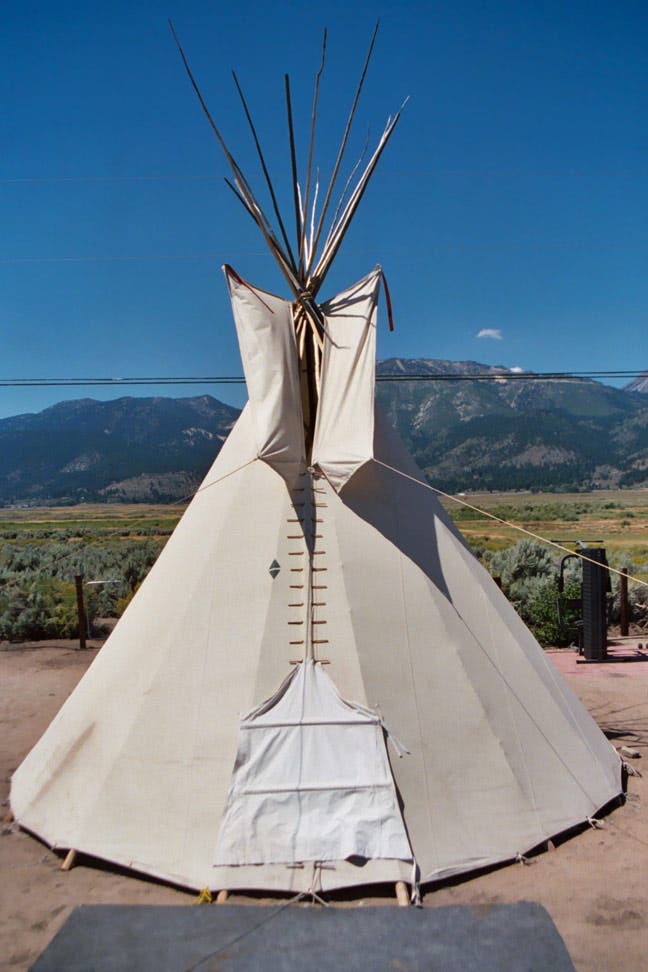
Nomadic people have used portable tipis for thousands of years. The word tipi (also teepee or tepee) comes from the Lakota word meaning to dwell or live. These simple, circular structures provide snug, low-cost shelter. Even though they look very basic, a well built tipi is precisely designed. Tipis consist of four elements: a set of ten to twenty sapling poles (depending on the size of the tipi), a canvas or hide cover, an optional inner canvas or skin lining, and a canvas or skin door.
Prior to the introduction of horses to North America, tipis were only about 8 to 14 feet in diameter, since the poles and buffalo skin coverings were pulled on travois from one encampment to another by dogs or women. Once the American Indian plains people acquired horses, tipi designs expanded into the shape and style we’re familiar with today. By the late 1800s, after the near extermination of the buffalo herds, tipi covers made from bolts of canvas provided by the U.S. government replaced the 10 to 14 buffalo skins needed for the earlier style.
Most tipis now are made of canvas and are about 16 to 20 feet across with ceilings 12 feet high. Many modern tipis include raised wooden floors for the sleeping area to keep bedding and clothes free from bugs, dirt and dampness. A fire pit or carefully vented small woodstove in the tipi center provides heat during winter months. In about an hour, two people can easily erect a 16 foot-diameter tipi with 22 foot-long poles. The conical shape of the structure makes it stable in the high winds that often blow briskly across the Great Plains, and closable smoke flaps keep driving rains outside. Tipis are routinely transported to powwows, barter fairs and rendezvous on a truck’s carrying rack. At Burning Man this year, I saw whole villages made out of tipis. They seemed to be very wind resistant and cool inside.
One aspect of tipis that lend to the romantic vision is the artistic details of the canvas or animal hide. In American Indian culture most tipis in a village would not be painted, but those that were often featured geometric portrayals of celestial bodies and animal designs. Sometimes tipis were painted to depict personal experiences, such as war, hunting or a vision quest. Many are also decorated with pendants or medallions. Traditionally these were embroidered with dyed porcupine quills; more modern versions are often beaded. Buffalo horns and tails, tufts of buffalo and horse hair, bear claws and buckskin fringe were also used to decorate tipi covers. These attachments are often referred to as “tipi ornaments”.
Earthworks Tipis
Earthworks is having a sale of 20% off their tipis until December 1, 2008.
Mother Earth News: That Good Ol’ Tipi Living
If you enjoyed this post, subscribe to our feed
Tiny Houses in Vermont
I recently discovered a movie by Eva Sollberger who has a blog and creates videos about being Stuck in Vermont. Eva discovered Peter King who has been building tiny houses for years in the state of Vermont and did a cool video tour of a couple of his tiny houses.
Eva gave me information on getting in touch with Peter, but so far I have been unable to talk to him.
I really like his 10 x 10 x 10 tiny house design and would like to see if he has plans available. The neat thing about the cube design is that the loft area has enough room to stand up in, or as Peter says “you can walk the plank.”
Peter is a person who believes in living simply, mortgage free, out in the woods and enjoying life. He is not connected to the internet and appears to live off the grid. His goal is to build at least one tiny home a month and to teach others to do it also.
Peter says any one can build a tiny house once you learn the basics of building. A tiny house can be easily fixed if you make a mistake and is a great learning experience. He believes that you can have several small spaces in an area and each person can have his or her own space. These tiny houses also are around 100 square feet so do not require permits to be built.
Rather than spend 6 weeks to several months building a home, you can build a tiny house in a weekend. Watch the movie below to hear Peter tell his idea of how to live life to the fullest.
Photo Credit: Eva Sollberger
If you enjoyed this post, subscribe to our feed
Little House on the Trailer
Last week I had the opportunity to meet another tiny house builder in Sonoma County California, his name is Stephen Marshall and last February he started a company call the Little House on the Trailer.
Stephen is a cabinet maker by trade and also a contractor. His line of homes are larger than the Tortoise Shell and Tumbleweeds, that are also built in Sonoma County. Stephen prefers the 12 foot width and only considers the home to be mobile in the way that you can move it to permanent location.
At this width a permit is required to move the home and it usually ranges around $150. These homes can range in size up to 400 square feet. You also need a large commercial truck to move the home to your location.
Stephen’s goal for these homes is to have you come to him and tell him what kind of structure you would like. You than spend a day or two designing the home. It can be anything like this old farm house structure design shown here to a modern design. You decide what works best for you and he will design and build it.
Stephen produces a wide range of structures, his basic shed structures start at $15,000. These are constructed at his site in a panelized format and hauled to your site and assembled.
He also offers, galleries and home office which start around $45,000, see example below of a gallery he has been building for a client.
His residential homes start at $60,000, which includes the design consultation and construction. Delivery is extra but is fairly affordable.
The Little House on the Trailer is having an open house and grand opening at the new location in Petaluma on Saturday November 29th from 10 to 4. For driving directions go to his site and click on the Contact Us page, let Stephen know you heard about his homes at the Tiny House Blog.
If you enjoyed this post, subscribe to our feed
Portable Tankless Water Heater
Rosemary from Content In A Cottage alerted me to this neat portable tankless water heater.
This water heater does not require an expensive hookup, but rather is portable and comes with a shower head attached and ready to use. The Ecotemp L5 just requires you to have a spigot or a garden hose to connect to and than attaches to a standard portable propane tank using the included connector. You can than anchor it using a nail or hook inside or outside and have an instant hot shower.
Tom Sackett has a nice story on how he and his wife use this portable tankless water heater in their remote cabin. You can read Tom’s story at the Cooltools blog.
I really like the design and portability of this unit. My only concern is that it is set up as shower. You will need to come up with some other connector if you want to use it to wash dishes in your sink or for other chores. This cool little tankless water heater is available at Amazon for $120 and you can visit the Eccotemp site to get more information.
If you enjoyed this post, subscribe to our feed
The T@B Trailer
After doing a post on teardrop and vintage trailers a few weeks back I thought I would do a post on the ultra-modern T@B. Since it was introduced a few years ago, the T@B trailer by Thor Industries has exploded as a popular alternative to a larger, heavier travel trailer.
The T@B is known for its European design, styling and lightweight construction. They are about 16 ft long and can be purchased for between $9,000 and $20,000. The full trailer stands at 7 ft 9 inches and the interior height is 5 ft 9 inches. It weighs under 2,000 lbs unloaded.
The T@B, which stands for Take America Back, also has all the amenities of a larger travel trailer (heating, air conditioning, fan, sink, refrigerator, stove and storage) but can be pulled with a smaller car and has no need for electronic brake control. The only thing the T@B does not have is a bathroom and shower. A port-a-potty can be installed. The Clamshell T@B even has a kitchen that opens up in the back, like the classic teardrop trailer.
The T@B also includes:
- Several floor plans
- Alufiber® construction
- Surge coupler attached to the hitch
- Seating area that becomes a 60 x 70 inch bed
- A covered area for a 20 lb. grill-style LP propane bottle and deep cycle RV battery
- A 5 gallon fresh water tank and on demand water pump
- A 25 amp power converter
- A marine grade amp with removable 20 foot power cord
- Smoke, propane, and carbon monoxide detectors
The T@B, because of its people friendly design and comfort, could be used for a temporary home or one that is more permanent. I came across several websites of people who live in or take extended trips in their T@Bs. I was specifically interested in the modifications they did to make the their T@B more comfortable and suited to their living needs.
Tabventures: Lynne takes extended trips with her dog, Millie
Chris Dunphy lived in his T@B for two years, before he upgraded to an Oliver
Mike and Trisha Kennedy travel in their T@B
Al’s T@B Mods: A list of T@B modifications
If you enjoyed this post, subscribe to our feed
Rebuilding New Orleans
This is the First thing I’ve seen that makes sense.
For complete description of materials
and how to build it,
please refer to Genesis, chapter 5:14-16
Ben shared this with me and I thought everyone would enjoy it as well.
Tiny Texas Houses make the News
A new article on Tiny Texas Houses and the tiny house movement hit the presses yesterday. Tiny Texas Houses are built from salvaged and renewable materials. These beautiful little homes show how old items can be reused and made into something new.
The article shows how people who have bought these homes use them for different purposes, from homes to art studios. Read the original article at statesman.com.
Photo credit Texas Tiny Houses
Small Chicago Home for Sale
*** Home has been Sold! ***
Pat Bukovy one of our readers has a small house on the market and asked me to share it with you. Although selling homes is not part of this blog, it is something I may develop in the future if there is a demand for this service.
It has taken me awhile as there has been much going on in the tiny house world of late. So I apologize to Pat for taking so long to show it to you. I’ll let Pat tell you about her home.
I have lived in a small house (1 BR/ 1 Bath / 1.5 stories) for 23 years and it worked fine for me.
I took the square footage of each room, added them together and came up with around 769 sq ft. There’s a connected utility room that I did not include nor the garage. The deck is about 20′ by 22′. The lot size is 30′ x 125′.
The first floor has three rooms. The first one off the entrance I’ve converted to a home office, the middle one is the living/dining (knotty pine pictures) and the room before the back exit is the kitchen. The bathroom is downstairs also. Upstairs is a 13 x 7 sitting room (I use it for a sewing room) and then the bedroom.
It’s very pet friendly — dog door, no grass in the backyard, with a dog run and fenced yard. I’ve made up for the lack of grass with tons of potted flowers. It’s a quiet neighborhood — near O’Hare.
Harwood Heights and Norridge create an island surrounded by the city of Chicago. It’s a town of about 8000 and they’re creating a ‘downtown Harwood Heights’ (whoo-hoo!) that will be near the house. They just built a beautiful new library (eisenhowerlibrary.org) which is two blocks from my house. The Village Hall and Police Dept are in close proximity too.
I don’t have a basement so it has never flooded (and we had some bad flooding here a month ago). I have a one car garage that looks like a 2 car garage from the outside that the extra room serves as storage for me.
I have it on the market for $195,000. I don’t know where you’re at but empty lots in my neighborhood are going for $200-$300k. Zillow has it estimated at $280k or so. You can contact Pat for more information at pat@bukovy.com
If you enjoyed this post, subscribe to our feed