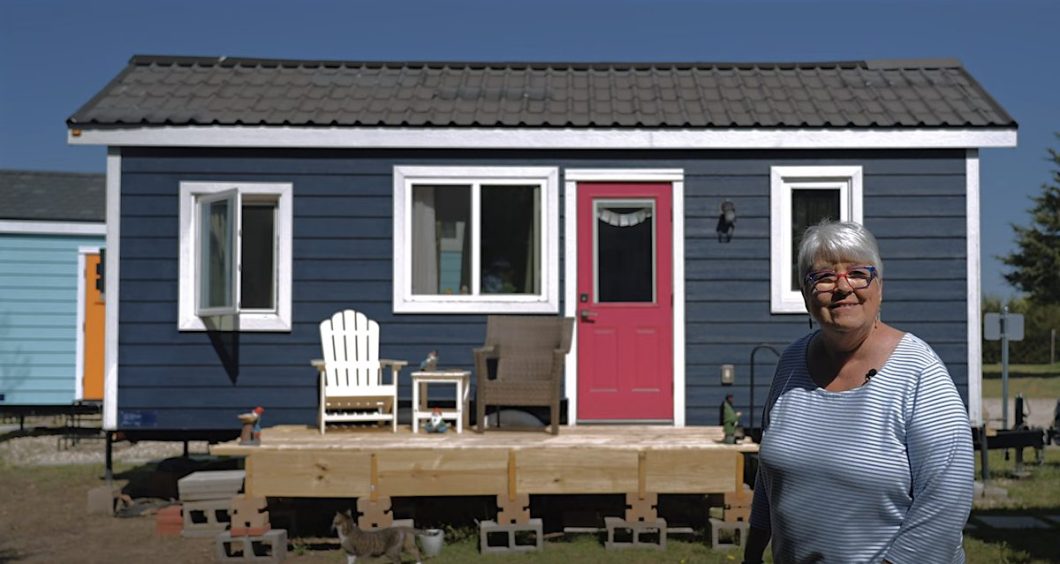
Ever wondered what it’s like to downsize in your golden years? Meet Elsie, a vibrant 71-year-old who’s doing just that in her tiny home in Vanol Stein, Texas.
Living on her social security income, Elsie has created a cozy 192-square-foot haven that’s all her own. She’s proof that you don’t need a big house to live a big life!
“I wanted to be intentional about how I spend my time and money,” Elsie explains with a warm smile. She’s embraced minimalism in a way that feels liberating rather than limiting.
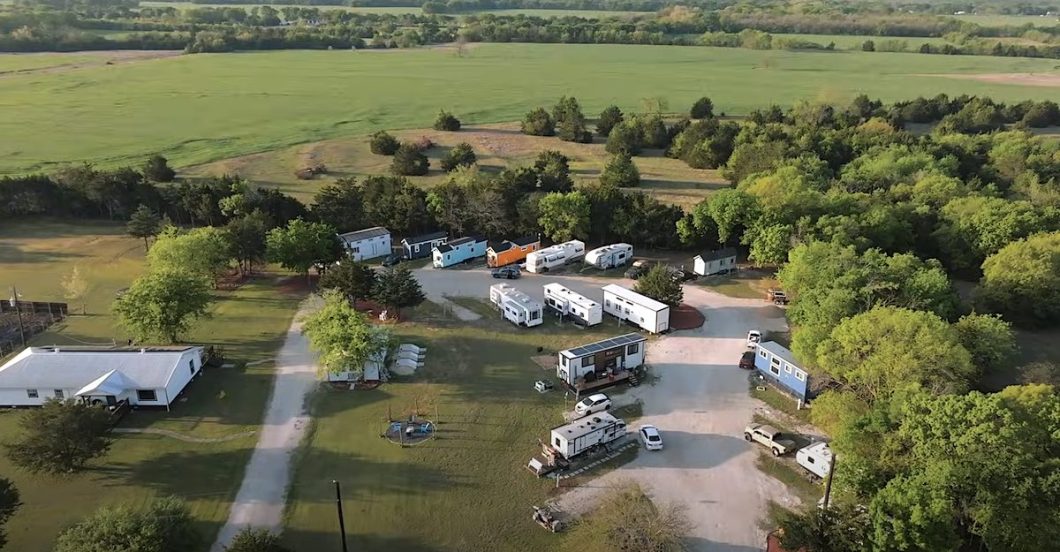
Her tiny home community has become her extended family. On weekends, you might find her working on her latest DIY project, she built her own deck! Or chatting with neighbors who share her values.
What makes Elsie’s story special is how she’s designed every inch of her small space to perfectly fit her needs. With creativity and a can-do attitude, she’s created a life that offers true independence and freedom.
As Elsie puts it, “Tiny living isn’t about what you give up, it’s about what you gain: freedom to live life on your own terms.”
Watch Tiny House Expedition’s video below:
My Takeaways
- Elsie lives comfortably on a $1,700 monthly Social Security check, demonstrating that intentional tiny living can lead to financial independence.
- Her 192-square-foot tiny house, named “Moy,” is located at Namaste Hideaway in Van Alstine, Texas. It features a blend of personal design touches and practical adaptations.
- According to Elsie, tiny living enables her to enjoy a joyful, manageable life at any age while fostering community with like-minded neighbors.
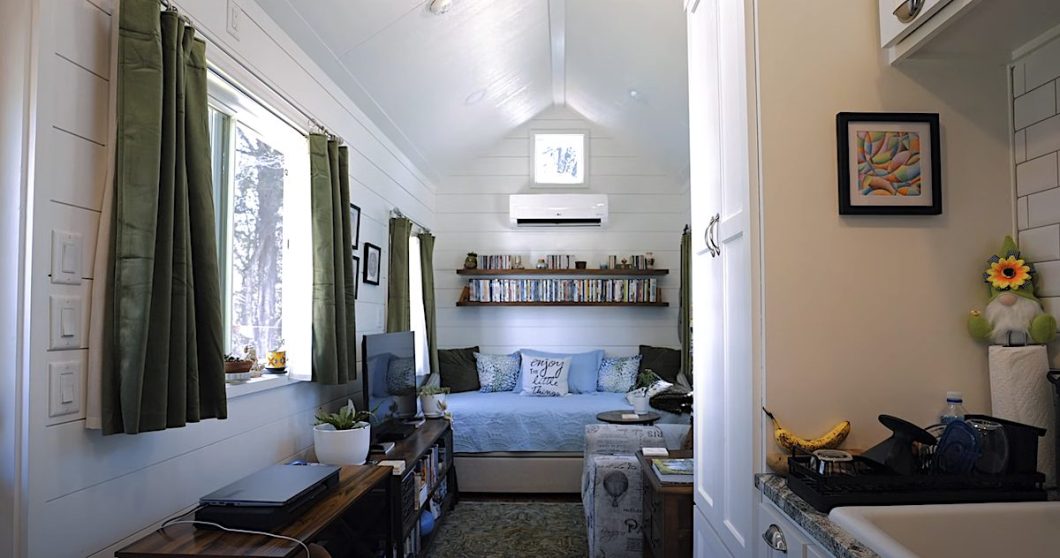
- Despite limited space, Elsie has optimized her home with thoughtful design choices, including a compact kitchen with an induction cooktop, microwave convection oven, and ample storage solutions.
- Elsie values the flexibility of tiny living, such as being able to relocate her closet to better suit her everyday needs.
- The deck that Elsie is building herself extends her living space outdoors, creating an area to enjoy coffee, wine, and meals.
- Working part-time from home allows Elsie to travel while maintaining a steady income, a freedom she highly values.
- She stresses the importance of personalizing your space, noting how even small details like fixture choices can significantly impact comfort in a tiny home.
- Elsie’s tiny house cost $67,000, financed through a combination of savings and a credit card loan that she quickly paid off.
- Elsie finds fulfillment in self-sufficiency and is committed to thriving rather than merely surviving, pursuing a vibrant life regardless of her age or circumstances.

Questions and Answers
How does Elsie manage to live comfortably on her $1,700 monthly Social Security check?
Elsie lives comfortably by minimizing expenses through intentional choices. Her tiny house significantly reduces costs for rent, utilities, and maintenance, making her modest budget stretch further.
What design features did Elsie include in her tiny house to make it functional and comfortable?
Elsie’s tiny house features granite countertops, easy-to-clean subway tiles, a deep sink, an induction cooktop, and a microwave convection oven. She maximized functionality through multi-purpose spaces and customized the layout by relocating the closet and selecting space-appropriate furniture.
What is the significance of the deck Elsie is building?
The deck provides valuable additional living space, effectively extending Elsie’s small indoor area. It creates an outdoor retreat for enjoying coffee, meals, and relaxation, making her tiny house feel more spacious and complete.
How does Elsie handle the limited space in her tiny house?
Elsie maximizes her space through creative design and multi-functional furniture. She uses a trundle bed for when her granddaughter visits and carefully selects appropriately sized furniture that enhances both functionality and comfort.

Why did Elsie choose to build a tiny house despite not having a large down payment?
Determined to pursue her tiny house dream, Elsie borrowed part of her down payment using a credit card. She recouped this investment within the first year, demonstrating her belief that following your dreams is worth finding creative financial solutions.
How does tiny house living align with Elsie’s values?
Tiny house living perfectly matches Elsie’s values of simplicity, self-sufficiency, and minimalism. It enables her to live intentionally, reduce her environmental impact, and maintain an enjoyable, manageable lifestyle as she ages.

What role does community play in Elsie’s tiny house experience?
Community is central to Elsie’s experience. Living among like-minded neighbors creates deeper connections than traditional neighborhoods offer. These relationships significantly contribute to her happiness and sense of belonging.
How does Elsie incorporate creativity into her tiny house?
Elsie expresses her creativity through art, particularly the mandalas that adorn her walls and thoughtful design choices. She personalizes her space through custom layout adjustments and carefully selected colors and furniture that reflect her personality.
What challenges does Elsie face with tiny house living, and how does she overcome them?
Elsie navigates space limitations, particularly in the kitchen and loft areas, through thoughtful design solutions, multi-functional furniture, and lifestyle adaptations that make efficient use of her available space.
How does Elsie envision her future, especially regarding her Pacific Crest Trail hiking dream?
Elsie plans to continue her tiny house lifestyle while pursuing adventures like hiking the Pacific Crest Trail. Though she’s new to hiking, she actively visualizes completing the trail, demonstrating how living with less physical space allows room for bigger dreams.

Embracing Tiny Living: What We Can Learn from Elsie’s Journey
Elsie’s story shows us that it’s never too late to change your life. At 71, she’s created a home that fits her needs perfectly—both financially and personally.
The biggest lesson? Living small doesn’t mean thinking small. By downsizing to 192 square feet, Elsie actually expanded her possibilities. She lives comfortably on her Social Security income, has the freedom to travel, and still has big dreams like hiking the Pacific Crest Trail.
What makes tiny living work isn’t just clever storage or multi-purpose furniture—though those certainly help! It’s about being intentional with your choices and focusing on what truly matters to you.
Elsie reminds us that our homes should reflect who we are and support the life we want to live. Whether it’s building her own deck or arranging her space just so, she’s created a home that feels uniquely hers.
Perhaps most importantly, Elsie has found her people. The community at Namaste Hideaway gives her the connection we all need, proving that tiny homes can lead to bigger relationships.
If Elsie’s story inspires you, remember her approach: dream big, start small, and make it your own. After all, the best tiny home is the one that makes you feel like you’re living large.

It’s just too bad she has to RENT a lot. RENT is theft. Interest is theft. Insurance is theft. And if you are forced to live in a big, expensive home then property taxes are theft. I lived in a mobile home park near Detroit for 18 years. The lot rent increased just over 5% a year. It must be $9000 a year by now. I lost my job and decided to retire at 59. I moved my singlewide to a quarter acre residential lot about 55 miles E of Cincinnati. Ordinary people understand what the rights to life, liberty and the pursuit of happiness actually mean. Enough ordinary people stopped paying dues and voted to end the HOA. The most I paid in property taxes for the year was $718. Last year my property taxes were $64.88 because I got a homestead property tax credit when I reached 65. My advice to this lady. Get your own lot and just pay some property taxes. I pay a monthly fee for a grinder pump for sewer and I also pay a monthly municipal water bill. I average about $16K a year. I never go to restaurants and just cook for myself. My singlewide is 14 X 52 = 728 square feet, so plenty of room. I did have to vapor-proof it from the inside to make it comfortable because of all the pressed wood products used in construction. Formaldehyde is in the glue. I also installed a fresh air heat recovery ventilator to bring in fresh air. There are better options out there than a formaldehyde trap singlewide. But I’ve made it work.
Thanks James for sharing your story. You have made some good choices and made a good life for yourself and with a limited income. I’m impressed!
Many thanks for your Info. Here in FL 34205 I still have that dream of that piece of property being all mine so I can place a tiny home or a shipping container home and, first thing settling there would be to plant a tree. Maybe a lemon tree, since I use them so much, and maybe some other fruit trees. The info about the formaldehyde is appreciated. I would like to set on fire 2 shelves with doors at the bottom, because of that chemical odor. I would not want anybody else own something that is harmful to their health. Many thanks for the rest of the info which is very helpful to all of the rest of us still dreaming of going smaller and stop placing our little money in the hands of COA and HOA.
It’s spelled Van Alstine. 😉
Thank you Donna, I’ll correct that error.
Thank you for sharing your journey, James. You’ve made thoughtful decisions and built a meaningful life despite having a limited income — truly inspiring!