Not Your Typical “Yurt”

Yurt Cabin

Guest Post by Josh Barry The technology for outdoor living has come a long way since nomadic Mongolians first created Gers, commonly referred to today as Yurts. In fact, the first instance of Yurts in recorded history dates back to hundreds of years before the birth of Jesus! Yurts were … Read more

Grant’s Portable Ger

Grant Olson contacted me about a portable Ger he built and lived in for 3 months and he asked me to share his project with you. I am impressed with his ger and think it would make a perfect temporary shelter or home. I’ll let Grant tell you more about it.

About this time last year, I was finalizing plans for a 7-month natural building apprenticeship in the Irish countryside. Though lodging was unavailable, our instructor invited us to camp on the property if the idea of renting a room in town was a bit pricey. Having spent my last dimes on the plane ticket, I began designing a shelter to bring with me: something portable enough to disguise as luggage, yet comfortable enough to keep me satisfied for the duration of my stay.

Inspired by the simple and tested design of the Mongolian ger, I set to work miniaturizing its components; the resulting structure measures 8′ in diameter and 6′ at its peak when set up, but folds down to fit inside an 11″ x 8″ x 48″ box. Its total weight is just over 20 lbs, and it cost less than $150 to build (though a few connections allowed me to obtain materials for cheap/free).
Read more

Mongolian Yurts

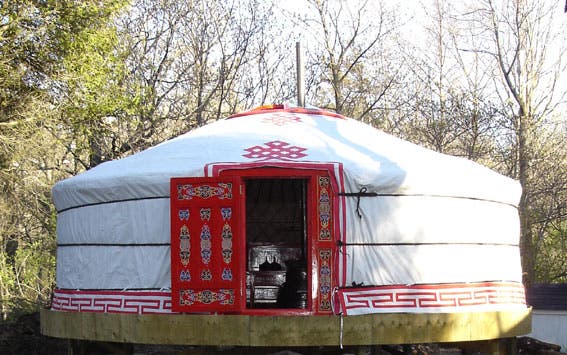
For over 3,000 years the nomadic tribes of Central Asia have lived in portable round abodes called ger or yurts. Probably because of the stark locations in which they live, their homes are showcases for their beautiful handiwork emphasized by bright, happy colors which certainly caught my attention. These handmade yurts, imported directly from Mongolia by Groovyyurts in Quebec and Mongolian Yurts in Ohio, are one way to live a simpler life while supporting a developing country.

Yurts are resilient, adaptable, portable and can be used for parties, exhibitions, as temporary or permanent housing, a hunting or ski lodge, a guest room or as a meditation space. Usually two to four people can assemble a yurt in about half a day.

Read more