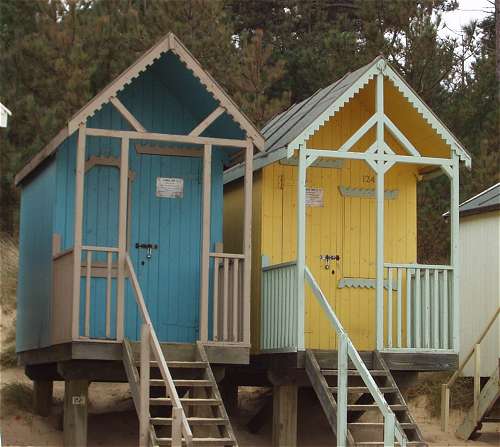
Even though the Northern Hemisphere is experiencing winter weather, I thought it would be fun to interject a bit of summer before the holidays really heat up. These colorful beach huts are custom made by James Ward in the United Kingdom and with a little foresight can be made into a tiny house.
The huts are made with 2×2 Red Swedish Pine frames for durability and the 8×8 pressure treated legs and subframe hold up the structure. The decks are pressure treated to resist moisture. Pine boards are used for the interior and the roofs instead of plywood and each hut is finished with galvanized hinges and locks. Each hut is also painted with an environmentally friendly water-based paint.
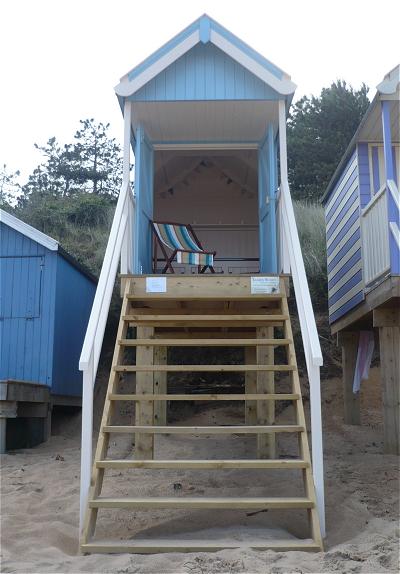
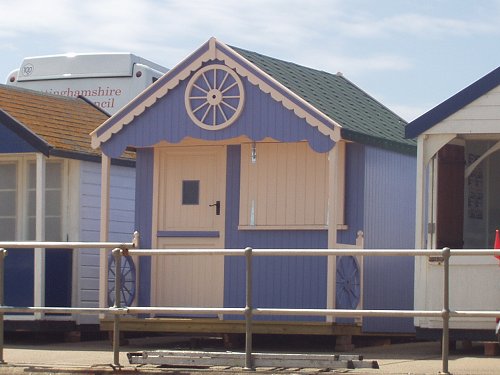

Many of these beach huts in the UK have storage, seating and dining options, gas or electric burners and sinks. With a little ingenuity, maybe a bed and a bathroom can be added on to create a tiny house on stilts.

Beach huts have been popular in the United Kingdom for over 250 years. The original beach huts were tiny houses on wheels that Victorian sea bathers would use to change out of their clothes at the same time the hut was being pulled by a horse directly into the ocean. The bathers would then be able to step directly into the ocean without having to show their modest bathing gear which usually consisted of skirts, pants and pantaloons.
Later on the huts lost their wheels and became more permanent fixtures on the beach. Some beach huts have been owned by families for generations and some pre-war huts have sold at auction for hundreds of thousands of dollars.

Photos courtesy of James Ward Beach Huts
By Christina Nellemann for the [Tiny House Blog]
Unfortunately I don’t think people are allowed to occupy beach huts overnight. But you’ve got some great pictures of them.
Christina I love these, they remind me of the shore houses on Long Beach Island in NJ. The bunting banner in the second beach hut photo is adorable.
The nice thing about this simple elegant cozy little getaway is it could be anywhere.A small footprint ,could be in the forest,lake,river,ocean or back lot.I want to take a nap on that bench with a cool breeze blowing in. 😉 Thanks Christina
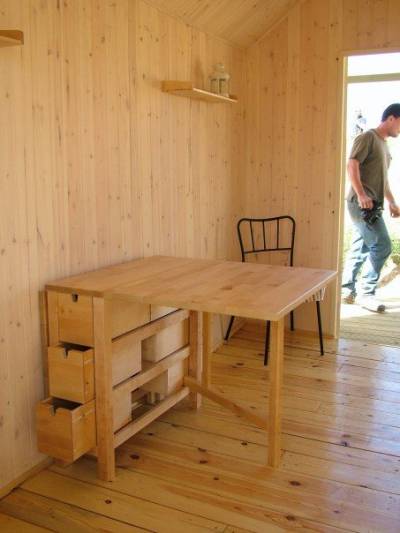
While I also think the hut is nice, that table really catches my attention. Simple, space-saving, and even provides some storage. I like it! Also, with the mechanism used to hold the surface up, it’s unlikely to fail easily, but would also be easily repaired. Who makes them? [Of course, if it’s for myself, I would probably build my own, but that’s another issue.]
try Ikea or pier one.
That’s an Ikea Norden table.
I also love the Norden table from IKEA. It seems to be pretty well made for the price. The top is a nice, but not heavy, butcher block.
I’ve seen a version of those tables that has a space to keep 4 folding chairs in instead of drawers http://www.amazon.com/Linon-Space-Saver-Set-Table/dp/B002USULCM but I think this one is the IKEA Norden table. A DIY version is on the list for my shackteau.
I much prefer the DYI options. Of course, I have my limits. I could put together a butcher block-style slab of wood with finger-joints or dowelled (slip tenon) joints to make the surface, but this seems like a better time for buying a ready-made top, cutting it, and putting together the remainder of the pieces. It looks like a fine time for “2×3” construction for the frame and some basic drawer/box construction.
You’re right–it looks a lot like the NORDEN, but I still like its simplicity.
You could always make shelves instead of drawers and use baskets or other containers. I’m going to use some of those laminated pine panels for the body and drop leaves, maybe make them more rounded. (easier on the hips in small spaces) The panels are a bit thin, might need some reinforcing for tops. I’ve screwed some of those metal u-channel type shelf brackets under my trailer table top made of the pine, helps keep it from cupping and doesn’t cost a lot, though you could also use a wood framework of some sort.
My understanding is these evolved because unlike the US there are few long expanses of good beach. With small huts many more can enjoy whole day @ the beach and homes & hotel development is away from the beach. Seems the model would have worked in the US but now McMansions blight much of the beach scenery.
That little stove looks interesting too. I wonder if it has a grill option under the burners, saw one like that in Ireland one time. Very handy for making toast and melted cheese things. I haven’t seen anything like it in North America.
Christina,
A milk house we acquired from a nearby farm has been sitting on skids for a long time waiting for the right “inspiration”. I think I can get started on it now. Thanks for the post.
You’re welcome Kevin. We would love to see your milk house when it is completed.
When I visit my mom in Myrtle Beach, SC, I see little beach huts like this in front of the rich people houses. I think every time we drive by that they would make really cool tiny houses. They’re built on slits over the dunes, and are really only used to store their beach stuff.
They would be cool to live in; until a hurricane comes!
It would be great if they were still on wheels, then you can just tow it out of harm’s way. 🙂
What’s “red Swedish pine?”
It’s a type of pine that grows in Sweden and is less subject to warping like other hardwoods.
These charming beach huts are called “chalets” in the UK (pronounced by most as ‘shally’).
No doubt this blog has already featured the wonderful (and widely published) chalet of the Danish-born & London-based industrial designer Nina Tolstrup at some time? It’s Scandinavian-inspired, has sleeping accommodations for her family of four in just 36 sq m/388 sq ft – and it’s on wheels!
Her tiny postage stamp-sized plot was bought at auction & is only about an hour away from London at Whitstable. It has lots of truly fantastic tiny house designery goodness packed into its miniscule footprint. She says the surf comes very close to the seaward deck in inclement winter weather.
If anybody reading hasn’t seen it yet, here’s the chalet’s page at the website of her firm, studiomama; be sure to scroll through to see all seven photos:
http://www.studiomama.com/chalet.html
I own a beach hut and we are allowed to stay in ours overnight. Some places you can stay over night and some you can’t. In 2008 I was offered £160 thousand for mine. But we have had it since 1904 and have many happy memories in ours, so it’s never going to be for sale at any price, but I was tempted for awhile.It was hard to resist that sort of money. One recently sold for £240 thousand, it’s odd to think that what amounts to a glorified shed can sell for so much. Oh and that table comes from Ikea, we have one in our hut. Will send you some photo’s past and present for you to enjoy. Just need to upload them to my lap top.
Love these beach huts, the bright colors and contrasting edging just make them stand out are are almost Picture Postcard magnets which makes the English coastline what it is today. They have not changed much since Victorian times and are still just as popular.