Living on the Lane

by Kent Griswold on March 7th, 2013. 35 Comments

By Alyse Nelson

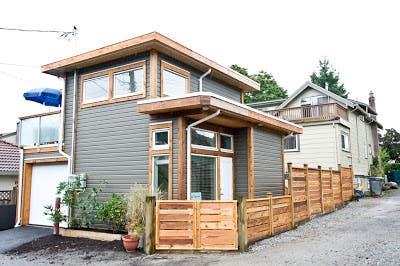
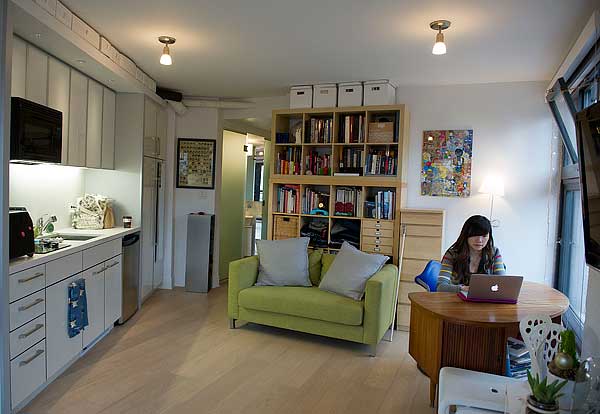
Akua Schatz and Brendon Purdy’s dream was to live near relatives, but they couldn’t afford a home in Vancouver, BC’s Dunbar neighborhood. Instead of moving to the suburbs, they decided to build a 500-square-foot laneway home in Brendon’s parents’ backyard.

Rental - Exterior Lane

Brendon and Akua’s laneway home, view from the alley, photo used with permission from http://buildsmall.blogspot.com

A few years ago, this wouldn’t have been an option for the young couple. Rules for laneway houses, as these backyard cottages are called in Vancouver, were adopted in 2009. Laneway homes are small backyard cottages that face alleys in traditional single-family neighborhoods. The density is hidden from the main neighborhood streets, leaving the appearance of Vancouver’s single-family neighborhoods intact. But while you might not see this hidden density, it could have a huge effect on the number of people able to call Vancouver home – nearly 70,000 single-family lots are eligible for an additional dwelling unit.

The Vancouver regulations allow a one-bedroom 500 square-foot laneway house on 33-foot by 122-foot single-family lots. The larger 50-foot wide lots can have a two-bedroom 750 square-foot cottage. Continue Reading »

Canada’s Smallest Rental

by Kent Griswold on December 29th, 2011. 37 Comments

Micro-lofts and Housing Affordability

Burns Block is an innovative market rental housing project built by Vancouver companies Reliance Properties and ITC Construction Group. Located at the site of the historic Burns Block in the Gastown neighborhood of the Downtown Eastside, the building dates back 100 years and is on the Vancouver Heritage Register. The building features 30 self-contained affordable furnished market rental suites or “micro-lofts.” Suites range from 226 – 291 sq. ft., making them the smallest in Canada. The spatially-efficient design contains built-in, pull-down wall beds with integrated folding tables, flat screen televisions, compact appliances, ample storage and built-in safes for storing valuables. Typical rental value for each suite is $850 per month, including cable and Internet, and starts as low as $760 per month. The building is 18,000 sq. ft and has five floors. The majority of occupants are between the ages of 25 and 35 and include students and those working in the heart of the downtown area.
While the former use of Burns Block was for a Single Room Occupancy hotel (SRO) with shared facilities, suites in the redeveloped building each contain a “wet” bathroom and full kitchen. The building also features a rooftop garden, basement gym, bicycle storage and several environmentally-friendly elements. The Bitter Tasting Room, owned by Heather Hospitality Group, is conveniently located on the ground floor of the building, which also includes 1,421 sq. ft. of future retail space. Continue Reading »
Smallworks

by Christina Nellemann on January 3rd, 2011. 13 Comments

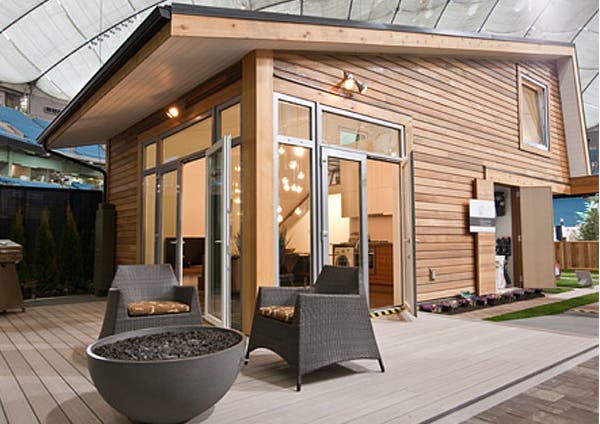
Smallworks Studios/Laneway Housing Inc. is a design and building company based in Vancouver, Canada. They specialize in small homes and laneway houses which are small cottages or homes that are built on the rear of a property lot, usually behind another house. Their designs range from around 100 square feet to 750 square feet.

Smallworks takes an active role in the entire process of building a small home including site inspection, custom design, permit applications, in house millwork, pre-fab and flat pack material delivery and on site construction management. The company uses LEED accredited designers and will walk a customer through various sustainability and green building options. Premium upgrades for each project include lifetime warranty metal roofing, upgraded siding, millwork and furniture packages and bamboo flooring. Continue Reading »

January 3rd, 2011and filed in Pre-fab, Stick Built
Tags: canada, delivered, design, Pre-fab, prefab, Vancouver
13 Comments

Quarters: Prefabricated Housing

by Christina Nellemann on December 13th, 2010. 30 Comments

Bowen Island seems to be an attraction for tiny houses. It’s home to the Eco-Shed by James Glave and is now home to the Quarters house by industrial designer Amanda Huynh in collaboration with Anna Gukov, Lydia Cambron and Emilie Madill. Following nearly a semester of intense research in materials, compact housing and the homelessness epidemic in Vancouver, a full-scale, timber-framed unit was built to house 1-2 residents in need of a simple shelter.

The 8 foot by 8 foot structure has a built-in sleeping loft, a readily available 5-gallon bucket wash basin, a City of Vancouver rain water barrel and modular furniture, which could be easily configured to create a second sleeping space. Because the individual unit does not provide running water or electricity to reduce cost, it would function best in a community of such dwellings with central kitchen/washroom facilities. Continue Reading »

Free Spirit Spheres

by Christina Nellemann on August 17th, 2009. 19 Comments

What do Ewoks and Julie “Butterfly” Hill have in common? They have discovered the ethereal magic of living up in a tree.

Tom Chudleigh of Vancouver Island, Canada has discovered the same magic with his Free Spirit Spheres, handcrafted tree houses that bob among the trees like giant apples.

freespirit-eve3

Chudleigh calls his design a bio-mimicry. Each sphere attaches to a web of rope. The web connects to whichever strong points are available. This replaces the foundation of a conventional building. A tree house sphere uses the forest for its foundation, so the occupants of a sphere then have a vested interest in the health of the trees. Each sphere has four attachments on top and another four anchor points on the boom. Each attachment is strong enough to carry the entire sphere and contents.

freespirit-eve5

A suspended sphere is tethered by 3 nearly vertical ropes to each of 3 separate trees. This distributes the load evenly over the 3 trees and results in a stable hang. Like an inverted three-legged stool, there will be almost equal tension in each of the three suspension ropes. The sphere resides in the center of the triangle formed by the 3 trees. It can be slung from 5 to 100′ off the ground, depending on the size of the trees.

Photo from Kiwipulse

Photo from Kiwipulse

If something really big, like a tree, falls through the web then some strands will break and let it pass through. The sphere remains suspended by the remaining strands. A major disaster like that is not likely, but possible. Everything, including spiral stairways and suspension bridges, are hung from ropes. Trees are protected where the spiral stairways hug the trees and ropes pass around the trees. The spheres are well adapted to life in a large mature forest.

The sphere concept borrows heavily from sailboat construction and rigging practice. It’s a marriage of tree house and sailboat technology. The wooden spheres are built much like a cedar strip canoe or kayak and suspension points are similar to the chain plate attachments on a sailboat. Stairways hang from a tree much like a sailboat shroud hangs from the mast. The joinery is yacht style with much brass trim, varnished wood and cane doors. They have closets on either side of the door.

Photo from Kiwipulse

Photo from Kiwipulse

A sphere is accessed by a spiral stairway and short suspension bridge. The two lower back suspension points of the sphere are tied horizontally to the two back trees, to keep the suspension bridge from sagging when it is walked on. The door faces the “door tree” and the suspension bridge connects the two. A helical stairway spirals up or down from the suspension bridge to the ground or next level.

Two Spheres, named Eve and Eryn, are available for overnight rental year round. Eve rents for $125 a night or $199 for two nights while Eryn rents for $175 a night or $299 for two nights Eryn’s rate is based on 2 people. The motion in a sphere is a slow gentle rocking when the wind blows. The rope tethers are almost vertical which lets the treetops move considerably while hardly moving the sphere at all. When another body inside a sphere shifts his/her weight the motion is abrupt. This is because the mass of the sphere is low.

Photo from Kiwipulse

Photo from Kiwipulse

In the Eryn style, there is a double bed on the right centered under the 40″ window. A settee with table is placed in front of the 42″ window on the left. The back wall opposite the door provides a galley area with counter cupboards and a sink. A microwave and refrigerator are also installed. Above the galley area there is a loft bed with full sitting headroom at the center. Circular shelf segments connect the loft bed to the cupboards on either side of the door. An outhouse and washroom are located nearby on the ground.

Photo from Kiwipulse

Photo from Kiwipulse

Free Spirit Spheres can also be purchased as completed projects or as shells and component kits. Wood spheres are made of two laminations of wood strips over laminated wood frames. The outside is then finished and covered with clear fiberglass. The result is a beautiful and very tough skin. The cost of these are sold for about $125,000-$150,000.

Fiberglass shells are also sold at $39,000-$45,000. The skins are waterproof and strong enough to take the impacts that come with life in a dynamic environment such as the forest.

Both wooden and fiberglass spheres are insulated. Vinyl upholstery fabric is stapled to the frames (lines of longitude). Each fabric joint is then covered with a decorative wood strip. The wood strips come together at the top and give a nice cathedral ceiling effect.

Photo from Kiwipulse

Photo from Kiwipulse

By Christina Nellemann

Copyright © 2009 Tiny House Blog

If you enjoyed this post, subscribe to our feed