Trillium RV

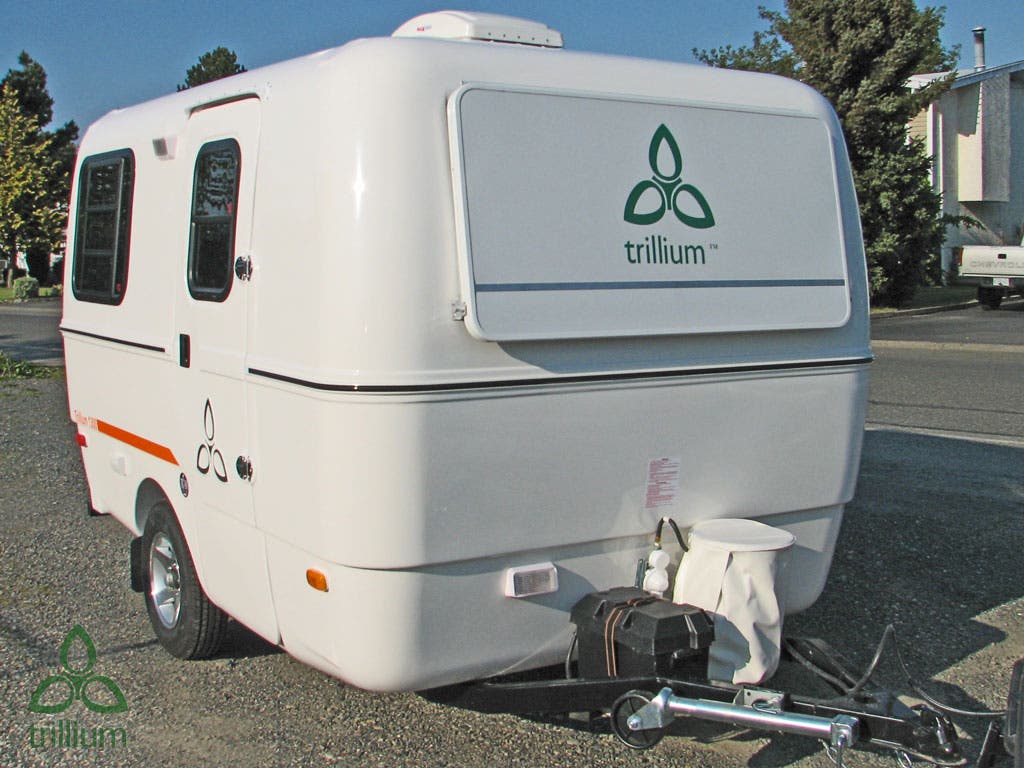
For fans of small fiberglass trailers, the popular and efficient Trillium is back on the road…with a new modern look. The original Trillium trailer was built in the 1970s and some are still being towed around after 35 years of use. The quality materials, cute design and useful floor plans of these original trailers are being used in the new design. Trillium RV has been set up by the former VP of operations of the original Trillium plant, which was in Markham, Ontario, Canada. Tom oversaw 10 years of manufacturing, sales, service and much of the design work of the original Trillium.
Today’s Trilliums are built utilizing the original models. So the quality, design, and floor plans are true to the former manufacturing standards. The overall look of the fiberglass body remains the same. Big improvements are in the area of newer, high tech appliances, modern cushion materials, curtains, and exterior graphics. The trailers have the same dimensions, but will weigh a little more. This is due to the addition of more equipment that users have requested in the trailers.

Read more

Phase I: Subfloor Sandwich System

Todd Miller from the Oregon Cottage Company is building another cottage and is going to be sharing with us a series of the steps involved in building a tiny cottage on wheels. This is the first in the series and I hope I can assemble his information in an easy to understand way. This first phase is about assembling the subfloor sandwich system. I will turn it over to Todd now:

Once you have a design set, received your lumber, windows, doors, fasteners and updated and provided your proper tool maintenance you will be ready to get your hands dirty.

Custom 10,000 lb GVWR Frame

I call this first phase of construction a “sandwich system” because of the way the materials are stacked to get you to the wall framing phase of the project.

Simply put, the “Sandwich” is 3 ½” rigid board insulation layered between two sheets of ¾” T&G plywood.

Read more

Insuring Your Tiny House on Wheels

Tarsha Downing who is building a tiny house and keeps us updated on facebook and also her personal blog is coming right along with her build. As Tarsha invests more and more into her home she was wondering what other owners with tiny houses on wheels have done for insurance? … Read more

Arogel Insulation in a Tiny House?

Erik sent me an email asking if anyone had considered Arogel insulation for a tiny house? I personally had not heard of it before so with Eriks help did a little investigation. If you are not familiar with it I’ll give you a small overview and than you can decide if this might be an option when you build your own tiny house.

Here is a brief description: Nicknamed “frozen smoke,” aerogel is extremely lightweight material, with a density only 3 times that of air. Only a small fraction of a volume of aerogel is the material itself. Most of the volume is filled with air. This makes aerogel an excellent insulator. (Aerogel provides nearly 40 times the insulation of fiberglass insulation.)

It is very expensive so has not made a big move into the building industry. NASA and other high tech companies have used it extensively up to this point.

A company called Themoblock is one company trying to bring it to main stream construction. Thermablok material is available both in sealed strips for stud insulation, and in bulk roll form.

Thermablok’s thin 1/4″ (6.35mm) profile allows it to fit between framing and sheathing without altering standard construction. It is applied in strips with a peel-and-stick adhesive backing or staples. It can be customized to fit on headers, rim joists, corners, rafters, window flashing and other hard to insulate areas. This makes ThermaBlok aerogel insulation an effectively universal solution for enhanced insulation value in any building partition.

Read more

Building a Shed – Fine Homebuilding

I am in the process of creating a small photo ebook to go along with the Sonoma Shanty plans and one of the resources I found to help in your construction education is located on the Fine Homebulding site called “How to Build a Shed.” This is an excellent video … Read more

Gypsy Wagon Design and Build Seminars

Last year I let you know about a coveted workshop offered up in Port Townsend, Washington on Gypsy Wagon design and builds. Jim Tolpin contacted me the other day to give me the schedule for the 2010 year.

Jim says, “We’ve shortened the seminars to three days to focus on design development and to make the class more affordable.” The price is $295 for the three day seminar and limited to 25 students at each of the seminars offered. Register Here.

DSC00584-sm
Students helping to steam bend a wagon hoop around a form.

In this three day weekend we will begin by exploring in depth how the late 19th century, English-made “Living Wagons” (called “Vardos” by the Gypsies)—were designed, built and used.

Read more