Archive for the 'Construction Articles' Category

The Hexayurt

Photo by cptravel

Photo by cptravel

On my trip to Burning Man this year, I noticed quite a few camps utilizing the Hexayurt. A model of this affordable “refugee” shelter was also on display along with the art on the playa, and I was suprised how cool it was in the boiling heat, and how sturdy it was against the notorious Black Rock Desert winds. The inside had room for a full-size futon, some chairs and a table, as well as a few bookshelves.

The Hexayurt, created by Vinay Gupta, is made from Thermax HD from Dow for permanent use and and with laminated hexacomb cardboard from Pregis for temporary use. The reflective material on the outside keeps out the heat. These units take a team of three people around an hour to assemble. They are assembled using a 6 foot wide, 600+ lb bidirectional filament tape, and anchored to the ground like a tent. No heavy lifting, ladders or scaffolding are required.

A Hexayurt is primarily an emergency structure which is self-contained and easily packed for transportation. They cost around $200 to $500 plus another $100 to add a utility package for water decontamination, heating and cooking, communal composting toilets and solar power.

There are three sizes available:
* Stretch Around $100 per unit, 6′ high, 72 sq ft
* 8 foot Around $200 per unit, 8′ high, 166 sq ft.
* 12 foot Around $300 per unit, 12′ high, 166 sq ft.

A Hexayurt can also be used for a temporary structure to live in while building a more permanent dwelling.

Based on work done at the Rocky Mountain Institute, a Hexayurt village is intended to replace all the infrastructure which might be damaged after a major disaster such as an earthquake or flood — in other words, it is an autonomous building suitable for a family. Both the American Red Cross and the U.S. Department of Defense are planning on using the Hexayurt for refugees and military use.

Treehugger: The Hexayurt: Efficient, Emergency Shelter

The Sietch Blog: Interview with Vinay Gupta

If you enjoyed this post, subscribe to our feed

Gypsy Rose

By Christina Nellemann

Because of their size and aesthetics, tiny houses lend themselves to being named: weeHouse, Tumbleweed, Box Turtle. Rarely do you see a 3,500 square foot house with a name.

Kevin Rose named his mobile house Gypsy Rose, after his last name and the fact that his lifestyle in this tiny house and aboard his boat (Raven) is somewhat footloose. Any similarity to the famous stripper, Gypsy Rose Lee, is purely coincidental, he said.

Kevin told me that the idea for Gypsy Rose was completely independent of the “small house movement” that has recently gained in popularity, and that simplicity and functionality were the primary criteria in designing the house.

“I live on a boat on Lake Champlain in Vermont for 7 months a year and had a need for winter accommodations,” he said. “My friend Marion had a need for summer accommodations on the land she owns in eastern Vermont. One day I called her up and suggested that we build a mobile cabin that we could share between the two locations. We designed it ourselves based on the maximum dimensions allowable on the highway without a permit (8.5 feet wide by 13.5 feet high) and my experience with efficient use of space on boats.”

The trailer for Gypsy Rose was custom made and Rose did the rest of the framing and details himself. Gypsy Rose is self contained and off the grid. It uses many systems that were developed for marine applications. She operates primarily on 12V electrical systems whose batteries will ultimately be charged by solar or small-scale hydro (with a generator backup). Propane powers the stove, the refrigerator, the furnace, and the on-demand hot water heater and a composting toilet handles the waste.

Rose’s passion for nature, sustainability and creating a sense of place is evident in his blog which documents the process of building Gypsy Rose, and his life around the New England area.

Ecomodder: Building Gypsy Rose

If you enjoyed this post, subscribe to our feed

Martin House-To-Go Update #2

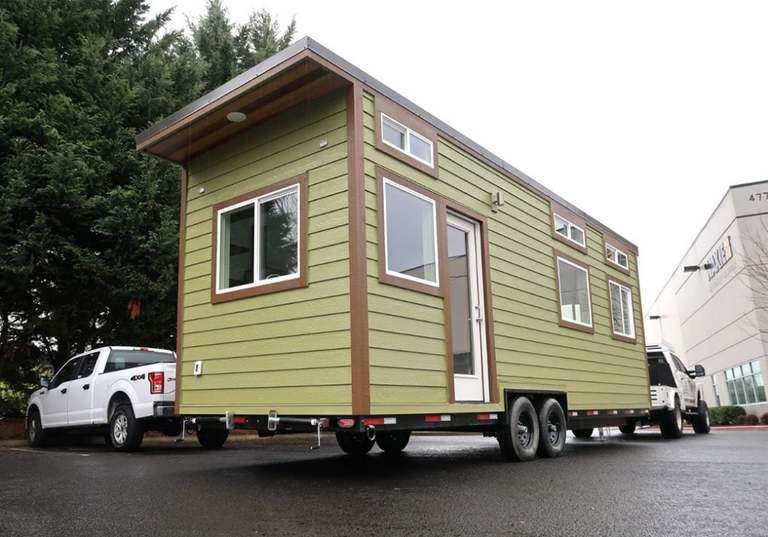
Here are a few answers to our last post on the Martin House-To-Go. I am featuring some new pictures of the Sportsman in this post. Again these are a first view thanks to Dan in Southern California who has been talking very seriously with Julie of Martin House-To-Go and getting these pictures and information for me to share with you.

A ladder is used to access the loft. Two singles or a queen size bed will fit very easily in the loft. The downstairs room also offers a sleeping area, as you can see two cots will fit in the room, although very closely.

Julie is using a European sink and burner that is very attractive as well as functional. This picture details the kitchen and shows off the cedar cabinet.

The bathroom consists of a sink, composting toilet and shower. Very attractively done and good use of the space.

The floor plan gives you the full picture. This model is 10 x 20 so in many states such as California, will require a permit to move it down the road. If you purchase one be sure and check this detail out before attempting to move it about in your state.

I’ll keep you posted as I learn more and be sure and check the Martin House-To-Go website as I am sure she will be updating it in the near future. This is one more choice for that mobile tiny house.

If you enjoyed this post, subscribe to our feed

« Previous PageNext Page »

done