Uber Shelter

Posted September 30th, 2008 by Kent Griswold and filed in Tiny House Concept
Tags: ,
5 Comments

Uber Shelter is an amazing concept for a portable housing unit that would help people in meeting their immediate shelter requirements created by disastrous events.

This great concept is designed by Rafael Smith. This shelter can be very quickly transported and reassembled with just few necessary tools and offer victims with individual living space. The best thing about Uber shelter is that it is made from recyclable and reusable materials. Around two to three personal rooms can be created in this shelter. I believe these types of concepts are very useful for unpredictable disasters.

Text from designer: ?My goal is to create more than an emergency shelter. This project is a shelter solution that meets the needs of emergency response but also provides victims with a more personal place to live; a base unit that can serve as a very basic shelter but also have the capabilities to upgrade and implement modern infrastructure.

This shelter is also stackable. Many alternative housing solutions deal with small scale but can’t cope with large scale displaced populations. There are 5 points that have been the focus during the design of this shelter. The shelter must be:

  1. Easily transportable, collapsible and able to be shipped flat.?
  2. Built of recyclable materials and have the ability to be reused.?
  3. Easy to erect and assembled with few or no tools.?
  4. Amenable to infrastructure?can be used as a basic structure, but have the capabilities to upgrade and implement modern conveniences.?
  5. Stackable

Über is shipped flat to allow for transport via air sea and land. All components that create the modular living unit are stored inside the shelter in its collapsed position during transport. It is then taken apart and assembled on location. When it is no longer needed, it can be dismantled, packed flat again, and moved to the next disaster area. The aim has been to design a shelter that is compatible with the current system used in refugee camps and emergencies by organizations such as the UNHCR (United Nations High Commissioner for Refugees).

Every camp is different since every situation is different. In some cases proper design of a camp is not possible because refugees have already settled on a site. Uber has been designed to adapt to different situations, terrains, and climates. Camp needs are addressed in phases. Phase one is to meet the basic needs of the people, providing them with the bare essentials.

When the camp is ready for phase two, a separate upgrade package is shipped and added into the shelters units to provide conveniences (electricity for light, compact stove and refrigerator).

If you enjoyed this post, subscribe to our feed

Ross Chapin and Tiny House Communities

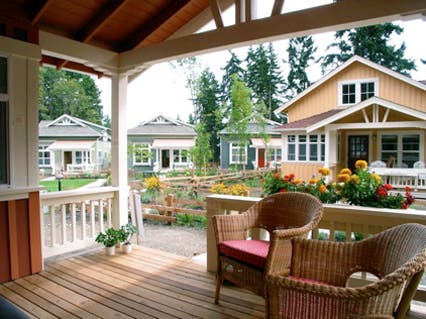
A few years ago I was given the chance to visit the Third Street Cottages on Whidbey Island and the opening of the Greenwood Avenue Cottages in Seattle. These communities, by renowned architect Ross Chapin and developer Jim Soules, have become famous for being small, sustainable and community oriented. Chapin calls them pocket neighborhoods.

Photo from Ross Chapin.com

I think my first exposure to small and tiny houses was Chapin’s Third Street Cottages, which were featured in Sarah Susanka’s book, Creating the Not So Big House. They were so well designed and so space efficient and sufficient that it has not occurred to me since that I would need anything bigger. The Third Street Cottages are about 600-650 square feet and have a great room with living, cooking and dining areas, a downstairs bathroom with laundry facilities and a downstairs bedroom. Each house also has a full size loft that is accessed by a ship’s ladder. The owners personalize each cottage by naming their homes. I visited a cottage in the Third Street community named Plum Corner for the plum trees that were left behind during construction.

Photo by Christina Nellemann

Third Street Cottages. Photo by Christina Nellemann.

Photo by Christina Nellemann

Third Street Cottages. Photo by Christina Nellemann.

The typical cottage community by Chapin includes 8 cottages on a 2/3 acre plot that usually  holds one or two larger homes. The cottages surround a “green” area that holds seating, grass and trees and a place to grow community vegetables. A parking lot is off to the side of each community, hidden from view by a fence or bushes. Each cottage has its own small garden area surrounded by a low fence and each community has a shared tool shed and meeting room. Each small house is sold as a condominium and a monthly fee helps to maintain the garden and outlying areas.

To create a balance between the public and private areas, Chapin uses the concept of “layering”. The entryway into the main garden is the first layer, moving from public to more private. Anyone who does not belong in this area is noticed right away from each of the cottages. This way, neighbors can keep an eye on each other’s homes. The layering concept continues with the main garden area leading into the more private cottage gardens through the small fences and then each house is entered by first going up several stairs to the open front porches. The porches bring to mind the charming bungalows of the Arts & Crafts movement of the early 1900’s. The porches extend the living area of the small homes as well as offering a convenient area for neighborly chats.

Greenwood Avenue Cottages. Photo from Ross Chapin.com

Greenwood Avenue Cottages. Photo from Ross Chapin.com

I was able to view the Greenwood Avenue cottages during an open house tour and I was impressed by how the little details in the homes gave them each a different personality. Each tiny home uses architectural tricks to create a larger space: built-in bookshelves, alcoves, delineated ceiling heights between living and eating areas, ample windows and skylights. Each home is personalized with special details such as trim, woodwork (the walls of the Third Street Cottages are paneled in reclaimed spruce saved from destruction by a piano company) and cubby areas holding shelves, window seats or dining nooks.

Greenwood Avenue Cottages. Photo by Christina Nellemann.

Greenwood Avenue Cottages. Photo by Christina Nellemann.

Greenwood Avenue Cottages. Photo by Christina Nellemann.

Greenwood Avenue Cottages. Photo by Christina Nellemann.

Greenwood Avenue Cottages. Photo by Christina Nellemann.

Greenwood Avenue Cottages. Photo by Christina Nellemann.

Chapin believes in not only designing and building to save space and money, but to promote sustainability. The low garden fences are recycled fencing, the cottage’s siding is cement fiber board rather than wood, and the garden pathways were laid with crushed hazelnut shells from a local nut company.

Ross Chapin Architects also sell cottage home and small home plans. The three smallest are the Blue Sky Cabin at 307 square ft. the Backyard Cottage at 449 square ft. and the Lizzie Cottage at 540 square ft.

Blue Sky Cottage. Photo from Ross Chapin.com.

Blue Sky Cabin. Photo from Ross Chapin.com.

Backyard Cabin. Photo from Ross Chapin.com.

Backyard Cottage. Photo from Ross Chapin.com.

Backyard Cottage Interior. Photo from Ross Chapin.com.

Backyard Cottage Interior. Photo from Ross Chapin.com.

The Cottage Company

Living small — Some Utahns discovering the charm of cottages

Cottage Housing in Your Community (PDF)
A guide to drafting a cottage housing ordinance

Tiny House Village Concept post on Tiny House Design

By Christina Nellemann

If you enjoyed this post, subscribe to our feed

Building with Cob – Update

Posted September 26th, 2008 by Kent Griswold and filed in Earth/Cob
Tags:
7 Comments

We discussed Brian Liloia cob cottage in an earlier post and I wanted to give you an update on his progress. Brian has started the roofing of his cob home as you can see by the picture above.

Brian was recently interviewed about building his cob house at Dancing Rabbit Ecovillage. He was interviewed by Tom Tucker of Greenblogosphere.com.

Cob Roof

He discusses his experience building the house, the benefits and history of cob, and why he chose cob over other materials. They also talk a bit about life at the Dancing Rabbit Ecovillage.

Brian is hoping that this audio interview will help shed more light on what it is like to build with cob and others will be encouraged to give it a try as well.
I have posted the audio below and attached some photos of the process so far. You can visit Brian’s “The Year of Mud: Building a cob house” blog to learn more as well.

Foundation
Foundation
Partial Walls
Partial Walls
Brian and his Window
Completed Walls
Completed Walls

If you enjoyed this post, subscribe to our feed

Shipping Containers

Posted September 24th, 2008 by Kent Griswold and filed in Pre-fab
Tags: ,
11 Comments

Shipping Containers
‘Dream’ Homes for Thousands

I was planning on writing about composting toilets today but came across an article on the CNN website that I just had to share with everyone. So toilets will have to wait for another day.

It was a side trip through a destitute, ramshackle neighborhood in Ciudad Juarez, Mexico, that detoured Brian McCarthy from building houses in Albuquerque to an idea to offer the very poor a chance to own a home.

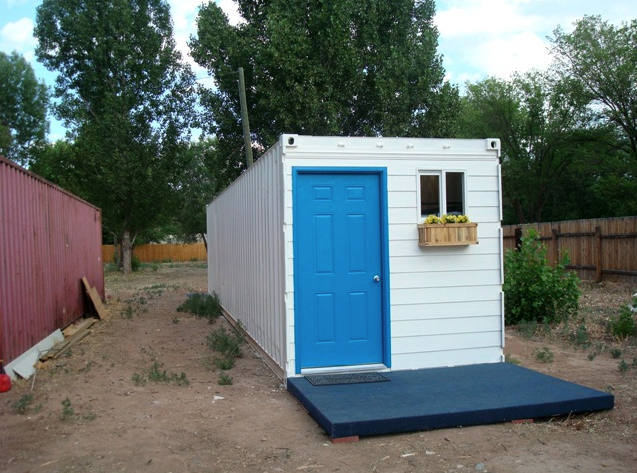
Container Home

PFNC stands for “Por Fin Nuestra Casa.” Translated in English this simply means “Finally, a home of our own.” These words are the foundation of PFNC, whose goal is to provide housing to those who most desperately need it around the globe.

PFNC utilizes surplus shipping containers resulting from the United States’ consistent trade deficit.  These containers serve as the building block of PFNC housing, but go through an extensive conversion process to make them a home.  PFNC offers an affordable housing solution that is scalable and fully portable. Each PFNC unit includes 1st world amenities for a price of less than $10,000 (US).

Though considered sparse by American standards, these tiny houses have everything a person needs to live a simple life. I personally would like to promote this company for what they are attempting to do and I hope they have great success. I am contacting them to learn more on how to help get these to people who really need a new home.

To learn more go to the PFNC site. Watch the video NBC has put together on PFNC and watch the walk through video as well. I would encourage you also to read the CNN article.

Floorplan

Prototype Construction

Prototype Construction

Exterior Construction

Exterior Construction

Kitchen

Kitchen

Bathroom

Bathroom

Bedroom

If you enjoyed this post, subscribe to our feed

Small Never Lived so Large:

Posted September 23rd, 2008 by Kent Griswold and filed in Stick Built, Tiny House Articles
Tags: ,
2 Comments

Boor Bridges’ Big Design for a Tiny San Francisco Cottage

This 840 square foot luxury cottage is tucked away mid-block on Ames Alley, steps from the vibrant Mission district, yet protected from the heavily trafficked streets of Guerrero and Valencia. Since the 40’s the existing structure was home to Betty Mae’s School of Tap, and the one studio room outfitted with low dance bars saw over 30 years of tiny dancers cross its maple floors.

Cottage Entrance Cottage Entrance

When faced with renovating the building, owners Kevin Smith and Flora Grubb could not bring themselves to tear it down even though they had approval to build a 2-story structure over a garage. Instead they tapped their friend Seth Boor of Boor Bridges Architecture to see just how luxurious and livable they could make such a compact space without losing the warm memory of the dance studio. The result is a one-of-a-kind urban sanctuary and grown-up clubhouse, where every square inch has been designed and manicured, and where the open feel of the studio remains the primary organizing principal.

In the main studio space, a new central fireplace wall sided with re-claimed douglas fir anchors the living room bathed in light from the skylight above. Around the other side this central piece opens up to become a closet space serving the master bedroom. Along the east wall custom FSC-certified cherry cabinets wrap in and out of the full kitchen, providing ample storage, framing the entrance to a clever bathroom, and a hidden washer and dryer. In the kitchen dark custom concrete counter tops wrap the u-shaped working space, overhanging the living room to form a dining bar.

Pulling this whole edge of the space together is a continuous integral color plaster wall that begins in the bathroom and travels through the kitchen into a petite open air patio space, reinforcing a beautiful indoor-outdoor connection where you didn’t even know you had room for a ‘backyard’. French doors open wide to the rear patio, letting in light and air and perfectly framing the view of the plaster wall hung with a framed vertical succulent garden. Stepping out onto the 40 square foot patio you are pleasantly surprised to find a custom concrete soaking tub tucked away at the garden’s edge. At the opposite edge a fixed ladder leads the adventurous to a rooftop redwood deck, complete with kitchen garden and fixed glass tabletop (which doubles as the bathroom skylight) for moonlit cocktails.

For additional information on the design of Ames Alley Cottage, please contact:

Seth Boor, Principal
Boor Bridges Architecture
415.241.7163
sboor@boorbridges.com
FAX 415.241.7164
www.boorbridges.com

To view some before picture of the cottage before the reconstruction go here. To see more pictures of the completed cottage click here. This house will be going on the market in mid October if you are interested.

Kitchen/Entrance

Kitchen/Entrance

Bathroom

Bathroom

Soaking Tub

Soaking Tub

Fireplace

Fireplace

Exterior

Exterior

Sketch

Sketch

If you enjoyed this post, subscribe to our feed

Tiny House Forum

Posted September 23rd, 2008 by Kent Griswold and filed in Tiny House Articles
Tags:
9 Comments

Michael Janzen (tinyhousedesign.com) and I were talking a while back and it occurred to us the tiny house world probably could use a real Tiny House Forum. Several readers of the Tiny House Blog have suggested that it would be a good idea as well.

A forum is different than a blog. A blog is a bit more of a one way communication tool. Forums are for true discussions where everyone is on even footing.

The Small House Society Yahoo Group is also a great place to chat about tiny house living but with so much happening in the tiny house world it seemed like an open forum might be a good addition to the tiny house online world.

We’ve been setting it up for a couple weeks but today we’re officially opening the virtual doors. We hope you’ll come and chat at TinyHouseForum.com

Straw Bale Women

Posted September 22nd, 2008 by Christina and filed in Construction Articles, Straw Bale
Tags: , , , ,
8 Comments

There is something feminine about straw bale homes. The warmth, curves and color of these natural spaces act like a hug when you walk in the door. While these profiled straw bale homes are small rather than tiny (most are around 400-800 square feet) they were envisioned, designed and built by women that I feel epitomize the beauty of the straw bale house.

Most followers of strawbale building and other natural building techniques know of the Canelo Project and Athena Swentzell Steen.

Carolyn Roberts and her straw bale home

She and her husband Bill run this small non-profit organization that is dedicated to the exploration and development of living systems, including growing food and building homes that creates friendship, beauty and simplicity.

Straw bale cottage at the Canelo Project

Straw bale cottage at the Canelo Project

Interior of straw bale cottage at the Canelo Project

Interior of straw bale cottage at the Canelo Project

Their latest book is Small Strawbale, which covers everything from building walls and open shelters to small and exquisite homes built out of straw bales.

Carolyn Roberts also wrote a book detailing the trials and triumphs of building her own straw bale home outside of Tucson, Ariz. A House of Straw: A Natural Building Odyssey profiles the challenges of passing her county inspections, the issues of building a house as a single woman while trying to raise two children, and the wonders of creating her own space and the friends she made along the way. Her website breaks down the cost of each part of the building process, and her total for the home (land not included) came to approximately $50,000. Because of the thick walls and use of passive solar, her electric bills average about $35 a month.

Interior of Carolyn Robert's straw bale house

Interior of Carolyn Robert's straw bale house

Caroline Coalter Wilson built her house, Paca de Paja, to also serve as a small bed and breakfast. She works at the Arizona-Sonora Desert Museum and runs the B&B part time. She was previously a park ranger and naturalist with the National Park Service and has written several publications on natural history.

Paca de Paja

Paca de Paja

I really admire these women who have tackled the building process from the ground up and utilize the beauty of natural products in their homes. More information for my fellow female dreamers and builders can be found in the book
The House That Jill Built.

By Christina Nellemann

If you enjoyed this post, subscribe to our feed

What Would You Like to Know?

Posted September 19th, 2008 by Kent Griswold and filed in Poll
Tags:
Add a Comment


I would like you to take a minute and fill in the form below and let me know what you are interested in as far as tiny houses are concerned. My goal for this blog is to be informative as well as fun, so your input is important to me. If I don’t know the answer I will try and find it. If I can’t, I’ll toss it out there and see if someone else does.

Simply enter your suggestion or question below and enter the verification code so I don’t get spammed and press Send Email.

Cub Creek Cabin

Thank you for your time.  —Kent Griswold

What Would You Like To Know
About Tiny Houses?

Verify

Script by Dagon Design

Outa the Woods

Posted September 18th, 2008 by Kent Griswold and filed in Tree House
Tags:
11 Comments

I have been wanting to cover some tree houses as they fit very well in the tiny house arena. There are some really neat ones around the world that I would like to share with you. I will start with one of my favorite finds, located in the East Kootenays of British Columbia. Mike Zamara and Debbie Lungal Zamara have built this unique tree house getaway.

Perched on a large platform 5 meters (15 feet) high and built on seven trees, “Outa-the-Woods” is a totally unique vacation retreat. 

Tree House
You can relax on the deck overlooking ponds and forest. Enjoy a spectacular Rocky Mountain view and watch the wildlife from the deck. This treehouse is built entirely out of the woods with carefully selected, curved, twisted and burled wood. It features many carvings, two handmade spiral staircases, and rustic furniture.

“Outa-the-Woods” has a comfortable and relaxing atmosphere in a peaceful natural setting. Experience the magic of living in the trees. Outa-the-woods is a secluded, romantic getaway, ideally suited for couples.

Features of the tree house include:

  • spacious two-sided front deck with barbeque,
  • main floor with dining area, kitchen, bathroom and lounge,
  • loft bedroom with walk-out balcony and double hammock,
  • propane kitchen with a full set of pots, pans, dishes and cutlery,
  • An attractive propane fireplace,
  • solar electric outlets for low amp appliances,
  • three piece bathroom with all bath, bed and kitchen linens supplied,
  • running hot and cold water, and solar powered lights.

Visit the “Outa the Woods” website to see more cool pictures get more information.

Photo Credit – Outa the Woods

Living Room

Living Room

Kitchen

Kitchen

Bedroom

Bedroom

Deck View

Deck View

Outa the Woods Tree House

Outa the Woods Tree House

If you enjoyed this post, subscribe to our feed

Tilt Sofa Bed

Posted September 17th, 2008 by Kent Griswold and filed in Tiny Furnishings
Tags:
13 Comments

In my search for furnishing for tiny spaces. I came across a company called apt which stands for apt: Adjective, exactly suitable.  The cool thing is that the furniture designed by this company is aimed at small spaces, which is exactly what we are looking for.

The studio collection of sofa beds is designed for one room living or any small space. Sofa models are designed to flip, flop, some slide, and some drop. The goal is for you to sit, sleep, and relax. Sounds good to me.

Tilt Sofa

There is quite a selection in the studio series but I am going to feature one of my favorites. The Tilt Sofa Bed. Here is the description from apt:

Designed for the modern home, the sleek Tilt Sofa Bed is the practical choice for today’s living room. The convertible sofa features a unique European click-clack mechanism that enables you to easily convert this sofa into a bed within seconds.

  • Double sized bed
  • Available in Suede Look
  • Polyurethane foam
  • Steel frame with pocket springs
  • Chrome legs
  • Designed in Denmark

Dimensions – 79W x 40D x 29H ”
Seat Height: 16″
Bed: 79 x 50

Check out their collection at the apt site. Choose one that works for your tiny space.

Tilt Sofa Open

Tilt Sofa Open

Tilt Sofa Flat

Tilt Sofa Flat

If you enjoyed this post, subscribe to our feed