


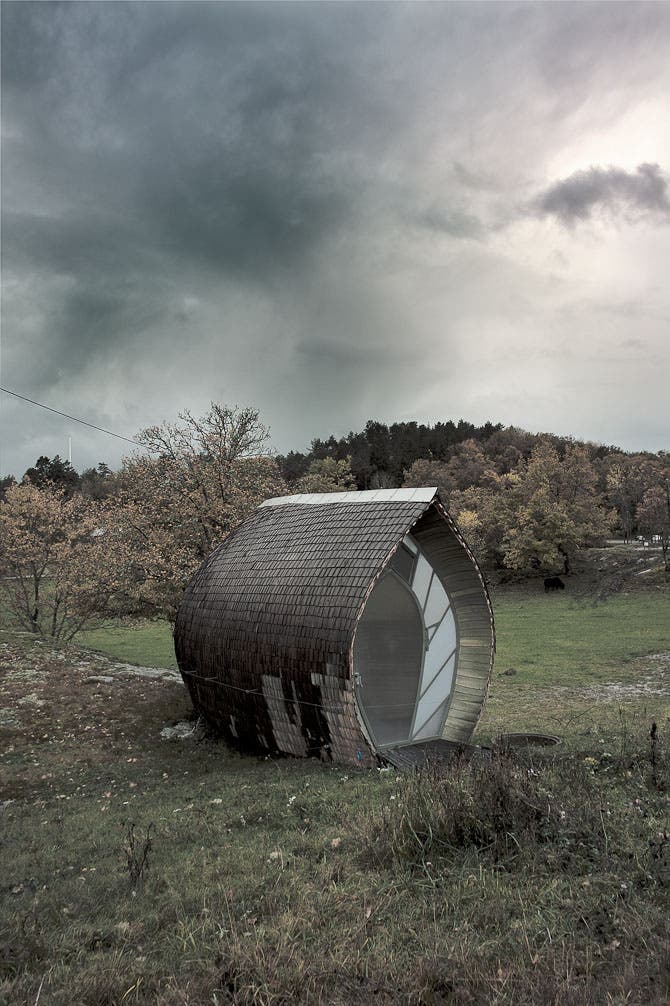
Swedish architect Torsten Ottesjö has recently create a free-standing and nearly free-form tiny house that can be moved anywhere to create the illusion that the house has sprouted out of the ground. The Hus-1 is a 270 square foot dwelling that can accommodate two people and contains a kitchen, sleeping quarters, dining table and windows that look like the surface of a leaf.
Ottesjö says that “block-shaped” buildings are not a suitable environment for humans and that integrating nature’s variety of form into a home will create a space that feels unconstructed. He also says that it is more common to hear a person express more love for a car than for a house since a car is more in scale with a human body. Homes should be sized smaller and adapted the same way to the movement and mechanics of the body.

He is inspired, not only by nature, but by airplanes, cars, boats and bridges. Their designs all have a very specific function and aesthetic and are freer in their forms than houses. These constructions require a lot; they need to be both light and strong, adapted to weather, to be both resistant to air and water, to be safe, comfortable and to have an appealing outside as well as inside. These constructions more often have a more optimized thought behind it than found in conventional architecture.

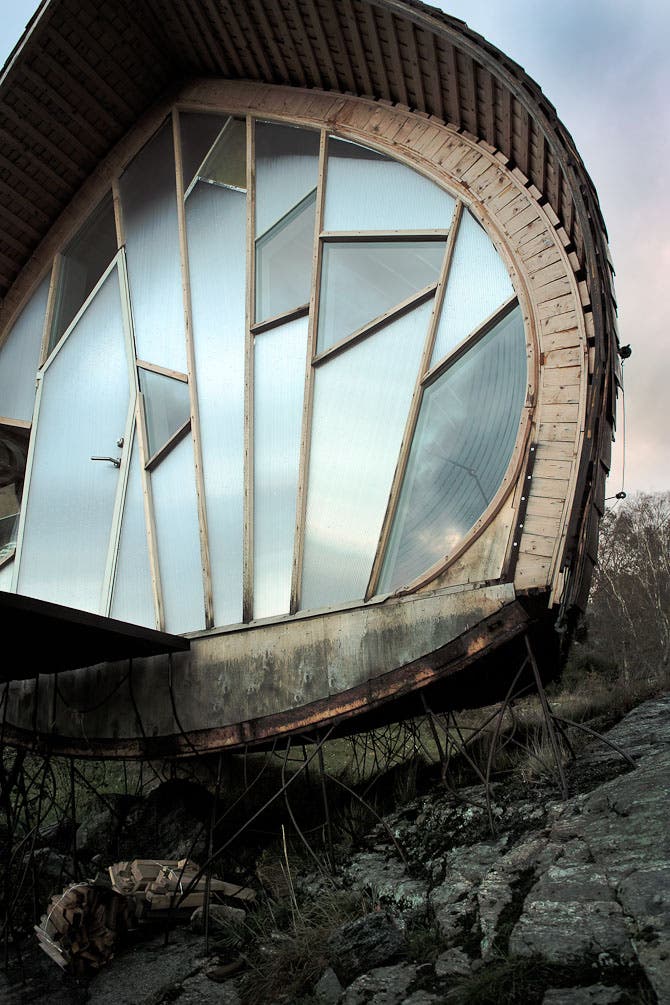

Photos courtesy of Torsten Ottesjö
By Christina Nellemann for the (Tiny House Blog)