
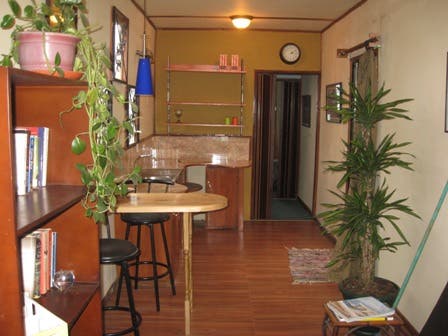
Are you looking to become an expat in Costa Rica? How about living in a shipping container? You can do both in one tidy package from Container Homes by Jimmy Lee. Lee designs and delivers surprisingly airy and open shipping container homes with a full kitchen, bedroom and a small bathroom.

Each of his homes is earthquake, fire and hurricane proof. And since they do stay within Costa Rica, you probably don’t have to worry about heating the place. He is selling a 45 x 8 x 9 foot finished home for $17,000, and a land and home package for $60,000. You can also order the raw containers from his company and build your own house. A 20 x 8 x 8 foot container sells for $2,700 and a 40 x 8 x 8 foot container sells for $3,600 to $4,100. Transportation costs are extra, but he can have a home delivered to you in 3-5 weeks.
This might be the best time to purchase one of these home/land packages. Costa Rica is no longer an undiscovered paradise. When I visited the country about 10 years ago it was just starting to cater to travelers, and now it’s a refuge for American and European expatriates. Prices are only going to go up.
Before opening up his business, Jimmy worked as a Greenpeace team leader for six years in Washington, D.C. He left Greenpeace to study to become a chiropractor. Weeks after receiving his Doctorate he moved to Costa Rica where he has been established for ten years as a chiropractor in the town of San Ramon, Costa Rica. He is also a yoga instructor.

He believes that shipping container homes are the most environmentally sound form of home construction on the market. It’s been estimated that 85 percent of the building materials used in each shipping container home have been recycled. Also, the foundation design is less expensive, uses much less material and is faster to install. The infrastructure for transport already exists, so the container homes can be easily moved by ship, truck or train. This component reduces the amount of transport time. Everything is delivered in one trip. You don’t have to pay for multiple deliveries of separate construction materials. Additionally, no building permits are required. Because the unit is on its wheels, it is referred to as a “non-permanent” structure.
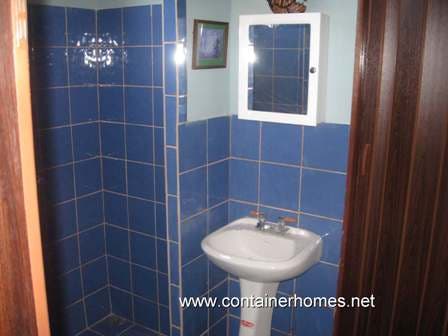
The 45 foot container home includes:
- The wheels. This unit is attached permanently to its base
- Total insulation on all walls and the ceiling, backed by fibrolite board
- All bathroom fixtures. Shower, toilet, sink, mirror, shelves and tile
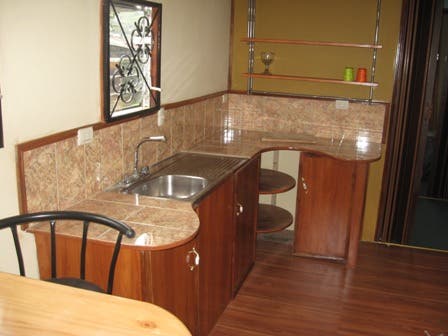
- Kitchen counter, sink and faucet, shelves, breakfast bar with two benches
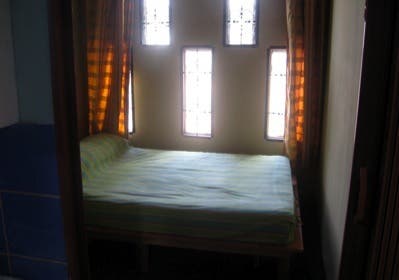
- Bedroom rug, shelves and bamboo curtain rod installed
- All windows and doors are equipped with metal bars
- Ceiling fan in master bedroom and lighting
- All electrical outlets and light switches
- Interior and exterior paint
The home does not include the following. However Jimmy’s company could supply the following for an additional cost:
- Furniture and appliances
- Second bedroom if requested
- Transportation to your destination
- Solar power
- Rainwater catchment system
- Hot water pump
- Bamboo roofing (the container naturally has its own roof, this would be on top of that)
- Deck
The first step to ordering from Jimmy is to visit the prototype and decide what changes you would like to make. If you cannot visit, and wish to place an order, you can do so and then as soon as the model home is picture ready he will send you the photos. A deposit of 50% is required to begin the building of your portable home. Estimated time to completion is between 3-6 weeks.

If you enjoyed this post, subscribe to our feed
I like this container home, it would look good overlooking the ocean.
http://www.containerhomes.net/_images/gallery-shipping-containers-homes1.jpg
Are shipping containers rigid enough that tiled surfaces can be transported w/o damage?
Great idea. There must be millions of these out there that are waiting to be put to good use once they are finished as containers.
More cool containers. 🙂
1) http://www.muvboxconcept.com/index_en.html#
2) http://www.runkleconsulting.com/ShippingContainerHouses/shippingcontainerhouses.htm
Yeah, you do have to worry about heating. Having lived for years in Costa Rica and having visited a couple of container houses, they can be REALLY hot inside! I certainly would recommend caution if you’re interested in this type of building a tropical setting.
I wonder could this container be damaged when transporting a lot?
how you get heat and electricity?
Heat and electric, propane and solar combo
That box he’s sitting in IS NOT a shipping container. It’s a tractor trailer. That’s an entirely different animal. It’s lightweight, underbuilt, mostly cheap aluminum and skin, and not fit for anything but hauling freight across highways.
To live in one would be foolish, for too many reasons to list here in a comment.
I’ve been teaching families to build their own ISBU based (Honest to goodness, REAL Shipping Container) homes for years, and on my blog;
http://renaissanceronin.wordpress.com
We’re documenting several builds, as I type this.
Don’t fall for this “fast and easy” hucksterism. He might mean well, but he’s doing a huge disservice to people looking into building homes out of “real” Corten Steel Shipping Containers.
Your life, and your families lives are at stake.
And like Expat, I too have spent many years in Central America, and Costa Rica specifically. To claim that you don’t have to worry about “heating and cooling” is just ridiculous.
To house a family, the box must be strong. Tractor trailers aren’t. This is just another attempt at shoddy housing, and the families that buy in, will waste their money.
To Renaissanceronin: I believe he is NOT selling the container he is sitting inside (above). that is just a proto-type.
@Dave;
The article makes it pretty clear that he’s selling “Container Homes – WHEELS ON.”
Further, he says that the fact that they roll means “NO PERMITS.”
And, I’ve done further investigation since into this alleged “housing solution” of his.
Beyond that, the claim that any housing type, especially this one, is “Earthquake, Fire and Hurricane PROOF” is just outright lies.
I’ve written a post on MY blog (about REAL Shipping Container Homes), which you can find here:
http://wp.me/pfIoi-VH
That post defines this further, if you’re interested.
I’m still calling “BS”. With MY “OUTDOOR Voice.”
Ronin
Shipping containers make great homes but insulation has always been a problem.
Straw bales are great for insulation but have less strength in earthquake and hurricane country.
I designed a straw bale and shipping container home to solve both problems!
Video here:
http://www.youtube.com/watch?v=8Cc1QyUNt-A
LaMar
This is truly amazing and brings a whole new concept of purchasing in another country!How affordable and inventive!
Very cool idea. Though the heat could be an issue. One of the ways people are getting around the problem of living in a steel box in the the sun is by coating it with a spray on ceramic insulation. Super Therm I think it’s called. (google bob vila container home to see some video of the process). I don’t know what exactly the stuff is or whether it will cause you to grow a third eye, but it’s extremely dense. With just a few coats it’s like 10 times better than traditional insulation. You can also get containers that were for refrigerated goods that still have the insulation in them.
Building with containers is worth taking a look at if you are contemplating a new home.
Good resource is the Residential Shipping Container Primer website. A DO IT YOURSELF (DIY) REFERENCE AND FOR CONVERTING RECYCLED INTERMODAL CARGO SHIPPING CONTAINERS INTO BUILDINGS AND ARCHITECTURE.
http://www.ResidentialShippingContainerPrimer.com
Lots of example buildings, details, facts, and links to other articles. They have something new that you can setup your own project wiki to get help with your project if you are the design build sort…
Very neat. And hey even if you do need a fan or A/C they are easy to add. These little wonders are much better than what you will find in most of the towns in CR. These at least have nice tile and counter tops. Some really modest houses in CR don’t even have floors.
I think these are great! – a fan from Costa Rica Rental Properties
Reading through the comments there where a number of unanswered questions from readers so even though the original post goes back a while I thought I would add this here.
@ EJ you asked about tile – the short answer like most things to do with shipping containers is its “conditional”
Like any mobile or modular home solution the greatest stresses and strains are incurred when moving and positioning the container, so the flexing that you would see in an unmodified container handled in “regular fashion” would cause the tile to fail as you suggest.
The internal walls built into the container would potentially “stiffen” the container and assist in this regard but each container design would be viewed on it own.
@ Daniel – the accepted wisdom is that refrigerated containers don’t lend them themselves well to modification and that its better to insulate a general purpose steel containers – more below.
@Ronin – Buddy take a pill – its an interesting housing solution that meets the needs of some people.
There is a series of 15 x videos on How to build your own Container Home over at http://www.containerhome.info – The first hour of videos are free for anyone interested.
HELLO, I HAVE A WAY TO THE PROBLEM OF A HOT CONTAINER HOME. IF YOU CANNOT HOOK UP TO ELECTRIC PUT THE NEW THIN SOLAR PANELS ON YOUR ROOF. THEY WILL GIVE YOU ALL THE POWER YOU WILL NEED FOR HEATING WATER, COOLING YOUR HOME, ETC. I WOULD PUT EITHER PANELING OR DRY WALL AND LEAVE ROOM BEHIND TO PUT IN INSULATION. I WOULD NOT BLOW IN INSULATION, IT HAS THE TENDENCY TO COMPACT, MAKING IT LESS EFFECTIVE AS TIME GOES ON.
YOU SHOULD SAVE A LOT OF MONEY WITH THIS KIND OF HOME.
I SAW THE ARTICLE ON THE NEW THIN/FLEXIBLE SOLAR PANELS IN MOTHER EARTH NEWS. YOU CAN MAKE A EXCELLENT SWIMMING POOL FROM CONTAINERS AND PUT IN THE KIND OF DECKING YOU WANT AND IF YOU WANT A COVERED PATIO AND A UPSTAIRS APARTMENT PUT ONE CONTAINER ON TOP OF ONE AND LET IT HANG OVER ONE END AND ON THE OTHER END PUT A PATIO DOOR THAT CAN LEAD OUT TO A NICE TERRACE /DECK WITH A NICE HOT TUB. ALSO IF YOU NEED TO CONSERVE SPACE INSTEAD OF PUTTING STAIRS PUT IN A BEAUTIFUL SPIRAL STAIRCASE. THEY CAN BE WOOD OR IRON AND COME IN A HUGE ARRAY OF DESIGNS. DEPENDING ON WHAT YOU CAN AFFORD THE IDEAS ARE ENDLESS. PUT A SKYLIGHT OVER YOUR BED WITH A MOTORIZED PANEL THAT CAN SHUT OUT THE SUN IF YOU SO DESIRE. ELECTRIC FANS IN EACH ROOM SHOULD MOVE THE AIR FROM THE TOP TO THE BOTTOM IN NO TIME AND HELP HEAT OR COOL THE HOUSE, DEPENDING ON WHICH WAY THE FAN BLADES ARE TURNED; UP OR DOWN. UPSTAIRS YOU COULD PUT A BALCONY OVERLOOKING THE COVERED PATIO. YOU CAN MAKE A CARPORT THAT HOLDS TWO CARS OUT OF SHIPPING CONTAINERS.
YOU CAN ALSO MAKE THEM INTO EXCELLENT STORM SHELTERS. GET SOMEONE TO DIG A HOLE FOR YOUR CONTAINER AND HAVE IT LOWERED DOWN IN THE HOLE FOR YOU. THEN YOU PUT IN VENTILATION AND POWER AND STAIRS DOWN TO IT AND “SHAZAM” YOU HAVE A EXCELLENT STORM SHELTER. AND IF YOU WANT ONE ABOVE GROUND, SIMPLY PUT IT INTO THE GROUND ABOUT 2 FEET AND YOU HAVE A NICE STORM SHELTER YOU CAN STEP INTO, VERY NICE IF YOU HAVE ELDERLY WHO HAVE TROUBLE WITH STAIRS. SOME PEOPLE, I HAVE NOTICED LEAVE THE DOORS ON THE END OF THE SHIPPING CONTAINER. YOU COULD THEN SHUT THEM UP TIGHT DURING STORMS. NOTHING COULD GET TO YOU.
THANKS FOR LETTING ME WRITE A BOOK!!!
I agree with some people in that this type of home is unique but is not as realistic for many people because it is alumimum. I’d prefer a steel ISO grade from a place like http://www.storagecontainer.com that will provide better security.
I am a distributor of insulating coatings. I also have a coating that you would apply first for rust, then the insluating reflective coating on the outside of the shipping container. I have a different coating for the interior. We will ship anywhere in the world. Please reply kblack@innovasol.com
I find these fascinating. I first saw housing made from shipping containers in vancouver last year and it just struck me as so logical and economical. glad tosee the idea is going global.
$60,000 for a shipping container home and a plot of land in Costa Rica sounds like a really good deal to me. Might be a great plan for retirement…
How about air conditioning? Does it get really warm in summer in Costa Rica?
Nice house. The square footage price is very good, but how does it compare with stick built houses in Costa Rica? We’ve done a number of shipping container houses in the US (see our website), but getting the cost down to a reasonable amount has eluded our clients so far.
The shipping container structures we’ve worked on for other uses (military, housing for oil fields) have come up with much lower prices per square foot. I suspect it is due the ability of our clients to mass produce them.
George
it’s really nice to see this blog post. i’ve heard alot about living in shipping containers also at country’s where the cash rate is low.
Like in afghanistan and irak several shipping containers could be used in a warzone for a bunker and a quick home a camp to read some military papers for operations or something. I would really like it when u people will take a look at my cargoshell website u can click my name . Cargoshell is also about containers that are collapsible so it wil be really handy for living in a shipping container when u can collapse it. thanx any ways for your nice post !
Some interesting comments, its surprising how much interest there is in shipping container homes these days. I run a small blog with literally hundreds of different designs and ideas from across the web at http://www.containerliving.net for those that are interested.
A lot of the issues that relate to other locations may not be relevant in Costa Rica mind as like here in the Philippines heat could be a problem but park under a large enough tree or add a trellis suddenly its not.
Also Earthequake proof may be overreaching but here in the Philippines homes are made of hollow block. A shipping container would actually save lives over falling chunks of concrete. Also if it fell into an earthquake crack I am sure it could be lifted back out. Unlike a concrete home that would need to be ripped down and rebuilt.
Like most things in life its all relevant to peoples needs and what is available.
I would like to visit and tour your facility on August 8 2014. my wife and i will be in Costa Rica this week and we also own 4 acres in Ojochal.
Hi Alan, you need to contact the company as this is just a post about them. -Kent
The blog says you are selling a 45 x 8 x 9 foot finished home for $17,000. I would be interested in knowing the shipping costs to the Nosara area.
gracias.
Hi Norma, you need to contact the business this is just a post about them.
I’m sure with a little more imagination and quality control from a professional builder these could be a great new innovation. I see that another company in Costa Rica seem to be offering these with some standards applied. http://www.containerhomes-costarica.com
INTERESTING. Don’t they get super warm though? I mean, not worried much about heating the place more like keeping it cool…