


I’d not given much thought to mold and/or mildew when we first began our tiny house adventure. Truth is I am not sure I even knew the difference between the two. But I know I had certainly not thought about how mold and mildew could attack our tiny house. I did realize the obvious. Leave standing water on a surface long enough and mold spores would take root. Leave food out or hidden in the house and mold would eventually begat freebase penicillin. But what can you do to prevent mold and mildew and what do you do if it has taken root?
My first mold realization came in late 2011 when Logan Smith wrote the following on Mobile Cabin Works:
Much to my surprise, if you lay a futon mattress directly on top of a loft floor it will breed mold. Who’d a thunk it? The science behind this is obvious once you realize what’s going on. The heat generated by your body and the coolness of the floor, especially a non-insulated interior ceiling/loft floor, combine to produce condensation. This moisture is then held in the fabric of the mattress as it has no way to be evaporated due to the lack of ventilation. So I will provide you with this scientific formula. The NW + moisture = green stuff. If you live here, you understand.
Now I don’t live in the Pacific NW so I never thought much about mold in so much as it wasn’t something we had had before or that I had seen in my folks house. Yes, there was the mold that grew around the tub if you didn’t clean regularly. There was mold on bread that had been sitting in the roll top too long. But mold running up a wall or appearing on sheetrock or even over head, just never worked out for me. I realize now though it is possible and is something that needs consideration.
Mold – a large and taxonomically diverse number of fungal species where the growth of hyphae results in discoloration and a fuzzy appearance, especially on food.
Mildew – a thin, superficial, usually whitish growth consisting of minute hyphae (fungal filaments) produced especially on living plants or organic matter such as wood, paper or leather.
What’s wrong with a little mold or mildew though? So long as the pores remain out of sight and stay put behind the laundry tub, under the basement carpet, or only peek around the edge of the bathroom wallpaper, who cares? We all should actually because they are eating us of house and home and are effecting our health, too.
TOP HIDING PLACES
- When washing machines in a room without a floor drain overflow or hose connections burst, water with no point of exit will soak into adjacent carpet, drywall and insulation. SOLUTION: Provide a floor drain near the washing machine. Install an overflow pan directly under the machine or install a lip at the doorway to contain overflows.
- Water-resistant drywall used as a tile backer quickly degrades once subjected to moisture. SOLUTION:
Install cement backer board, which will remain structurally sound even if repeatedly subjected to moisture. - Poorly ventilated bathrooms row. SOLUTION: Install a bathroom fan (or at least, open a window) to exhaust moisture. Remove surface mildew by scrubbing the area with a 1/2 percent bleach solution. When the area is dry, prime it with an alcohol-based, white pigmented shellac, such as Zinsser Bullseye, and use a paint containing mildewcide.
- Humidifiers (especially reservoir-type central units and portable units) provide both a growth medium and a distribution system for mold and mildew. SOLUTION: Clean and treat the reservoir often with an antimicrobial solution which can be bought at most convenient store.
- Improperly flashed or caulked windows (and those with large amounts of surface condensation) let moisture seep into the surrounding wood, drywall and insulation. SOLUTION: Properly flash and caulk windows during installation; minimize condensation with good ventilation and airflow.
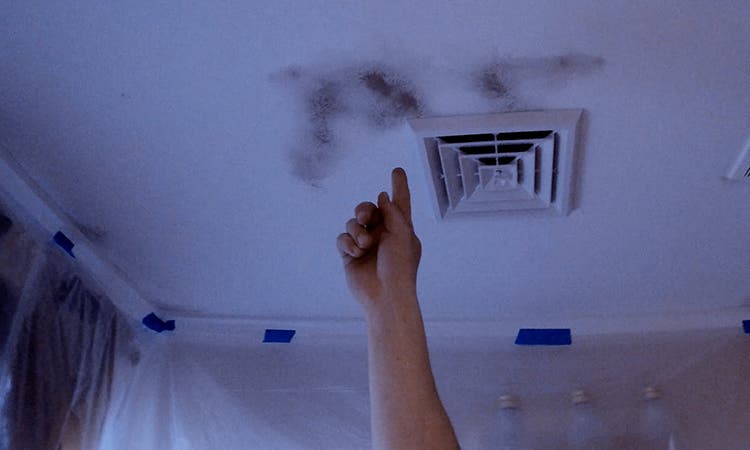
Remember. Some types of molds are toxic so do not attempt to use this post as an EPA-certified guide. Remove and treat mold at your own risk!
NOTE: Top hiding spots courtesy of: The Family Handyman