


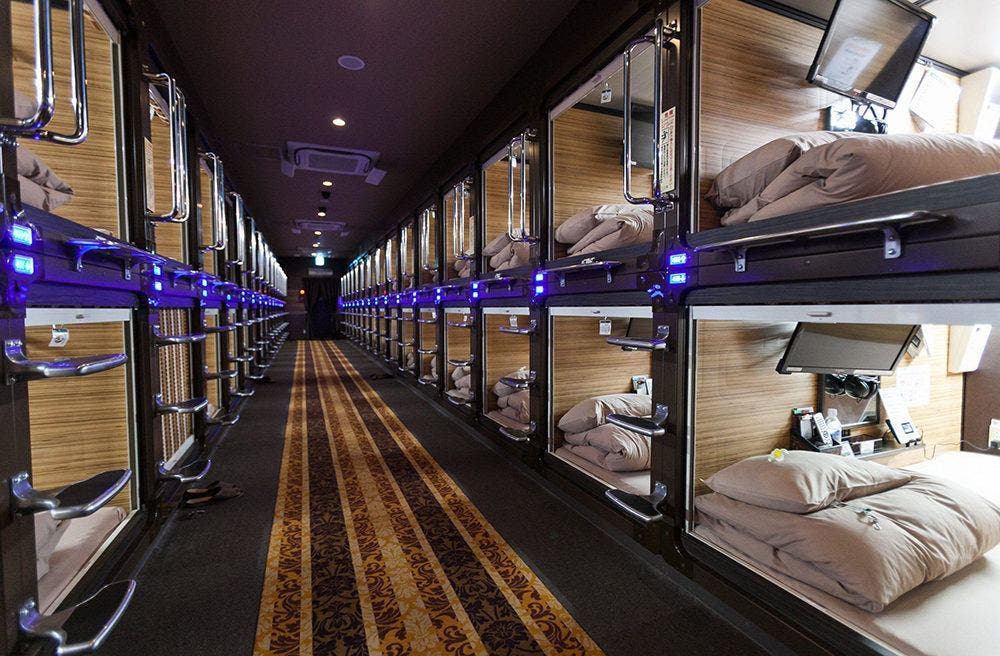
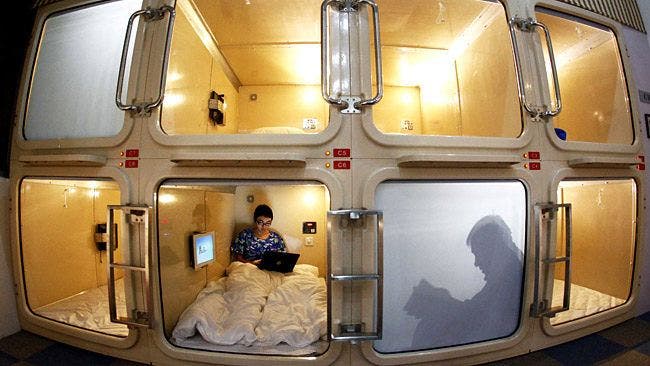
It has been commonly accepted that a tiny house is somewhere around 250 sq.ft. While a number of people – myself included – argue this fact regularly, the news media and a number of tiny housers themselves hold this number as gospel. But what about 6 ft. 7 in. by 3 ft. 3 in. by 4 ft. 1 in.? (for those who just whipped out the calculator that is 118 sq.ft.). That sounds fairly big until you figure in the fact that there is only 49″ of headroom. That is shorter than the average American male by about 16″. Let’s be honest though. No matter how large (or small) they may seem, the Japanese capsule is just that. It is a capsule. It is void of natural light, fresh air, etc. They are everything that excited us about forts we built as a kid and everything that made us nervous in 2001: A Space Odyssey.

LEAVE THE GERMS AT THE DOOR. In Japanese homes and this includes capsule hotels, the first thing you do is remove your shoes and replace them with slippers. This is done for a couple of reason. The first is that the act of taking ones shoes off when entering a home signifies the understanding that you are entering someone’s personal space. The second is that the removing of shoes leaves the dirt and grime from the outdoors where it belongs: outdoors! In fact, a 2014 study at the University of Arizona collected germs and microbes on footwear. The researchers found 421,000 units of bacteria on the outside of the shoe, including E. coli, meningitis and diarrheal disease; Klebsiella pneumonia, a common source for wound and bloodstream infections as well as pneumonia; and Serratia ficaria, a rare cause of infections in the respiratory tract and wounds. So a good practice in the tiny house may well be to have everyone leave their shoes at the entry.
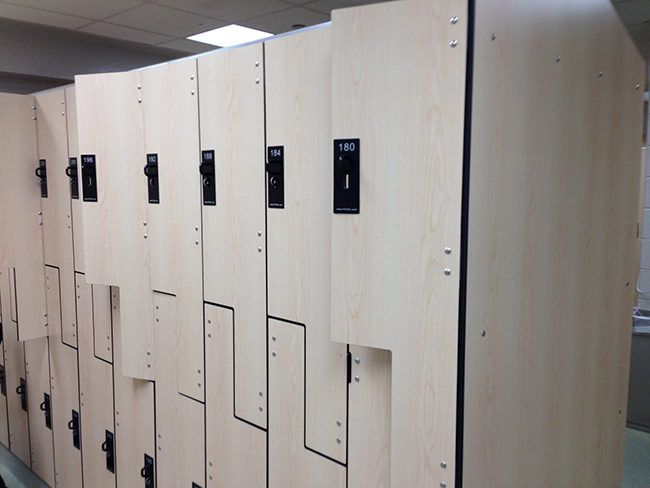
LOCK IT UP. I am a huge proponent of the “need -vs- want argument”. When checking into a Japanese capsule hotel you are handed your slippers, a key to your personal locker, and a door password. That locker is your personal space. Since Japanese capsule hotels are designed for users who may have missed the last train home or who are either too drunk to make it home or traveling on a budget, the locker serves as closet, chest of drawers, and coat rack. They are typically narrow spaces that are just long enough for a suit coat but hole only a few items of clothing, a pair of shoes, and maybe a backpack. They give true meaning to the western term “capsule wardrobe”. Imagine adopting that understanding of minimum space to your own lifestyle or your own house. It pushes need -vs- want to the extreme and allows you only enough room for the things you need in life.

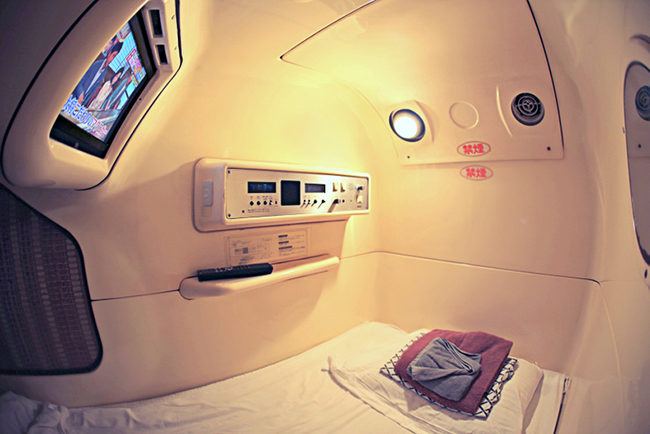
CONDENSE YOUR TECHNOLOGY. I remember growing up I was so excited on my 10th birthday to receive a boom box that had detachable speakers, 2 tape decks, a CD player, a small clock, and an AUX jack for some other peripheral device. As I got older though I became more interested in media and tech and graduated to a component system that had a receiver, 6 [surround] speakers, a CD changer, a turntable, an equalizer deck, and an amplifier. This said nothing of the clock radio next to bed, my collection of CDs, my small TV across the room…well, you get the point. Fortunately in recent years technology has become far more integrated and space conscious. In a capsule hotel room there is usually one component system that has an alarm, a CD player, a radio changer, a USB charger, and more! The pod also has a flat screen TV on a swivel arm and headphones for private listening. I think this should be the norm in a tiny house. Electrical outlets should have built in USB chargers. TVs should be flat and maybe even recessed into the wall or a piece of furniture. Audio should be integrated into a phone or laptop and playable via USB to speakers recessed into wall cavities. Big sound. Small space!

All in all, the capsule is not for full time living. Multiple nights as a substitute for a more expensive hotel or even hostel? Absolutely. But it provides lessons – some academic and some experiential – that are well suited for the tiny house lifestyle. They serve a purpose and that is exactly what a tiny house is meant to do. Life is meant to live amongst other, in community and in some realm of public. As houses have gotten larger since the post-WWII years our houses have become prisons of sorts keeping us excluded from each other giving us reason to stay indoors and isolated. Traditionally though houses were meant for eating and sleeping in safety and out of the elements. They weren’t supposed to make us poor or feel trapped. That is what the Japanese capsule hotel does. It gives us an affordable, safe place to sleep. Life is what happens outside of the capsule.
By Andrew M. Odom for the [Tiny House Blog]