

A few years ago we purchased some vacant land in northern New Mexico. We chose that area based on a number of factors. Some of those included wide-open space, abundant sunshine, affordability and artistic history (Georgia O’Keeffe lived down the road a bit). Our long term goal is to retire there and pursue a simple artistic life. One of the main reasons we chose that piece of property is its remoteness to other neighbors and the lack of congestion that comes from urban living. Urban living has a lot of advantages like electricity, water, and corner coffee shops. We plan to work around some of these conveniences using “off-grid” practices. I have enjoyed camping since I was toddler. The slower pace of life in an environment more closely linked with nature has always been a draw. Our cabin provides all of this with far more elbow room than a tent. Add in windows, a wood stove and a comfy bed and what could be better?

Site Location and Solar Power
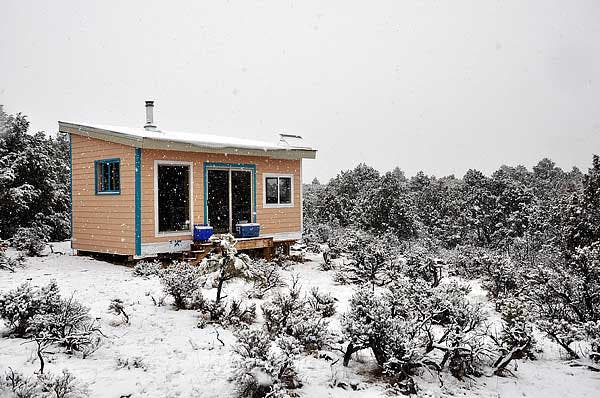
Our parcel of land is a bit under 42 acres and nearly all the land around us is uninhabited grazing land. In fact, the people we bought our land from still graze horses and cattle on their square mile that surrounds us. I have spent enjoyable nights there listening to the baying of cattle and cry of a lonely coyote. Our decision to go “off-grid” was simple: the nearest utility pole to our cabin is nearly a mile away. We could have paid thousands of dollars to run power poles and lines to “connect” but then those “lines” would disturb our pristine views and require a monthly payment. For a fraction of that cost, we simply installed a basic PV (Photovoltaic) system. Our cabin is small at a bit under 200 sq. feet and has modest energy needs.
I designed all of our cabin’s lighting needs to be met with 12 volt DC based LED’s. This eliminates the energy losses of converting solar DC in to normal AC current. By utilizing a lot of task lighting, the whole cabin does not need to be lit to perform basic tasks. Even so, if every light in the cabin is turned on our total lighting use is less than 40 watts. This low demand allowed us to scale down the entire PV system to a basic 80-watt panel and a single 110-amp/hour storage battery. This DC system is supplemented with a basic power inverter, which allows us to run some AC devices and even some smaller power tools. The coffee bean grinder is our most common use of 120-volt AC.
Challenges with Building the Cabin
Building in a remote location has some added challenges that many take for granted. Power, water and access to building materials top the list. For us the build began with pouring concrete footers that would support the cabin’s framing. Getting the concrete there was the easy part; mixing 1800 pounds by hand with water carried in jugs was the hard part. I completed the bulk of the framing over a couple of weeks using a generator to run my air compressor. Having compressed air allowed me to use my pneumatic nail guns which greatly sped up the build. Since then, a lot of the work has been done using smaller 18 volt cordless tools, hand nailing trim, etc. The solar system has no trouble charging the battery packs for my cordless tools, and as an added bonus the solar system is silent…that gas powered generator would drown out the subtle sounds of nature that surround us, and that is a primary reason we like living there.

Cooking, Water and Heat
In a conventional home, the turning of a knob may bring life to a cook stove using natural gas or electricity at 220 volts. Our cooking heat is provided by a couple of means depending on the season and the items being cooked. In the summer we often will cook over a campfire outdoors…grilled steaks, hotdogs on a stick and of course marshmallows for s’mores. The morning coffee is French press, with water heated on the Coleman camp stove (summer) or on the wood stove (winter). Other cooking is done in a similar manner; the only thing that we are still experimenting with is small scale baking using a Dutch oven on top of the wood stove.
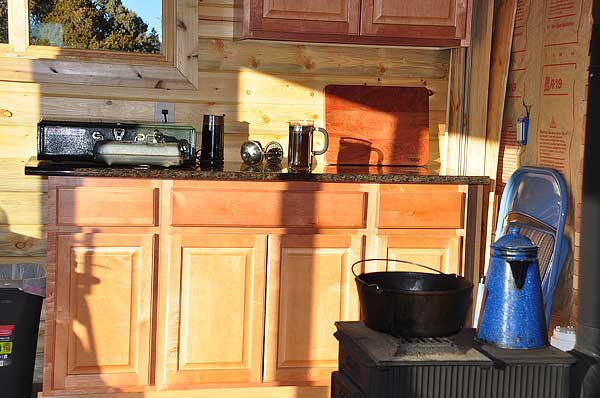
All of our water is brought in using 5 gallon Nalgene jugs. Hot water for washing and cleaning is heated the same way that we heat our cooking water.
Our cabin is passive solar by design and when the winter sun is shining, the wood stove is not usually required. When the winter chill does come calling at night, we stoke it up and can stay quite comfortable with just a few logs. Our grey water is used to irrigate the local sagebrush and we use a basic sawdust composting toilet for solid waste. Since it’s portable, the sawdust toilet can be brought inside if the winter temps make its normal use in our woodshed uncomfortable. We have a small alcove in the cabin that provides privacy for this if needed.
A Work in Progress
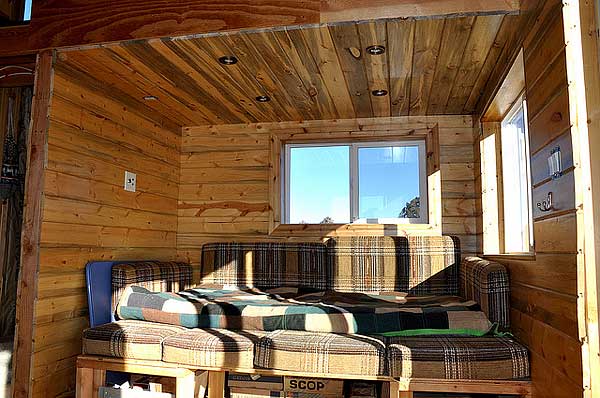
The initial building process had us “dried in” after a months work, but I still have a ways to go on a lot of the smaller details. The build is being completed as time and money allow. Our cabin is a six hour drive from our full time home so we do not get down there as often as I would like…but when we are there time is well spent with a balance of work and play. When the time does come to live there full time, the plan is to live in the small cabin while a more elaborate (ie: running water) home is built using the same basic “off- grid” mind set.
Kevin Stevens writes for Networx.com.