


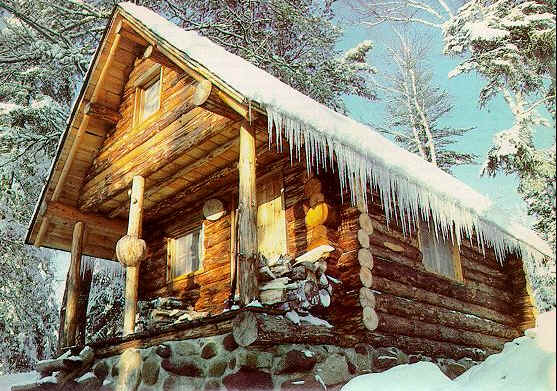
In the last post I introduced you to my favorite tiny log home builder. In this post I want to show you some options to think about to build your own tiny log home. This is part 1 of 3 posts on this subject.
Below are some building associations to become familiar with.
- Log Building Associations and Organizations
- Log House Builders’ Association Of North America
- International Log Builders’ Association
The best way to learn is by doing. Here are a couple of schools that will teach you the techniques you will need to build your own cabin.
- Schools Teaching Log Building
- Great Lakes School of Log Building & Stonemasonry
- Earthwood Building School – Actually deals with cordwood construction
- Lasko School Of Log Building
Following are a few notes from Skip Ellsworth’s Log House Building Seminar. This will give you an idea of what is involved. This by no means takes place of the seminar but is a brief outline of what you need to think about when building your own tiny cabin.
There are three basic methods of log home construction:
- Saddlenotch
- Scandanavian
- Chinkless
- Butt and Pass
Water is the worst enemy of the log home – not fire.
You don’t need any preservatives if you keep the logs dry. You need large overhangs. At least 3 feet on the sides and 8 feet on the ends.
With a frame house, you add the house to the floor. With a log house, you add the floor to the house.
Plastic chinking doesn’t breath so water is trapped inside to rot the wood.
Mortar breathes.
The overdangles should be 1.5 times the diameter of the logs when finally cut off.
If you are going to build a notched house, you really need seasoned wood due to irregular shrinkage.
For butt and pass method, you can use green logs. No seasoning required.
Getting logs:
- Eliminate the middleman. Go to the loggers or owners.
- Find loggers by visiting the local tavern
- Tell the loggers you will pay cash, require no receipts, will take delivery after dark
- If needed pay them 10-15% above what the mill will pay themInsist that you want the option to pick your logs
- Generally, you will need 20% more logs that you think.
- Get the “Offical Log Scaling and Grading Rules” book by Scribner
To find out what the mills are paying, call five of them and act like you have a load of perfect logs to sell and see what they would pay.
A good rule of thumb is to look for logs with no more than 1″ of taper per 10′ of length
Following are types of logs that are acceptable for building log homes:
- Hardwoods
- Oak
- Hickory
- Ash
- Maple
- Birch
- Softwoods
- Douglas Fir
- White Fir
- Alpine Fir
- Lodgepole Pine
- White Pine
- Pondarosa Pine
- Tamarack
- Engleman Spruce
In the next section we will talk about the tools that you will need to construct your cabin. Check back soon!
If you enjoyed this post, subscribe to our feed