Sing RV Cottage for Sale
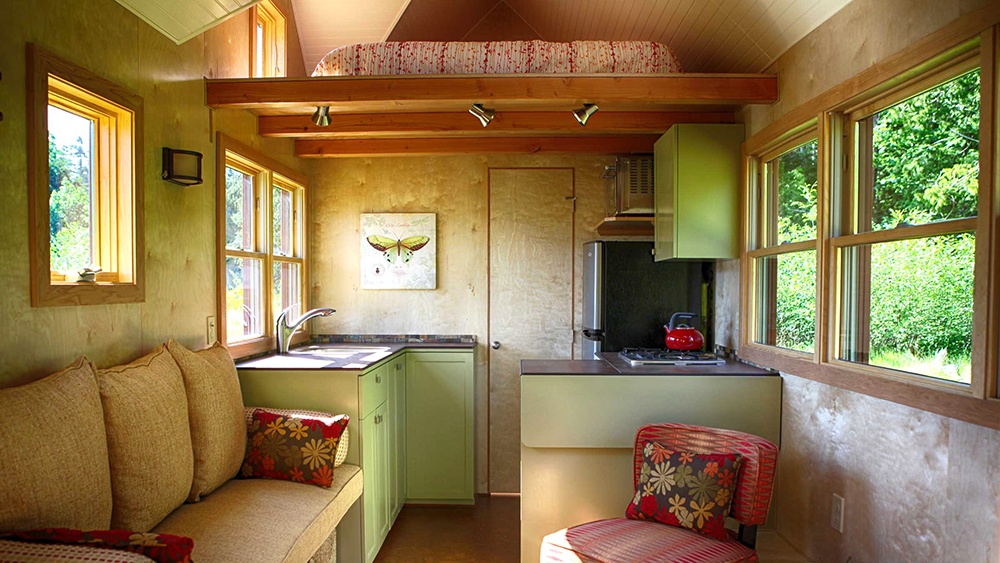
Peter Sing the designer of the Sing Panel is selling an 8×14 cottage on wheels and is asking $9,800 for you to take it home.
This little cottage weighs in at less than 2700 pounds so can be towed easily. The cottage is ready for you to use as is for an office or spare bedroom, or a kitchen and bathroom could be added and you could have a perfect little cottage getaway or even live in it full time.
The Sing RV cottage is built using the Sing honeycomb product designed by Sing. Continue Reading »
Belmar Cottages
Guest post by Laurie Kazimir
My husband, Christian and I love building beach homes and have been building and selling them for the past 5 years on the Olympic Peninsula, way out here on the edge of the country in the state of Washington. We are probably one the most pristine, remote locations in the entire 48 states. Just 20 minutes away is a one million acre national park filled with hundreds of pure rivers and forests of old growth trees that can rival the Redwoods. We are fortunate enough to be able to hike to both glaciers on the top of snow capped mountains, and to deserted beaches sprinkled with sand-dollars. The air we breathe has been rated some of the best in the country.

When we moved here 8 years ago, from New Jersey where our parents were involved in beach real estate, we realized that clean air and water, and natural space are the things that matter to us most.
A few years ago, we came up with this idea: to get an extra large multifamily lot, and build four tiny homes a block from the sandy beach. Our goal was to provide a beautiful beach home with everything a true home entails for under $100,000. These small homes were a new idea for the area, and it wasn’t easy to get the go ahead.

We had to learn and grow and work with the city to figure out ways to get past the minimum square footage requirement. At first we got a definite “no” because the city was misinterpreting the zoning codes, and thought that each cottage had to meet the minimum. We were able to politely educate them and slowly go over the rules and legal language. By putting all four homes on the lot and totaling the square footage we were able to surpass the square footage requirement.
After selling our first home, to a very nice person, they explained to us that they had been trying to build a tiny home for many, many years, and that they kept running into the same minimum square footage problem no matter where they tried to build. This person actually moved across the state, over 100 miles away from the place that they were trying to build, just so they could have a tiny home. They didn’t purchase the cottage because they wanted to be a block from the beach like most of our clients, but because they wanted a small home that was nice, new, and efficient with low maintenance and in a price range that they could afford. Needless to say, they are extremely happy, and now that they’re here, they are glad to have made the relocation, because this is a great place to live.
These experiences really showed us that building a tiny home can be impossible in most towns, but by designing a tiny home development, we could overcome all the red tape, and create a true small home community. This same concept can be implemented in other towns and cities that would not normally allow a small square footage home.. We are very excited, and we think that this concept can be repeated.

Now that the cottages are built they are absolutely beautiful. We have incorporated 9ft walls and vaulted ceilings to create a more expansive feeling. With lots of large windows, you never have to turn on lights during the day. The 400 square foot homes have a full kitchen and bath, and a custom made Murphy bed allowed us to combine the living and sleeping areas. They’re fun and affordable, and for a vacation home, that may only be used a few weeks a year, we can’t think of a better option.
Currently we have two of the four cottages sold, and we are getting lots of interest in the other two, which are available for $99,000 each. Visit the Belmar Cottage listing page to learn more.


If you enjoyed this post, subscribe to our feed
Rolling Huts
When I first saw these huts on wheels, they looked a bit like an alien vehicle from Star Wars. The more I looked at them though, the more I fell in love with these sleek little houses.
Designed as a modern alternative to camping by Tom Kundig of Olson Sundberg Kundig Allen Architects in Seattle, the Rolling Huts are available for rent in the Methow Valley of Washington state. The huts are several steps above camping, while remaining low-tech and low-impact in their design.
The huts sit lightly on the site, a flood plain meadow in an alpine river valley. The owner purchased the site, formerly a RV campground, with the aim of allowing the landscape return to its natural state. The wheels lift the structures above the meadow, providing an unobstructed view into nature and the prospect of the surrounding mountains.
The huts are grouped as a herd: while each is sited towards a view of the mountains (and away from the other structures), their proximity unites them. They evoke Thoreau’s simple cabin in the woods; the structures take second place to nature.
Each hut comes equipped with a small refrigerator, microwave, fireplace and Wi-Fi. A sleeping platform is perfect for two, and the modular furniture in the living area can be reconfigured to sleep two more. Each hut has an adjacent portable toilet, and full bathrooms and showers are housed in the centrally located barn a short distance away. There is a water faucet outside of each hut and a picnic table in front of each hut that seats 12. You can stay in one of these huts for about $80-$100 a night.
If you enjoyed this post, subscribe to our feed
VardoForTwo
“We aren’t building big, we are dreaming big and dreaming innovation.”
Mokihana and Pete have recently finished their beautiful VardoForTwo and are living in the woods of the Olympic Peninsula of Washington with their cat, Jots. Mokihana suffers from multiple chemical sensitivities (MCS), an illness that makes her very sensitive to laundry products, perfumes, household cleaning supplies, pesticides, wood smoke and traditional building and construction materials. She and Pete decided to control their own environment by building a small gypsy caravan, or vardo, to live and travel in.
To combat Mokihana’s MCS, they painted their 12 foot long by 8 foot wide vardo with paint made from milk and have insulated it with recycled denim batting and wool batting. They use a ceramic heater and an air filter inside their tiny home. Their cooking area is outside under an awning.
The couple got a lot of their ideas from the Tumbleweed Tiny House Company and also embrace the same tiny house concept as Jay Shafer. Their blog sums up the concept of creating a house that is both healthier for the homeowner and the enviroment:
“Building VardoForTwo as an MCS safe home involves attention to detail and conscious choices every step along the way. The cost of a simplified and safe home means it takes more time and a willingness on both our sides to be respectful as we learn what works, and what doesn’t. We are building a sustainable lifestyle in a teeny home to be. In so many ways this is contrary to the old American Dream.”
Photos by Mokihana and Pete/VardoForTwo

If you enjoyed this post, subscribe to our feed