Tiny House Blog on Vacation
My family and I are taking a vacation during the holidays and I will be away from a computer and the internet most of this time. I have pre-published a few posts and they will show up at different times. Christina will continue with the usual Monday posts so be sure and check in on those.
I will not be answering emails, but want to encourage you to continue to send in your stories and photographs like you usually do. I will also not be posting on the Facebook fan page or Google+ during this time. Please, feel free to dig back through the archives for inspiration and visit some of the other tiny house blogs during this brief vacation.
I want to wish you all a Merry Christmas and a Happy New Year. I will return on January 5th and will get back into the normal routine shortly there after.

Mushroom Dome Cabin
My husband and I have been utilizing the services of Airbnb for several of this year’s trips (New Orleans and Chile) and we’ve been very pleased with the ease and rental opportunities offered by the company. Airbnb is an online booking service that allows property owners to rent out their home or a room to travelers and it allows travelers to stay in unique places around the world. I was curious about the most popular rental location on Airbnb and was surprised to see that it was a beautiful tiny house shaped like a mushroom.
The Mushroom Dome Cabin in Aptos, California is rated as the number one listing on airbnb.com and consists of a semi-rustic cabin under a geodesic dome surrounded by oak, redwood and madrone trees. The cabin has a double bed located in the loft, an LCD screen with DVD player, a small deck, a couch, a small hot plate, refrigerator, toaster oven, blender and other kitchen supplies. The cabin has a tiny bathroom and shower. The owners provide clean linens and soap. Depending on the time of year, length of stay and amount of people, prices for the Mushroom Dome are about $90 per night and about $600 per week. Continue Reading »
Tiny House Blog Vacation
I will be taking a vacation and returning August 8th and will only be publishing two to three times per week during this time. I am trying to make this a real vacation and am taking the bare minimum of electronic equipment. I will only have an iPod touch with me with limited internet access.
I want to encourage you during this time to dig back through the archives and learn what you can from them. I will not be responding to emails during this time, but I want to encourage you to still send in your stories and ideas for the Tiny House Blog. Send all correspondence to tinyhouseblog@gmail.com. Thank you for your faithful readership and I will return to normal daily posts when I return.

Utilitoy Trailer
With gas prices so high these days and not likely to go down anytime soon. The idea of towing your vacation home down the road may soon be a thing of the past. Like the Utilitoy site says, if you want to vacation in your home, than camp in your home, if you want an adventure go in a Utilitoy.
Though not a tiny house the Utilitoy would make a great extra bedroom for a tiny house or hop in your small car and attach it and go on a vacation to the beach, or the woods, or mountains.

The Utilitoy is made to be ultra lightweight and is very versatile and practical. It is designed to fit into a standard garage for easy storage and unlike most teardrops will easily sleep a family of four. It also can be used as a utility trailer, so you can haul around kayaks, mountain bikes, lumber or furniture. It can be cleaned out with a garden hose. At a base weight of only 962 pounds it really is a light trailer. Continue Reading »
Teardrop Trailer Gatherings
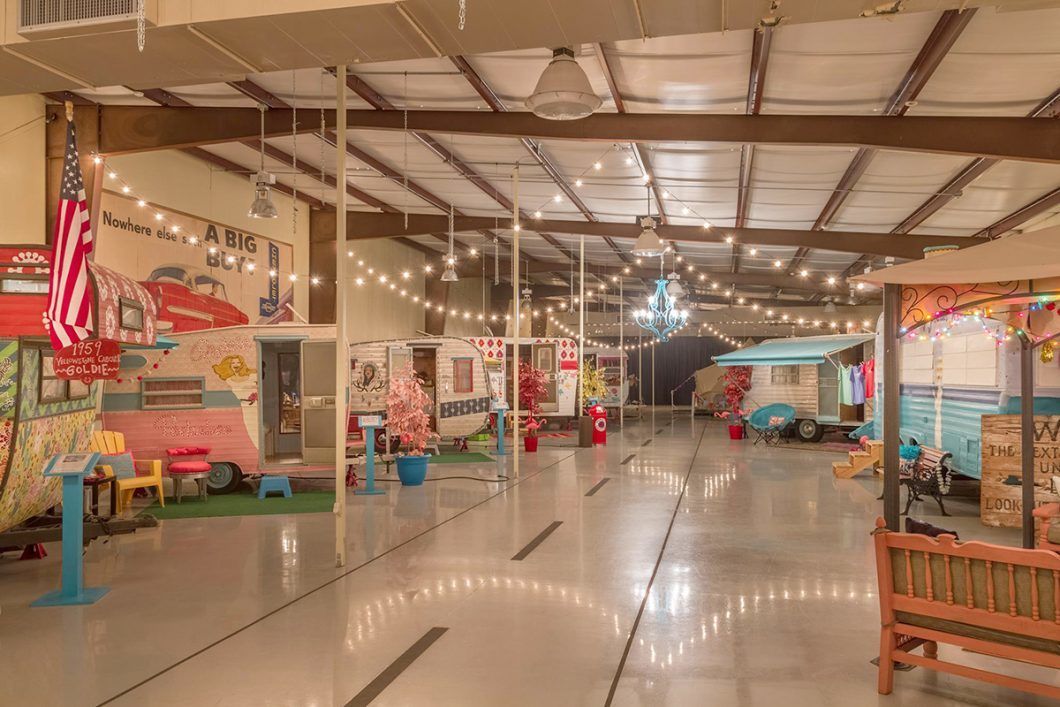
Throughout the year, owners of tiny trailers will gather together for rallys or gatherings, in order to show off their designs, bargains or builds. The best way to get ideas for a tiny trailer is to go to one of these trailer gatherings. You will also end up meeting a wide range of really great people.
I recently went to a teardrop trailer gathering outside of Austin, NV. This was my third gathering and while there were only about 20 trailers, it was a wonderful way to see what other teardrop enthusiasts are capable of building and creating. Most gatherings will have over a hundred trailers. Continue Reading »
Free Spirit Spheres
What do Ewoks and Julie “Butterfly” Hill have in common? They have discovered the ethereal magic of living up in a tree.
Tom Chudleigh of Vancouver Island, Canada has discovered the same magic with his Free Spirit Spheres, handcrafted tree houses that bob among the trees like giant apples.
Chudleigh calls his design a bio-mimicry. Each sphere attaches to a web of rope. The web connects to whichever strong points are available. This replaces the foundation of a conventional building. A tree house sphere uses the forest for its foundation, so the occupants of a sphere then have a vested interest in the health of the trees. Each sphere has four attachments on top and another four anchor points on the boom. Each attachment is strong enough to carry the entire sphere and contents.
A suspended sphere is tethered by 3 nearly vertical ropes to each of 3 separate trees. This distributes the load evenly over the 3 trees and results in a stable hang. Like an inverted three-legged stool, there will be almost equal tension in each of the three suspension ropes. The sphere resides in the center of the triangle formed by the 3 trees. It can be slung from 5 to 100′ off the ground, depending on the size of the trees.
If something really big, like a tree, falls through the web then some strands will break and let it pass through. The sphere remains suspended by the remaining strands. A major disaster like that is not likely, but possible. Everything, including spiral stairways and suspension bridges, are hung from ropes. Trees are protected where the spiral stairways hug the trees and ropes pass around the trees. The spheres are well adapted to life in a large mature forest.
The sphere concept borrows heavily from sailboat construction and rigging practice. It’s a marriage of tree house and sailboat technology. The wooden spheres are built much like a cedar strip canoe or kayak and suspension points are similar to the chain plate attachments on a sailboat. Stairways hang from a tree much like a sailboat shroud hangs from the mast. The joinery is yacht style with much brass trim, varnished wood and cane doors. They have closets on either side of the door.
A sphere is accessed by a spiral stairway and short suspension bridge. The two lower back suspension points of the sphere are tied horizontally to the two back trees, to keep the suspension bridge from sagging when it is walked on. The door faces the “door tree” and the suspension bridge connects the two. A helical stairway spirals up or down from the suspension bridge to the ground or next level.
Two Spheres, named Eve and Eryn, are available for overnight rental year round. Eve rents for $125 a night or $199 for two nights while Eryn rents for $175 a night or $299 for two nights Eryn’s rate is based on 2 people. The motion in a sphere is a slow gentle rocking when the wind blows. The rope tethers are almost vertical which lets the treetops move considerably while hardly moving the sphere at all. When another body inside a sphere shifts his/her weight the motion is abrupt. This is because the mass of the sphere is low.
In the Eryn style, there is a double bed on the right centered under the 40″ window. A settee with table is placed in front of the 42″ window on the left. The back wall opposite the door provides a galley area with counter cupboards and a sink. A microwave and refrigerator are also installed. Above the galley area there is a loft bed with full sitting headroom at the center. Circular shelf segments connect the loft bed to the cupboards on either side of the door. An outhouse and washroom are located nearby on the ground.
Free Spirit Spheres can also be purchased as completed projects or as shells and component kits. Wood spheres are made of two laminations of wood strips over laminated wood frames. The outside is then finished and covered with clear fiberglass. The result is a beautiful and very tough skin. The cost of these are sold for about $125,000-$150,000.
Fiberglass shells are also sold at $39,000-$45,000. The skins are waterproof and strong enough to take the impacts that come with life in a dynamic environment such as the forest.
Both wooden and fiberglass spheres are insulated. Vinyl upholstery fabric is stapled to the frames (lines of longitude). Each fabric joint is then covered with a decorative wood strip. The wood strips come together at the top and give a nice cathedral ceiling effect.
Copyright © 2009 Tiny House Blog
If you enjoyed this post, subscribe to our feed