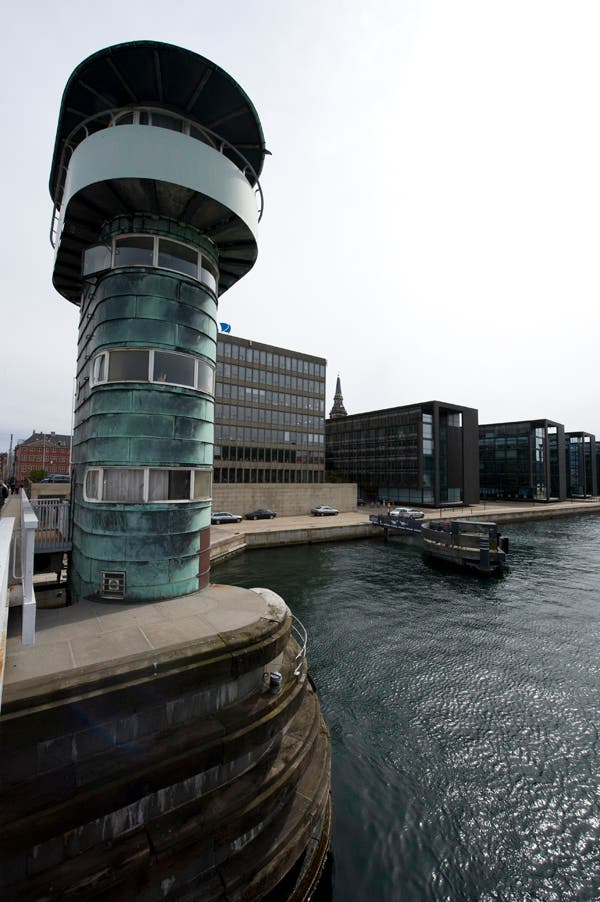
Bridge Tender Houses
I recently got back from a trip to Europe to visit family and kept my eye out for tiny houses across the pond. What caught my attention in downtown Copenhagen, Denmark was a steel and copper bridge tender house. My husband and I actually peaked into the windows and contemplated if we could buy one of these things and spend our days watching the traffic and bicyclers speed past. These particular bridge tending homes are now being used as municipal offices, but I think most of these types of buildings would make great tiny houses along the lines of a lighthouse…utilitarian and beautiful.
In the past, bridge tenders were needed to run the electronics and machinery that raised and lowered bridges on major rivers, waterways and railroad bridges. The machinery was kept in a small house near or on the bridge and the bridge tender would spend most of their time in the house, or even lived there. Their jobs consisted of controlling and monitoring traffic around the bridges, keeping the bridge and the raising/lowering mechanism in good condition and running telegraph machines and other communications. Most bridge tender houses were usually built by government departments of transportation. Continue Reading »
Tiny Churches
If you can’t find sanctuary in your own tiny house, how about in a tiny church? As we get closer to the holidays we can celebrate the many different ways that people worship, and some of them worship in tiny little churches or chapels that can only hold about a dozen attendees. Many of these miniscule churches and chapels are famous just for their size and have been included in several websites including Roadside America.
A few of these churches were built small because of a lack of construction funds, and some because of a lack of space or land. Whatever the reason, these tiny little treasures might really prove that God is in the details. Continue Reading »
Train Depots
I recently re-watched the movie, “The Station Agent”, and afterward began fantasizing of living in an old train depot. Finn (Peter Dinklage) is a man born with dwarfism who loves trains, and is willed an abandoned train depot by his elderly employer. I thought that a small, restored train depot would make a perfect tiny house, especially if you don’t mind the sound of trains.
Finn’s depot was filmed at the Newfoundland train station in Dover, New Jersey. I found a few other beautifully designed train depots in the area that have been converted into museums or historical markers.

The train depot used to be a visitor’s first view of a new town as the train they were on came chugging into the station. According to the Railroad Station Historical Society, railroad stations are designated locations along railroad lines to serve the handling of passengers, freight, and other commodities; as traffic control, maintenance, and/or communication centers.

Newfoundland Depot, New Jersey

Bonegap Depot, Illinois

Hoschton Depot, Georgia by ChapterHouseInc. and Waymarking.com
Often stations were marked by buildings including depots, towers, and maintenance facilities and almost always by a sign visible from the tracks. The word “station” is often used interchangeably with “depot”, but it refers to much more or less than a depot. The word “depot” is appropriate for a structure serving the public at a station.
We would love to hear of any train depots or other structures near you that would make a wonderful tiny house: a silo, an old train car (a la Maude from “Harold and Maude”), an old barn, a firestation or even a lighthouse.

Ashland Depot, New Hampshire by the Grafton County Historic and Genealogy Society
Oberlin Depot, Ohio by Ohio Bikeways
If you enjoyed this post, subscribe to our feed


