MorningStar Solar Home
MorningStar home, built by the Penn State Center for Sustainability has been around since 2007, but it will hopefully be the home of the near future. The 799 square foot building is a net-zero home that produces more energy than it consumes, and it has been used for educational and research activities on the university campus. It will also serve has a home for one lucky graduate student who will test the house systems in real life conditions.
The MorningStar not only has solar panels on the roof, but on the east- and west-facing sides of the home. The south-facing windows have sliding exterior shelving to regulate solar gain and the home has a sliding wall of liquid glass containers that, when filled with water, can retain heat during the day and release the warmth into the home during the night. Continue Reading »
Tiny Housing Advantages
Guest Post by Krista Peterson
Rising costs for utilities, high mortgages, and economic problems have brought on some popularity growth for tiny houses. The benefits of cutting costs are popular, but what are some other advantages to living in a tiny house versus a regular home? For those people who simply do not need the extra indulgences, possessions, extra expenditures involved with a normal house style, a tiny home may be perfect.
For one, an overall cut in cost and increased sustainability are some of the largest factors in the tiny housing boom. Living in less overall space triggers to less spending and consuming in general. Lower utilities and energy costs will definitely be an upgrade over larger houses and their need for more water, gas, and electric. The smaller houses should also take less time to pay off.
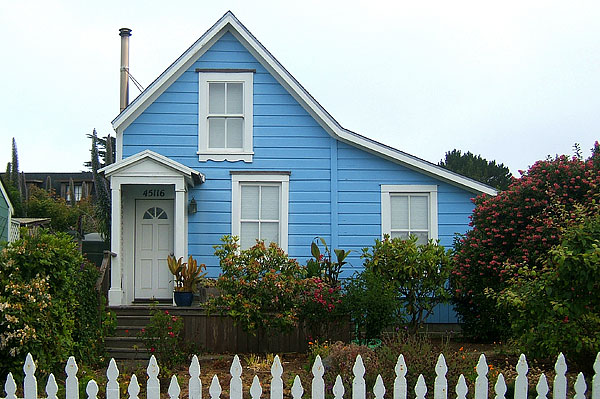
Photo Credits Jay Shafer

The less space will also mean less wasted time. With a smaller area to consume the time, simple chores such as vacuuming and cleaning take much less time off your hands. The size of the home is often directly connected with the amount of free time on your hands. If you have a smaller home, you will have more free time than with a larger space. Continue Reading »
Straw Bale 101
Guest Post by Andrew Morrison
Straw Bale construction is an old technology that has grown to become a respected and viable building option in most locations and climates. Not only is it beautiful and energy efficient, but it is also three times as fire resistant as a conventionally framed home and does extremely well in natural disasters such as earthquakes and extreme wind conditions. Straw bale and tiny house enthusiasts have a lot in common in that both are invested in being responsible earth stewards, want to reduce their living expenses, aren’t afraid to try something new and do things on their own, and are committed to creating a new model of sustainability by living within their means financially and from a resource stand point. Here are 9 reasons why we think you should consider building with bales:

Reason #1 Energy Efficiency.
A well built straw bale home can save you up to 75% on heating and cooling costs. In fact, in most climates, an air conditioning unit is not needed in the home as the natural cooling cycles of the planet are enough to keep the house cool all summer long. In addition, a simple heating system, very often radiant floor heating, can inexpensively supplement a passive solar design to keep a house warm all winter long.
Reason #2 Sound Proofing.
Straw bale walls provide excellent sound insulation and are superior wall systems for home owners looking to block out the sounds of traffic, airplanes, or other urban sounds. The assembly itself, a rigid skin of plaster sandwiched around a softer core of bales provides excellent sound absorption.
Reason # 3 Fire resistance.
Straw bale homes have roughly three times the fire resistance of conventional homes. Dense bales mean limited oxygen which in turn means no flames. Now wrap the dense bales in over an inch of plaster and you have a superior fire wall assembly.
Reason # 4 Environmental responsibility.
Building with straw helps the planet in many ways. For example, straw is considered a waste product that is either burned or composted in standing water. By using the straw instead of eliminating it, we reduce either air pollution or water consumption, both of which impact the environment in major ways.
Reason #5 Natural Materials
The use of straw as insulation means that the conventional insulation materials are removed from the home. Standard fiberglass insulation has formaldehyde in it, a known carcinogen. Bales also eliminate the use of plywood in the walls. Plywood contains unhealthy glues that can off-gas into the house over time. By building with natural materials, a healthy home is created from the start.
Reason #6 Aesthetics
There is nothing as calming and beautiful as a straw bale home. Time and time again I walk people through homes and they are immediately struck by the beauty and the “feeling” of the walls. I really can’t explain this one, you’ll just have to walk through your own to see what I mean. There really is nothing like it.
Reason #7 Minimize wood consumption.
If built as a load bearing assembly, the wood in the walls can be completely eliminated, except for around the windows as necessary to attach them to the structure. The harvesting of forests is a global concern and any reduction in the use of wood is a good thing for the long term health of the planet. Even framed walls with infill bales (bales as insulation) can reduce the use of wood by using engineered lumber for the posts and beams. The engineered material uses smaller, faster growing trees in place of larger, slower growing species. In addition, even a standard post and beam frame can use smaller timbers on larger spacing, thus reducing the amount of wood in the home and also working with the faster growing, more renewable wood resources.
Reason # 8 Built in window-seats/niches/storage
For space conscious builders, the options for creating wall niches and storage into the bale walls are pretty much endless. Because the bale walls are so thick, there is plenty of depth for people to essentially carve out niches for storage. Further, one can create window seats with some simple modifications during the construction process which creates space saving seating. The end results are beautiful and timeless.
Reason # 9 Perfect for the Do-It-Yourself builder
Building with bales is frankly, quite simple. If you’ve spent time building with legos, you already understand the basic principles of baling! The baling process goes very quickly and is extremely fun and rewarding to be a part of. Working with a natural material is also a wonderful way to connect with responsible building practices. It doesn’t take long to learn. In fact, we can teach people how to bale their own homes including the electrical and plumbing and plastering systems within our 7 day workshops (www.strawbaleworkshops.com).
This is just a short list of reasons to build with straw bales. This construction technology is widely accepted in nearly all building municipalities in the US and other countries around the world and many locales even have their own straw bale code for straw bale. You can run electrical wiring through the bales without any problems and have plumbing in the house as well. It is possible to get insurance and bank funding. This technology has really come a long way from when it began in the mid-west in the late 1800s!
If you are interested in learning more about straw bale construction, please visit www.StrawBale.com for tons of free information. We also offer instructional DVDs showing the whole process step by step at www.LearnStrawBale.com.
Andrew Morrison
Consultant, Teacher, Inspiring Change
===================================================
Learn the Secrets to Successful Home Construction:
www.BeYourOwnContractorTraining.com
===================================================
Get Your Straw Bale Construction Questions Answered at:
www.StrawBale.com
====================================================
Sign Up For a Seven Day Straw Bale Construction Workshop Near You at:
www.StrawBaleWorkshops.com
====================================================
Work Directly With Me at:
www.StrawBaleConsulting.com
Follow Me on Twitter: @StrawBaleTeach
*Note if you purchase the DVD’s or workshops through the links above a portion goes to support the Tiny House Blog.
Tiny House Inspiration
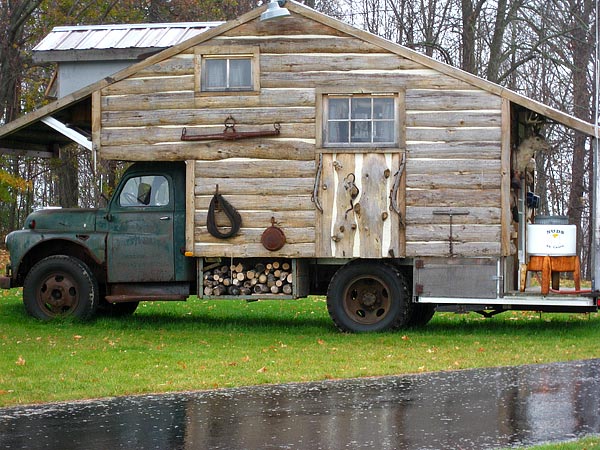
John Mitchell sent this picture to me and wanted to share it with the readers of the Tiny House Blog.
John says: I follow TinyHouse blog on facebook.
I dream of one day living in a tiny house and practicing sustainability. I’ve also been in love with the idea of traveling the continent and south america in retirement by RV. I had to share this great image taken by my aunt, Ruthanne McEwen, while visiting Nueske’s in Wittenberg, WI. My aunt and I both live outside Milwaukee which is about 3 hours from Wittenberg.
This tiny house/vehicle captured my imagination in both cases. I would be very happy if you could share this image on your blog.

Indianapolis Island
What looks like an iceberg in the middle of a lake or a half-melted marshmallow is actually is an experimental living structure inhabited by art students. Indianapolis Island is an art piece created by Andrea Zittel and inhabited this summer by art students Jessica Dunn and Michael Runge. It is one of the eight works of art in the Indianapolis Museum of Art’s 100 Acres art and nature park.
About 20 feet in diameter, Indianapolis Island is a tiny house made of fiberglass and foam that examines the daily needs of contemporary human beings. For the next four summers, the island will be occupied by one or two commissioned residents who are local art students. They will collaborate with Zittel by adapting and modifying the island’s structure according to their individual needs. Continue Reading »
Ross Chapin and Tiny House Communities
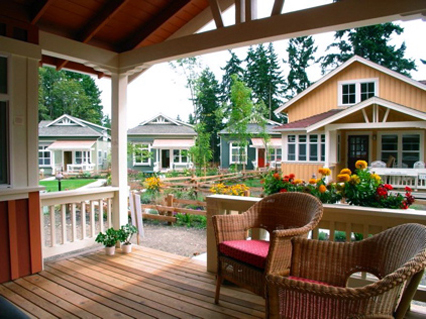
A few years ago I was given the chance to visit the Third Street Cottages on Whidbey Island and the opening of the Greenwood Avenue Cottages in Seattle. These communities, by renowned architect Ross Chapin and developer Jim Soules, have become famous for being small, sustainable and community oriented. Chapin calls them pocket neighborhoods.
I think my first exposure to small and tiny houses was Chapin’s Third Street Cottages, which were featured in Sarah Susanka’s book, Creating the Not So Big House. They were so well designed and so space efficient and sufficient that it has not occurred to me since that I would need anything bigger. The Third Street Cottages are about 600-650 square feet and have a great room with living, cooking and dining areas, a downstairs bathroom with laundry facilities and a downstairs bedroom. Each house also has a full size loft that is accessed by a ship’s ladder. The owners personalize each cottage by naming their homes. I visited a cottage in the Third Street community named Plum Corner for the plum trees that were left behind during construction.
The typical cottage community by Chapin includes 8 cottages on a 2/3 acre plot that usually holds one or two larger homes. The cottages surround a “green” area that holds seating, grass and trees and a place to grow community vegetables. A parking lot is off to the side of each community, hidden from view by a fence or bushes. Each cottage has its own small garden area surrounded by a low fence and each community has a shared tool shed and meeting room. Each small house is sold as a condominium and a monthly fee helps to maintain the garden and outlying areas.
To create a balance between the public and private areas, Chapin uses the concept of “layering”. The entryway into the main garden is the first layer, moving from public to more private. Anyone who does not belong in this area is noticed right away from each of the cottages. This way, neighbors can keep an eye on each other’s homes. The layering concept continues with the main garden area leading into the more private cottage gardens through the small fences and then each house is entered by first going up several stairs to the open front porches. The porches bring to mind the charming bungalows of the Arts & Crafts movement of the early 1900’s. The porches extend the living area of the small homes as well as offering a convenient area for neighborly chats.
I was able to view the Greenwood Avenue cottages during an open house tour and I was impressed by how the little details in the homes gave them each a different personality. Each tiny home uses architectural tricks to create a larger space: built-in bookshelves, alcoves, delineated ceiling heights between living and eating areas, ample windows and skylights. Each home is personalized with special details such as trim, woodwork (the walls of the Third Street Cottages are paneled in reclaimed spruce saved from destruction by a piano company) and cubby areas holding shelves, window seats or dining nooks.
Chapin believes in not only designing and building to save space and money, but to promote sustainability. The low garden fences are recycled fencing, the cottage’s siding is cement fiber board rather than wood, and the garden pathways were laid with crushed hazelnut shells from a local nut company.
Ross Chapin Architects also sell cottage home and small home plans. The three smallest are the Blue Sky Cabin at 307 square ft. the Backyard Cottage at 449 square ft. and the Lizzie Cottage at 540 square ft.
Living small — Some Utahns discovering the charm of cottages
Cottage Housing in Your Community (PDF)
A guide to drafting a cottage housing ordinance
Tiny House Village Concept post on Tiny House Design
If you enjoyed this post, subscribe to our feed